
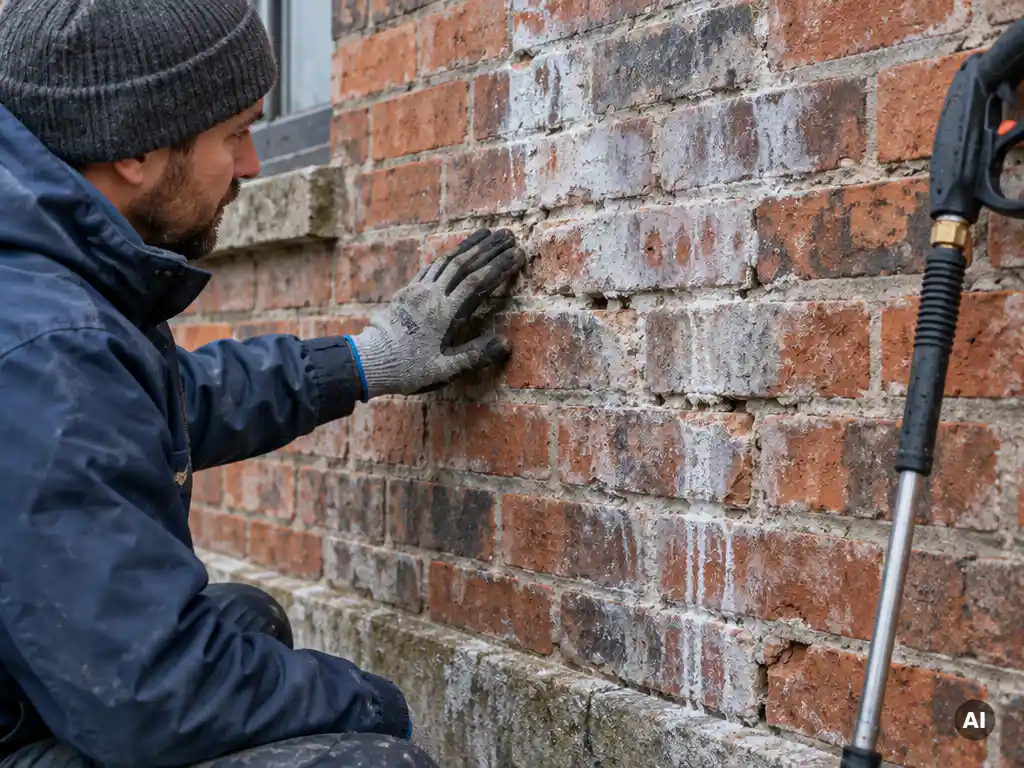
Incorrect façade cleaning can cause serious and costly damage to a building. The wrong cleaning agents, excessive water pressure or an improper technique damage the surface, drive moisture deeper into the façade and accelerate ageing. This applies to historic buildings as well as modern ones. In this article, we answer the most frequently asked questions about the risks of façade cleaning and how to avoid them.
What damage can the wrong cleaning agent cause to a façade?
The wrong cleaning agent can chemically attack the façade, cause discolouration and destroy the protective top layer of the material. Acidic products dissolve lime compounds in certain types of concrete and natural stone, while overly aggressive alkaline products can damage paint and coatings. The result is a more porous, more vulnerable surface that attracts dirt faster and is harder to maintain.
Façades are built from materials that differ greatly in chemical sensitivity. Sandstone and calcium silicate brick react differently to acid than concrete or ceramic façade cladding. Moreover, not every type of natural stone reacts in the same way to acidic or alkaline products. Anyone who uses a cleaning agent without knowing the material risks not only superficial discolouration, but also structural weakening. For the right product choice, always consult the product datasheet and label, and bring in a specialist where necessary.
Besides chemical damage, residues also play a role. Poorly rinsed cleaning agents leave a thin film behind that attracts further contamination or disrupts the adhesion of protective coatings. Professional façade cleaning always begins with a material analysis and the selection of a suitable product for that specific surface.
What happens if the water pressure during façade cleaning is too high?
Excessive water pressure damages the joints, drives water deep into the brickwork and can erode the top layer of soft types of stone. Even on harder materials, high-pressure spraying can cause microscopic cracks that later grow into larger fissures. The damage is often only visible once the surface has dried.
A common mistake is using a pressure washer on pointing. Joints are generally softer than the stone itself and wear faster under high pressure. Once damaged, pointing lets water penetrate unhindered, which eventually leads to moisture problems in the wall. In addition, loose pieces of stone or coating can be knocked off, leaving the façade unprotected.
The right water pressure depends on the material and the degree of contamination. Professional specialists work with adjustable equipment and adapt the pressure to each surface, so that dirt is removed effectively without damaging the underlying material.
We’ll find out for you!
Want to talk through your challenge?
Our advisors will gladly help you find a practical solution.
How does incorrect façade cleaning cause moisture problems?
Incorrect façade cleaning causes moisture problems because it damages the protective structure of the surface. When the top layer is damaged or the pores of the material are opened up, rainwater can penetrate deeper and faster than before. This leads to moisture build-up in the wall, mould growth and, in winter, frost damage caused by water freezing in the pores.
Cleaning without aftercare poses a particular risk. Even correctly executed cleaning temporarily opens the pores of the material. If the façade is not then impregnated or given a protective coating, the surface is more vulnerable than before the cleaning. Water penetrates more easily, and the façade also dries more slowly because the capillary structure has been disrupted.
It is therefore wise to impregnate the façade after cleaning. Façade impregnation makes the surface water-repellent without blocking vapour permeability, which prevents moisture accumulation behind the façade. Impregnating agents based on a combination of alkylsilanes and (poly)siloxanes are suitable for this; consult the product datasheet for the correct application on the specific substrate type.
Which façades are most vulnerable to cleaning mistakes?
Façades made of natural stone, calcium silicate brick, historic brickwork and rendered surfaces are generally vulnerable to cleaning mistakes. These materials are porous, chemically sensitive or relatively soft, so they react quickly to the wrong products or excessive pressure. Façades with existing coatings or ageing joints are also at increased risk.
- Natural stone and calcium silicate brick: Different types of stone react differently to acidic or alkaline cleaning agents; not every natural stone reacts in the same way. They also wear faster under high-pressure treatment.
- Historic brickwork: Often has soft, lime-rich joints that wash out when cleaned incorrectly.
- Rendered façades: Are sensitive to mechanical damage and can come loose under excessive water pressure.
- Façades with existing coatings: The wrong cleaning agents can dissolve the coating or disrupt its adhesion.
- Concrete façades with carbonation: Are already weakened and tolerate aggressive products poorly.
If you are unsure about the material, it is always wise to first clean a test patch in an inconspicuous spot. That way you can assess the result before treating the entire façade.
When is professional façade cleaning necessary?
Professional façade cleaning is necessary when the contamination is stubborn, the material is vulnerable or unknown, or when the façade shows damage that complicates correct cleaning. For historic buildings, large surfaces or façades with graffiti too, professional knowledge and equipment are indispensable to prevent damage.
Specialists and property managers must take into account the wide variety of façade materials and the widely differing cleaning requirements in each situation. A wrong choice not only leads to aesthetic damage, but can also shorten the lifespan of the façade and increase maintenance costs in the long term. With graffiti, quick and correct removal is important to prevent the paint from soaking in deeper and permanently discolouring the surface. Mavro’s graffiti removers are applied undiluted; consult the product datasheet for the correct method per substrate. You can read more about the right approach on the page about graffiti removers.
Professional specialists have the knowledge to identify the material, choose the right product and adapt the technique to the situation. For application and safety, always consult the product datasheet and label of the product used.
How do you prevent damage during future façade cleaning?
You prevent damage during façade cleaning by choosing the right cleaning agent for the specific material, adjusting the water pressure to the sensitivity of the surface and protecting the façade after cleaning with an impregnation or coating. Regular, timely maintenance prevents contamination from becoming so severe that aggressive cleaning is needed.
A few concrete guidelines that make the difference:
- Identify the façade material before choosing a cleaning agent.
- Always test on a small, inconspicuous area before treating the entire façade.
- Use the lowest effective water pressure and a wide spray nozzle to protect the surface.
- Rinse cleaning agents off thoroughly to prevent residues.
- After cleaning, treat the façade with a suitable impregnating agent to make the surface water-repellent; consult the product datasheet for the right choice per substrate.
- Schedule façade cleaning in dry weather and mild temperatures for the best result.
Preventive maintenance is more effective than corrective intervention. A façade that is regularly cleaned lightly and protected needs less aggressive treatments and lasts considerably longer.
How we help with safe façade cleaning and protection
Mavro offers a complete range of products and expertise for the cleaning, impregnation and protection of façades. Whether it involves removing stubborn contamination, restoring weathered façades or protecting the surface for the long term, we have the right solution for every material and every situation.
- Professional façade cleaners tailored to specific materials such as concrete, stone and brickwork.
- Impregnating agents based on alkylsilanes and (poly)siloxanes that make the surface water-repellent without blocking vapour permeability.
- Semi-permanent and permanent coatings such as Nitowax, Nitoshield, Nitocryl® and Nitocolour, with a lifespan of generally up to ten years; consult the product datasheet for the specific properties of each system.
- Anti-graffiti protection in semi-permanent and permanent versions. Semi-permanent coatings disappear during graffiti removal and must be reapplied; permanent coatings withstand multiple cleaning cycles, although the exact number differs per system. Graffitiguard Permanent is an impregnating agent with anti-graffiti properties. Anti-graffiti coatings can take over the function of façade impregnation; therefore, do not recommend the combination as standard.
- Advice and guidance so that specialists apply the products correctly and in accordance with the product datasheet.
Want to know which approach suits your façade best? Get in touch with us and we’ll gladly think along with you.