
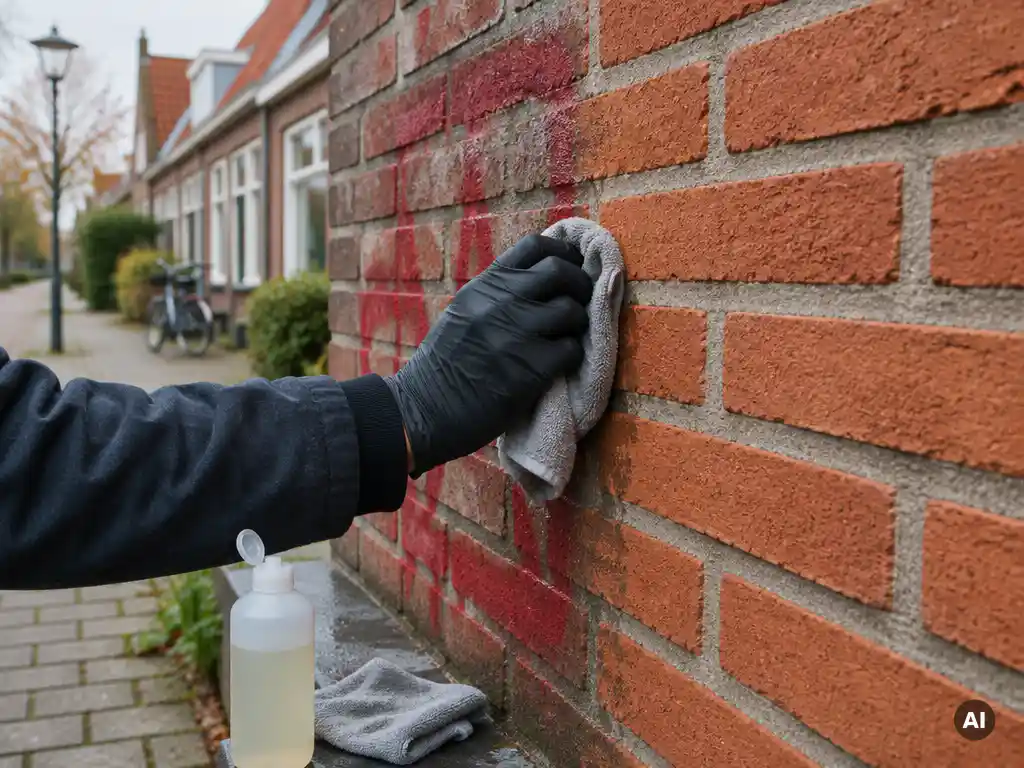
The most effective way to remove spray paint from facade brick is with a professional graffiti remover matched to the type of stone. The right approach depends on the type of stone, the age of the graffiti and the paint used. Below we answer the most frequently asked questions, so you know exactly how to proceed without causing damage.
Which method works best for your type of facade brick?
The best method for removing spray paint depends directly on the type of stone. Porous materials such as brick, sandstone and concrete require a different approach than non-porous surfaces such as ceramic or glazed stone. For porous stone, a gel-type graffiti remover works best, because the gel has a longer contact time and penetrates deeper into the material. For smooth, non-porous surfaces, a liquid cleaner can be more effective. Consult the product data sheet for the correct application on the specific substrate type.
Never choose a one-size-fits-all approach. Brick is sensitive to certain cleaning agents that can damage the mortar joints. Limestone reacts strongly to caustic substances. Concrete quickly absorbs paint deep into its pores. Always start by asking yourself: what type of stone do I have, and how long has the graffiti been there? Fresh graffiti is considerably easier to remove than dried paint that has been on the stone for weeks or months. If you are unsure about the type of stone or the right product, call in a specialist.
What are the risks of removing spray paint the wrong way?
Removing spray paint from facade brick the wrong way can cause permanent damage to the surface. The most common risks are: discoloration of the stone, damage to the mortar joints, graffiti being driven deeper into the material, and structural damage from overly aggressive use of high-pressure washers or unsuitable cleaning agents.
A common mistake is using a high-pressure washer without chemical preparation. The pressure drives the paint deeper into porous stone instead of removing it. Using unsuitable solvents can also discolor the stone or damage the surface structure. Cleaning agents that are not matched to the type of stone in question can attack the joints and weaken the facade structure in the long term. A so-called graffiti ghost is also a risk: this is the discolored stain left behind when the paint has been removed but the underlying stone has already been damaged.
We’ll figure it out for you!
Want to talk through your challenge?
Our advisors will be happy to help you with a practical solution.
Which cleaning agents are suitable for spray paint on stone?
For spray paint on facade brick, professional graffiti removers matched to the specific substrate type are the most suitable. These products are formulated to dissolve virtually all types of paint and ink, including acrylic, alkyd and epoxy-based sprays, without damaging the underlying stone structure. Gel-type graffiti removers offer an extra advantage on vertical surfaces because they don’t run off. Mavro’s graffiti removers are applied undiluted; consult the product data sheet for the correct procedure.
When choosing a cleaning agent, look at the following criteria:
- Suitable for the type of stone: check that the product is approved for use on the substrate in question, such as brick, concrete or natural stone
- Versatile: a good graffiti remover works on multiple types of paint and substrates
- Professional quality: consumer products are often too weak for dried spray paint
- Product-specific substantiation: base your choices on the product data sheet and label, not on general claims
Avoid cleaning agents that are not formulated for stone surfaces, such as bleach or general degreasers. These can cause irreparable stains or discoloration. Take a look at our range of professional graffiti removers to find the right product for your situation.
How do you remove spray paint step by step without causing damage?
You remove spray paint from facade brick without damage by following a fixed sequence: first assess the surface, then apply the right product, let it work, and finally rinse in a controlled way. Haste is the biggest enemy in graffiti removal. For contact times and procedure, always consult the product data sheet of the product you are using.
- Assess the surface: determine what type of stone it is and how old the graffiti is. This determines the choice of cleaning agent and the procedure.
- Test on an inconspicuous spot: first apply the cleaning agent to a small, hidden section of the facade to check that no unwanted reaction occurs.
- Apply the graffiti remover: use a brush, spray bottle or roller to apply the product undiluted and evenly to the spray paint. Make sure coverage is sufficient.
- Let the product work: observe the contact time stated on the product data sheet. The time required varies by product and substrate.
- Remove the paint: use a soft brush or spatula to help the loosened paint come off mechanically. Avoid metal scrapers on soft types of stone.
- Rinse with water: use a pressure washer on a low setting or a garden hose. Rinse thoroughly to remove all residue of the cleaning agent.
- Repeat if necessary: stubborn or old graffiti may require a second treatment.
For graffiti on buildings, a quick response makes all the difference. The longer paint soaks into the stone, the more intensive the treatment has to be.
When is professional help needed for graffiti removal?
Professional help with graffiti removal is needed when the graffiti covers a large surface, the stone is delicate or historic, or when previous removal attempts have already caused damage. For listed buildings or facades with special coatings, it is also wise to call in a specialist.
Specific situations where you are better off not tackling it yourself:
- Graffiti on limestone, marble or other delicate types of natural stone
- Surfaces with an existing protective coating that you don’t want to damage
- Large surfaces where the right equipment and products are lacking
- Cases where the graffiti has already burned in or contains multiple layers of paint
- Situations where the facade already shows visible damage from previous treatments
For these reasons, municipalities and managers of public transport infrastructure almost always opt for specialized cleaning companies that work with professional products and equipment. More information about removing graffiti in public transport shows how a specialist approach works in practice.
How do you prevent new graffiti on facade brick?
The most effective way to prevent new graffiti on facade brick is to apply an anti-graffiti coating after cleaning. This protective layer means paint penetrates less deeply into the stone and can be removed more effectively after the next attack. Consult the product data sheet for the correct application and expected performance per system.
There are two types of anti-graffiti coatings you can consider:
- Permanent coatings: these remain on the surface after graffiti is removed and withstand multiple cleaning cycles. The exact number of cleaning cycles differs per system; consult the product data sheet. Graffitiguard Permanent is an example of an impregnating agent with anti-graffiti properties.
- Semi-permanent coatings: these are removed together with the graffiti and must be reapplied afterwards. They are suitable for locations that are regularly vandalized.
Anti-graffiti coatings can take over the function of facade impregnation; therefore, do not routinely recommend combining a coating with a separate impregnating agent. In addition to coatings, good lighting, surveillance and prompt removal also help prevent graffiti. Graffiti that is removed quickly attracts less new graffiti. This principle, also known as the broken windows theory in urban management, is a proven approach in practice.
How we help with removing spray paint from facade brick
We develop and produce professional cleaning and protection products specially formulated for this type of application. Whether you are dealing with fresh graffiti on brick or dried spray paint on concrete, our range offers a suitable solution. Here is what we offer:
- Gel-type graffiti removers matched to both porous and non-porous substrates
- Graffiti removers that are applied undiluted, in accordance with the product data sheet
- Anti-graffiti coatings for protection after cleaning, available as a permanent and semi-permanent system
- Technical advice and training for professional application by specialists
Do you have questions about which product best suits your situation? Contact us and we’ll help you further with concrete advice.