
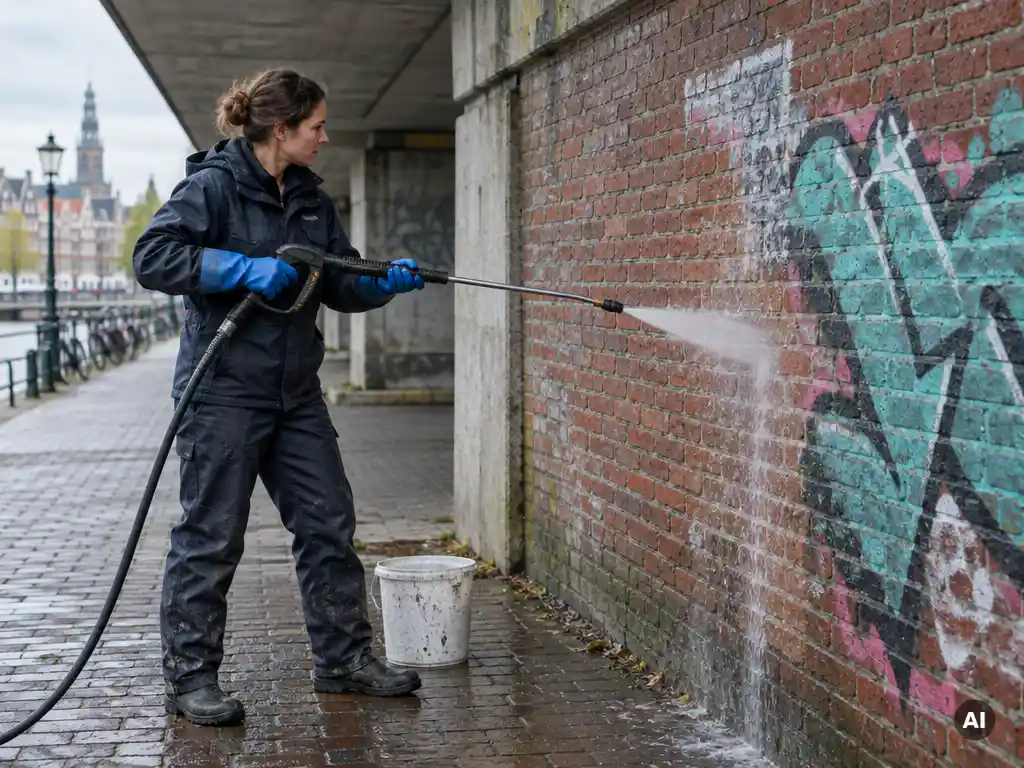
You choose the right graffiti remover based on the surface you are working on. A porous surface such as concrete or natural stone calls for a different product than a non-porous surface such as glass or metal. If you choose the wrong product, you risk damaging the material or getting an incomplete result. In this article, we answer the most frequently asked questions about choosing the right graffiti remover for your situation.
Which types of surfaces require a different graffiti remover?
Not every surface tolerates the same graffiti remover. Porous materials such as concrete, brick and natural stone absorb paint more deeply, which means a different formulation may be needed than for non-porous surfaces such as glass, metal and ceramic. Always consult the product data sheet to determine which graffiti remover is suitable for the specific surface.
The main categories to keep in mind when choosing a graffiti remover:
- Porous surfaces (concrete, brick, sandstone, natural stone): A gel formulation stays on the surface longer and can penetrate deeper without running off. Note: not every natural stone reacts the same way to graffiti removers. Consult the product data sheet and always carry out a spot test.
- Non-porous surfaces (glass, metal, ceramic, glazed tiles): Check the product data sheet to see which formulation is suitable for the surface in question.
- Sensitive materials (polished marble, historic facades, wood): Extra caution is required here. Always test on an inconspicuous spot first and call in specialists if in doubt.
Also take the age of the graffiti into account. Fresh graffiti is generally easier to remove than paint that has been on the surface for a longer time. The longer the paint has been there, the deeper it can soak in and the more intensive the treatment may need to be.
How does a graffiti remover work chemically?
A graffiti remover works by breaking the chemical bond between the paint and the surface. The active substances in the product dissolve the polymers in the graffiti paints, after which everything can be rinsed or wiped off. The exact action differs per formulation and the type of paint that needs to be removed.
Professional graffiti removers are applied undiluted. Gel formulations have the advantage that they stay on the surface longer, giving the active substances more time to work. This is especially relevant on vertical surfaces or with stubborn inks and lacquer. Consult the product data sheet and label for the correct application and safety instructions.
We’ll figure it out for you!
Want to talk through your challenge?
Our advisors will gladly help you find a practical solution.
How do you test whether a graffiti remover is safe for your surface?
Always carry out a spot test on an inconspicuous area before using a graffiti remover on the entire surface. Apply a small amount of product, let it work for the dwell time specified on the product data sheet, and then remove it. Next, check whether the surface shows any discoloration, leaching or surface damage.
During the test, watch for the following signs:
- Discoloration or white efflorescence on the surface after cleaning
- Changes in the texture or gloss level of the material
- Damage to joints or finishing layers
- Insufficient removal of the graffiti after the dwell time recommended on the product data sheet
Always consult the technical data sheet of the product. It states which surfaces the product is suitable for and what the maximum dwell time is. Never use the product on materials that are not listed in the product specifications.
What is the difference between a graffiti remover and an anti-graffiti coating?
A graffiti remover removes existing graffiti, while an anti-graffiti coating protects the surface against future graffiti. The two products have different functions and can complement each other in a professional approach to graffiti management.
A graffiti remover is a reactive product: you use it after graffiti has been applied. It dissolves the paint and cleans the surface. An anti-graffiti coating is a preventive product: it forms a protective layer on the surface so that graffiti adheres less well and is easier to remove the next time it is attacked.
An important distinction: a semi-permanent anti-graffiti coating disappears during graffiti removal and must be reapplied afterwards. A permanent anti-graffiti coating withstands multiple cleaning cycles; the exact number differs per system. Graffitiguard Permanent is an impregnating agent with anti-graffiti properties. Anti-graffiti coatings can take over the function of facade impregnation; therefore, do not recommend the combination as a standard.
For locations that are regularly targeted, such as building facades in urban environments or public transport, the specific situation determines which approach is most suitable. Call in specialists to make the right product choice.
What safety and environmental requirements apply to professional graffiti removers?
For application and safety, always consult the product data sheet and the label of the product in question. They contain the applicable instructions for safe use, personal protective equipment and waste disposal.
Practical points of attention when working with graffiti removers:
- Personal protective equipment: Wear the protective equipment prescribed on the product data sheet and label, such as gloves and safety goggles.
- Waste disposal: Follow the instructions on the product data sheet and comply with local regulations for the disposal of cleaning water and residual products.
- Ventilation: When using the product indoors or in enclosed spaces, always work with sufficient ventilation, in accordance with the instructions on the product data sheet.
Additional requirements may apply to applications for municipalities, housing associations or in public spaces. Always ask the supplier for the available technical documentation, including safety data sheets and product data sheets.
When is professional advice needed when choosing a graffiti remover?
Professional advice is useful as soon as the situation becomes more complex than a standard case. Think of sensitive or historic surfaces, large areas, stubborn inks, or situations where the wrong product choice can cause significant damage. Specialist advice is also recommended for graffiti ghosting that remains after an initial cleaning.
Specific situations in which you are better off not experimenting yourself:
- Monumental or historic buildings with delicate facade materials
- Graffiti on vehicles or public transport with painted or foil-wrapped surfaces
- Large projects where the wrong product choice leads to high repair costs
- Situations where graffiti has been applied to a surface with an existing anti-graffiti coating
In those cases, it is wise to work with specialists who not only supply products but also think along with you about the right approach.
How we help you choose the right graffiti remover
We develop and produce professional graffiti removers that are suitable for a wide range of surfaces and applications. Whether you are working on a concrete viaduct, a natural stone facade or a metal structure, our range offers a suitable solution. What we offer:
- Gel formulations suitable for both porous and non-porous surfaces, applied undiluted
- Technical documentation including safety data sheets and product data sheets
- Personal advice on the right product choice for your specific surface and situation
- Training and support from specialists for the application of our products
Want to know which graffiti remover best suits your project? Get in touch with us and we will help you further with concrete, tailored advice.