
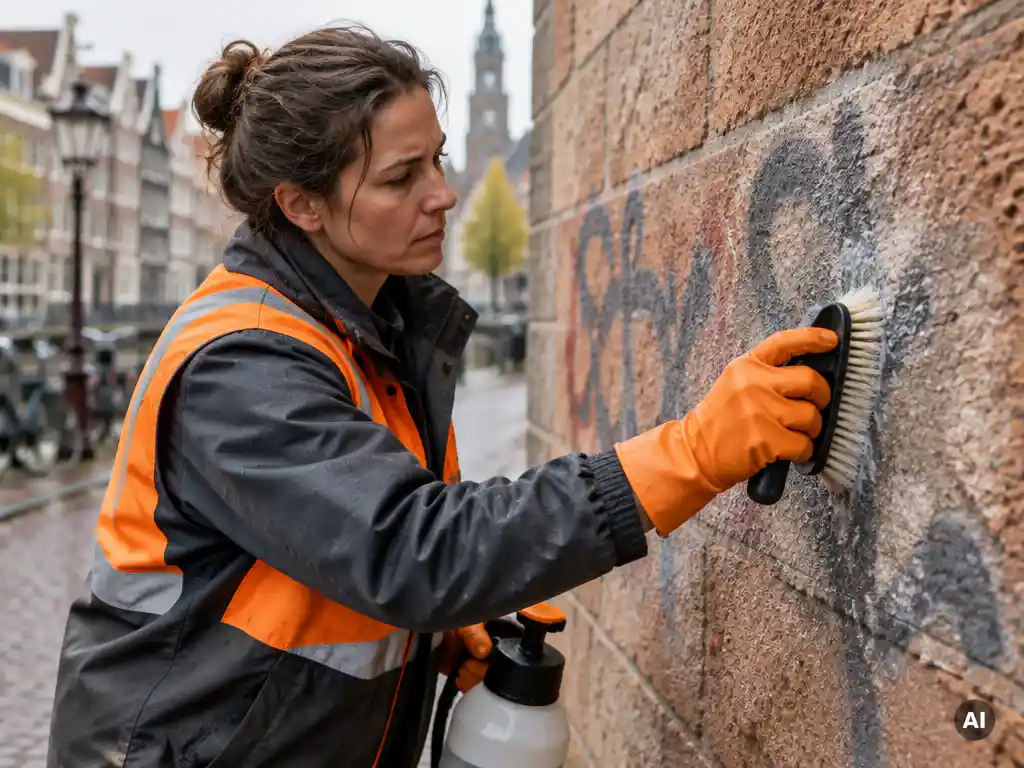
You use a graffiti remover on porous surfaces once graffiti has soaked into the structure of the material and is no longer just on the outside. Porous substrates absorb paint faster than smooth materials, which means you need a specifically formulated product that penetrates deep enough to loosen the paint without damaging the surface itself. This article answers the most frequently asked questions about using graffiti removers on this type of substrate.
Which surfaces count as porous when removing graffiti?
Porous surfaces are materials with an open, absorbent structure, which means liquids and paint particles penetrate the material instead of staying on the surface. When it comes to graffiti removal, this usually involves concrete, masonry, untreated brick, sandstone, calcium silicate brick, and certain types of natural stone. Cement-based plaster layers also fall into this category.
It is important to know that not every type of natural stone reacts the same way. Granite is a dense natural stone, but even granite varies in porosity depending on its origin and finishing. If you are unsure about the porosity of a substrate, it is wise to clean a test area before treating the entire surface. Always consult the product data sheet for substrate-specific recommendations.
How does a graffiti remover work on porous substrates?
A graffiti remover for porous substrates works by allowing active components to penetrate deep into the structure of the material, where they break the bond between the paint particles and the substrate. The remover dissolves the graffiti so that it can then be rinsed off with water or removed mechanically.
Gel products are particularly suitable for this. The gel form ensures that the product stays on the surface longer and does not run off immediately, which increases the dwell time and improves effectiveness on vertical surfaces. This gives the product the time it needs to soak the paint out of the pores of the material.
A product such as GraffitiRemover Gel is applied undiluted. Specialists apply the product, let it work, and then rinse it off. The result depends partly on the type of paint, the age of the graffiti, and the porosity of the substrate. The longer graffiti has been on a porous surface, the deeper it has penetrated and the more intensive the treatment needs to be.
When is a graffiti remover suitable for porous surfaces?
A graffiti remover is suitable for porous surfaces when the product is specifically formulated for this type of substrate, the graffiti has not yet fully cured or aged, and there is no protective coating present that complicates the treatment. Suitability depends on both the product and the condition of the substrate.
In practice, using a graffiti remover on porous substrates makes sense in the following situations:
- The graffiti was applied recently and has not yet penetrated deep into the material
- The surface is untreated and uncoated, such as raw concrete or untreated brick
- The substrate is sturdy enough to withstand mechanical post-treatment
- There is no risk of damage from the active components in the product
For removing graffiti from buildings with porous facades, it is always wise to test a sample area and consult the product data sheet for the correct application.
What is the difference between a graffiti remover for porous and non-porous surfaces?
The most important difference lies in the formulation and the way the product penetrates. A graffiti remover for porous surfaces contains components that penetrate deep into the open structure of the material to loosen the paint from the inside out. A product for non-porous surfaces, such as glass, metal, or glazed ceramics, works more superficially because the paint has not penetrated the material.
Other relevant differences are:
- Gel versus liquid: For porous vertical surfaces, a gel is more practical because the product stays on the substrate longer
- Dwell time: Porous substrates usually require a longer dwell time so that the components penetrate deep enough
- Post-treatment: After removal on porous substrates, a shadow or residual discoloration may remain, which occurs less often on non-porous surfaces
- Risk of material damage: Porous materials are more sensitive to aggressive components; an incorrect product can damage the structure
What damage can occur when used incorrectly on porous substrates?
Incorrect use of a graffiti remover on porous substrates can lead to surface damage, discoloration, or deterioration of the material structure. This happens when a product is used that is not suitable for the specific substrate, when the dwell time is too long, or when the product is not rinsed off completely.
Specific risks include:
- Leaching: Active components can draw lime constituents or binders out of the material, causing white efflorescence or weakening of the structure
- Discoloration: Some materials react with the components in the remover and discolor permanently
- Surface damage: Products that are too aggressive or a dwell time that is too long can damage the texture of soft stone or plaster
- Graffiti ghosting: With incomplete removal, a shadow remains in the pores of the material; see also removing graffiti ghosting for how to deal with this
Always have porous substrates treated by specialists who know the product data sheet and label and who carry out a test area before the full treatment.
When is anti-graffiti protection more sensible than removing graffiti afterwards?
Anti-graffiti protection is more sensible than removing graffiti afterwards when a surface is regularly targeted by graffiti, when the substrate is sensitive to repeated chemical treatment, or when removal costs are structurally high. A coating prevents paint from penetrating the pores, which makes graffiti easier to remove with fewer products.
There are two types of anti-graffiti coatings relevant to porous substrates:
- Semi-permanent coating: Disappears during graffiti removal and must be reapplied after each treatment
- Permanent coating: Withstands multiple cleaning cycles; the exact number varies by system
For porous substrates, an impregnating agent with anti-graffiti properties is also an option. Graffitiguard Permanent is an example: it penetrates the structure of the material and gives the surface anti-graffiti properties without drastically changing its appearance.
The lifespan of an anti-graffiti coating is generally up to ten years, depending on exposure and the type of system. In busy locations such as public transport infrastructure, preventive protection is almost always more cost-effective than repeated removal. You can find more information about graffiti removal in the public transport sector in our applications overview.
How we help with graffiti removal on porous surfaces
We develop and produce professional graffiti removers that are specifically formulated for use on porous and non-porous substrates. Our products, including GraffitiRemover Gel, are aimed at specialists working on buildings, infrastructure, and public transport. This is what we offer:
- Graffiti removers in gel form, to be applied undiluted on porous substrates
- Anti-graffiti coatings and impregnating agents for preventive protection
- Tailored technical advice for choosing the right product for each substrate
- Support during application, including training for specialists
Do you have questions about the right graffiti remover for your situation, or would you like advice on preventive protection? Get in touch with us via our contact form or call us directly at +31 (0) 418 680 680.