
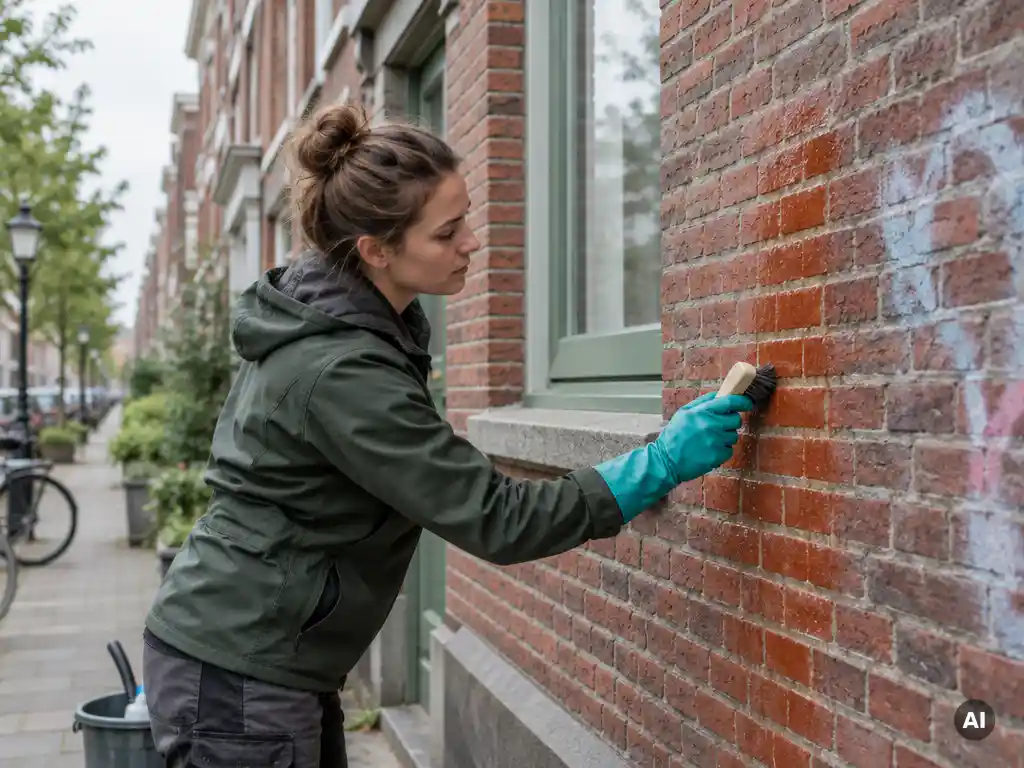
Removing graffiti without causing damage is important because improper handling can permanently damage the underlying surface, leading to higher repair costs than the graffiti itself. For property owners, property managers and contractors, the same rule applies: the faster and more professionally graffiti is dealt with, the better the surface is preserved. The questions below give you a complete picture of the risks, the right approach and when to call in professional help.
What damage can graffiti cause to facades and surfaces?
Graffiti damages surfaces in two ways: chemically and mechanically. The solvents and pigments in paint, markers and sprays penetrate the pores of the material. On porous substrates such as concrete, brick and natural stone, the paint bonds deep into the structure, making it difficult to remove without leaving traces. On non-porous surfaces such as glass, metal and ceramics, the bond is less deep, but prolonged exposure to sunlight can also cause the paint to sink in.
In addition to the immediate contamination, graffiti ghosting can also occur: a discoloration that remains after the graffiti has been removed. This happens when pigments have penetrated deep into the material or when the cleaning method has damaged the surface. The longer graffiti stays on a surface, the deeper the penetration and the greater the risk of permanent discoloration.
Why is prompt graffiti removal so important?
Prompt removal limits the penetration of pigments into the material and prevents the graffiti from leaving a permanent stain. Moreover, visible graffiti acts as a signal to other vandals: untreated graffiti attracts new graffiti, an effect that is widely recognized in practice by municipalities and property managers. The longer you wait, the more intensive the treatment required.
For professional parties such as housing associations, contractors and facility managers, this also has a practical dimension. Deferred maintenance increases cleaning costs and raises the risk of permanent damage to the facade. In the case of graffiti on buildings, a damaged facade also directly affects the appearance and value of the property.
We’ll figure it out for you!
Want to talk through your challenge?
Our advisors will gladly help you find a practical solution.
What goes wrong when you remove graffiti yourself?
When graffiti is removed without the right expertise, two things structurally go wrong: the choice of product and the way it is applied. Wrong products, such as aggressive acids or solvents that are not matched to the substrate, can damage the surface, discolor it or make it more porous. Mechanical sanding or high pressure without the right product spreads the paint over a larger area and drives pigments deeper into the material.
In addition, DIY approaches often fail to follow the instructions on the label. Dwell times are not observed, products are diluted when they should be applied undiluted, or work is carried out on a substrate that requires a different treatment. The result is not only incompletely removed graffiti, but sometimes also a damaged substrate that is more expensive to repair than the original graffiti.
How does professional graffiti removal work without surface damage?
Professional graffiti removal works by using products matched to the type of substrate and the type of graffiti, combined with correct application by specialists. A gel-type graffiti remover has the advantage that it stays in place on vertical surfaces and gets sufficient dwell time to dissolve the paint without attacking the underlying material.
Specialists always follow the product specifications: the product is applied undiluted, the dwell time is observed as stated on the product data sheet, and the surface is then cleaned. If there is any doubt about the substrate, specialists first carry out a test in an inconspicuous spot. For the exact application, always consult the product data sheet and label of the specific product.
Not every substrate reacts in the same way. Granite is a type of natural stone, but other types of natural stone also each require a specific assessment before a graffiti remover is used. Specialists assess the substrate, choose the right product and thus prevent damage that would occur with a generic approach.
What is the difference between graffiti removal and anti-graffiti protection?
Graffiti removal is a reactive action: you remove paint that is already on the surface. Anti-graffiti protection is a preventive measure: you apply a coating or impregnation that prevents graffiti from adhering to the surface, or that makes future removal considerably easier. Both are part of a complete approach, but they serve different functions.
Semi-permanent anti-graffiti coating
A semi-permanent coating protects the surface, but disappears along with the graffiti during cleaning. After every removal, the coating must be reapplied. This system is suitable when the frequency of graffiti is limited.
Permanent anti-graffiti coating
A permanent coating withstands multiple cleaning rounds; the exact number varies per system. Graffitiguard Permanent is an example of an impregnating agent with anti-graffiti properties. Such a coating generally has a service life of up to ten years, unless product-specific information indicates otherwise. For objects that are regularly vandalized, a permanent solution is often more cost-efficient in the long term.
When is professional help with graffiti removal necessary?
Professional help is needed as soon as the substrate is vulnerable, the graffiti is extensive or earlier removal attempts have left traces behind. With historic buildings, natural stone, coated metal or surfaces with a special finish, the risk of damage from improper handling is too great to take yourself. For graffiti on vehicles and public transport as well, specialized knowledge of the substrate and the right product choice is indispensable.
Professional involvement is also advisable when graffiti has been on the surface for some time and the pigments have penetrated deep. In that case, the risk of graffiti ghosting is greater and the treatment requires more expertise than a standard cleaning. Specialists can assess which product and which method give the best result without damaging the substrate.
How we help you with graffiti removal
We develop and produce professional graffiti removers tailored to a wide range of substrates and applications. Our range gives specialists the tools to remove graffiti effectively, even in complex situations. These are the characteristics of our approach:
- Gel-type graffiti removers, suitable for both porous and non-porous substrates such as concrete, masonry, metal, glass and ceramics
- Products are applied undiluted, in accordance with the instructions on the product data sheet and label
- Wide range of graffiti removers for professional use by specialists
- Support with product selection based on the specific substrate and the type of graffiti
- ISO 9001-certified production for consistent quality
Want to know which product best suits your situation? Get in touch via our contact form or call +31 (0) 418 680 680 directly. Our specialists will gladly think along with you.