
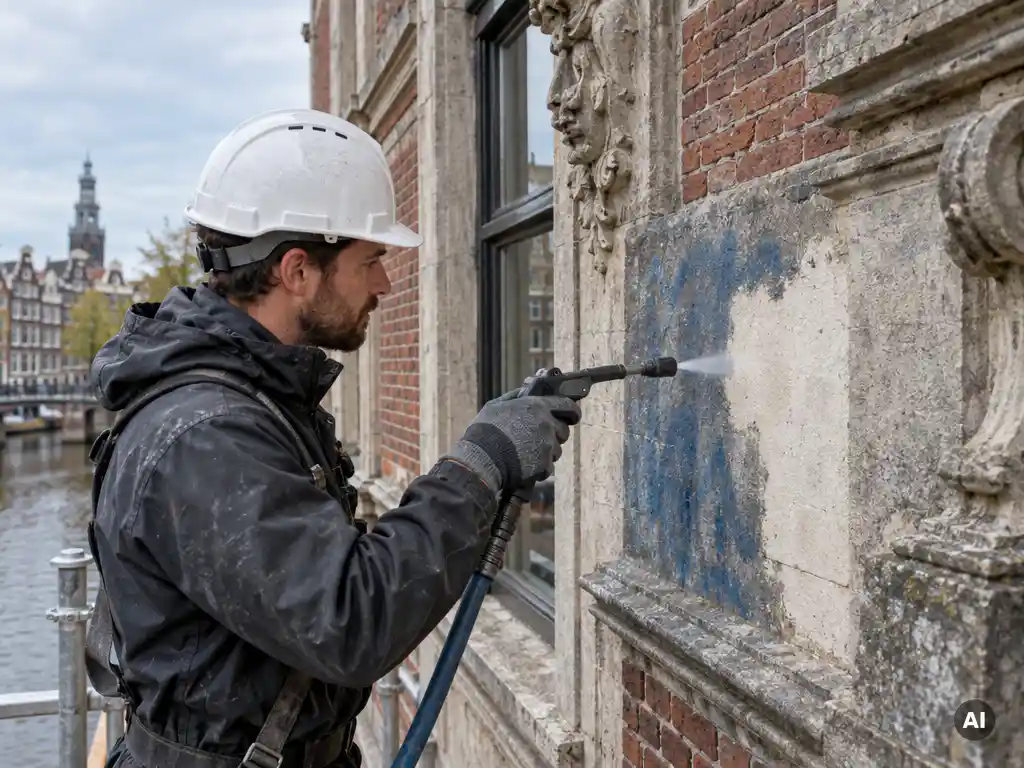
Graffiti can be removed from a historic building without causing damage, but it requires a careful approach: choose a graffiti remover that is specifically suited to the substrate, always test it on an inconspicuous spot, and leave the work to specialists with experience in heritage cleaning. The combination of fragile materials, historic finishing layers and often porous substrates means that standard methods are rarely sufficient here. This article answers the most important questions about safe graffiti removal on historic heritage.
Why is removing graffiti from historic heritage so risky?
Removing graffiti from historic buildings is risky because the substrates are fragile, old and often unknown. The wrong products or techniques can damage original material, cause differences in color and texture, or permanently harm historic finishing layers. That makes every intervention on heritage a balancing act in which both the result and the preservation of the original are paramount.
With modern buildings, the substrate is usually well documented and uniform. With historic heritage, that certainty is missing. Facades are built from materials that are decades or centuries old, sometimes painted or treated several times, and sensitive to chemical reactions that do not occur with new materials. A product that is too strong penetrates too deeply. A method that is too aggressive damages the surface. And the wrong choice is often irreversible.
In addition, protected monuments are subject to extra requirements from heritage authorities. This means that the choice of method and product must be justified not only technically, but also procedurally.
Which materials are found in historic buildings and how do they react to cleaning?
Historic buildings typically contain materials such as natural stone, brick, lime mortar, sandstone, limestone, terracotta and cast iron. Each of these materials reacts differently to cleaning products. Acidic products attack calcareous materials. Alkaline products can cause discoloration on certain types of stone. Porous materials absorb cleaning products more deeply, which increases the risk of damage.
We’ll find it out for you!
Want to talk through your challenge?
Our advisors will gladly help you find a practical solution.
Natural stone and lime mortar
Natural stone is not a uniform category. Granite behaves differently from sandstone or limestone. Lime mortar is particularly sensitive to acids, because the lime reacts directly and dissolves. When cleaning joints and mortar work, this is an important point of attention. Always check the composition of the material first before choosing a graffiti remover.
Brick and terracotta
Brick is porous and absorbs both graffiti and cleaning products relatively quickly. Terracotta has a fired surface that can be sensitive to mechanical cleaning. For both materials, a longer dwell time of the cleaning product increases the chance of deeper penetration. Therefore, always work with the dwell time stated on the product data sheet and rinse thoroughly afterwards.
Which methods are suitable for graffiti removal on fragile substrates?
On fragile historic substrates, chemical cleaning with a suitable graffiti remover and controlled rinsing with water are the most commonly used methods. High-pressure cleaning is rarely suitable for heritage, because the pressure can damage the material. Blasting is almost always too aggressive for historic stonework and masonry.
A gel-type graffiti remover is preferred. A gel stays on the surface longer, penetrates the graffiti in a controlled way and is easier to remove without the product running off onto adjacent materials. This is especially relevant on vertical surfaces, such as facades.
Mechanical methods, such as sanding or scraping, are strongly discouraged on historic substrates. They remove not only the graffiti but also the original surface structure. This causes visible damage that cannot be repaired without compromising the character of the building.
How do you choose the right graffiti remover for a historic substrate?
You choose the right graffiti remover based on three factors: the type of substrate, the type of graffiti and the age of the contamination. The older the graffiti, the deeper the ink or paint has soaked in and the more the product has to be able to do. Always test on a non-visible part of the surface before applying the product to the entire area.
For porous substrates such as natural stone, brick and concrete, a gel-type graffiti remover is suitable. The gel form ensures a controlled action on the surface without the product running off or evaporating too quickly. Mavro’s GraffitiRemover Gel dissolves almost all types of graffiti and inks and is applied undiluted.
Keep the following in mind when choosing a product:
- Check whether the product is suitable for the specific substrate
- Consult the product data sheet for the correct application and dwell time
- Use the product undiluted, unless the product data sheet states otherwise
- Rinse the surface thoroughly with water after use
- Always carry out the test on a non-visible spot
What is anti-graffiti coating and does it also protect historic facades?
An anti-graffiti coating is a protective layer applied to a substrate to prevent graffiti from adhering to the surface. In the event of a subsequent graffiti attack, the contamination is easier to remove and with less risk of damage. There are two main types: semi-permanent and permanent coatings.
Semi-permanent anti-graffiti coating is removed along with the graffiti and must be reapplied afterwards. Permanent anti-graffiti coating withstands multiple cleanings, although the exact number varies per system. For historic facades, it is important that the coating does not affect the appearance and vapor-permeable properties of the original material.
A special option is Graffitiguard Permanent, an impregnating agent with anti-graffiti properties. This product penetrates the substrate instead of forming a visible layer, which makes it suitable for situations where the original appearance must be preserved. Consult the product data sheet for suitability per substrate and the expected service life, which is generally up to ten years at most.
Would you like to know more about removing graffiti from buildings? On that page you will find additional information about methods and products for various types of buildings.
When should you call in a professional graffiti removal company?
Call in specialists when dealing with a protected monument, an unknown substrate, extensive graffiti over a large surface, or when previous removal attempts have caused damage. In those situations, the risk of irreversible damage is too great if you carry out the work yourself.
Specialists have the knowledge to assess the substrate, select the right product and carry out the application in a controlled manner. They know which dwell times are responsible, how to rinse afterwards without stressing the material, and how to apply a suitable protective layer after cleaning.
Even when it comes to removing graffiti ghosting, where ink has already soaked deep into the substrate and leaves a visible residual imprint, professional execution is strongly recommended. Graffiti ghosting reacts differently to cleaning products than fresh graffiti and requires a specific approach.
How we help with graffiti removal on historic heritage
We develop and produce professional graffiti removers that are suitable for use on both porous and non-porous substrates, including natural stone, concrete, masonry, metal and ceramics. Our products are applied undiluted and are designed for use by specialists in professional environments.
What we offer for applications on historic heritage:
- Gel-type graffiti removers for controlled action on vertical and fragile surfaces
- Products that dissolve almost all types of graffiti and inks without damaging the substrate
- Anti-graffiti coatings, including impregnating agents with anti-graffiti properties for situations where the original appearance must be preserved
- Technical advice on product selection and application, tailored to the specific substrate
- Product data sheets and labels with clear instructions for safe and correct application
Contact our team for advice on the right approach for your project. Call us on +31 (0) 418 680 680 or send a message via our contact form. We are happy to think along with you about the most responsible solution for your situation.