
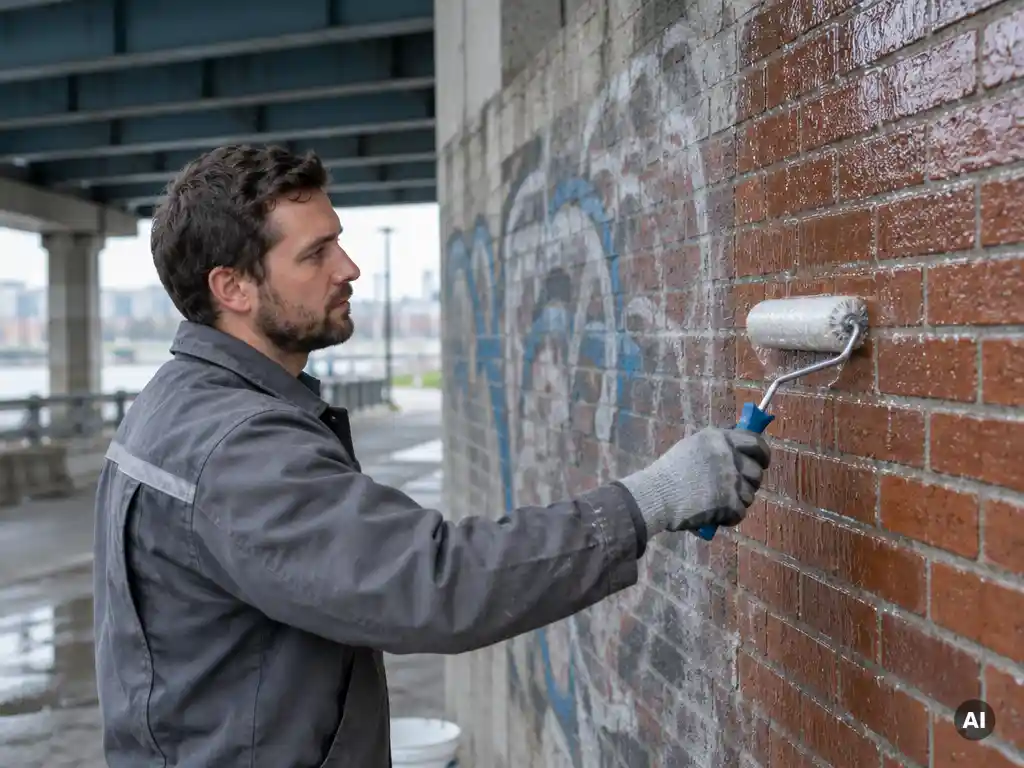
Graffiti removal and anti-graffiti coating are two different approaches to the same problem. Removal is a reactive measure: you clean up existing graffiti. A coating is a preventive protective layer that you apply in advance, so that graffiti is easier to remove later or does not bond as deeply. For professional managers of buildings and infrastructure, both approaches are relevant, and they complement each other. In this article, we answer the most frequently asked questions about both methods.
When should you choose graffiti removal and when a coating?
Choose a graffiti remover when graffiti is already present on a surface. Choose an anti-graffiti coating when you want to protect a surface against future attacks, or when a location is regularly targeted. In practice: removal is always the first step, and a coating is the logical next step to prevent recurrence.
The choice depends on the situation. Is it a one-off incident at a spot that is rarely hit? Then removal is sufficient. Is it a location that structurally deals with graffiti, such as a tunnel, a station building or a school? Then a coating is a sensible investment. The sooner you remove graffiti after it appears, the less damage the surface suffers. If you wait too long, the paint bonds deeper into the material and removal becomes more difficult and more expensive.
How does anti-graffiti coating work as a protective layer?
An anti-graffiti coating forms an invisible or slightly glossy layer on the surface that prevents graffiti from penetrating directly into the material. There are two types: permanent coatings, which withstand multiple cleaning cycles — the exact number differs per system — and semi-permanent coatings, which are removed together with the graffiti and then reapplied.
Permanent coatings are suitable for hard, non-porous surfaces such as metal and glass. They prevent graffiti from bonding, allowing specialists to remove the contamination with the appropriate cleaning agents. Semi-permanent coatings are more commonly used on porous materials such as concrete, brick and certain types of stone. They penetrate the material and form a barrier. After a graffiti incident, specialists remove the coating together with the graffiti and apply a new layer. A special category is Graffitiguard Permanent, an impregnating agent with anti-graffiti properties that protects the material from the inside out. Consult the product data sheet for the specific application guidelines.
A correctly applied coating reduces cleaning costs in the long term and makes the work of specialists considerably easier. Anti-graffiticoatings can take over the function of facade impregnation; therefore, do not routinely recommend combining a coating with a separate impregnating agent.
We’ll figure it out for you!
Want to brainstorm your challenge?
Our advisors are happy to help you find a practical solution.
Which methods are used to remove graffiti?
Graffiti can be removed in several ways, depending on the surface, the type of paint and the age of the damage. The most commonly used methods are chemical cleaning, high-pressure cleaning and mechanical cleaning. In professional practice, chemical cleaning with a graffiti remover is generally the most effective approach with the lowest risk of surface damage.
Chemical cleaning
Professional graffiti removers, such as gel formulations, dissolve the paint particles without damaging the underlying material. The products are applied undiluted. Gel products offer the advantage that they stay on the surface longer, which increases the dwell time and improves effectiveness. Consult the product data sheet and the label for the correct application, dwell time and safety measures. Not every substrate reacts the same way to a cleaning agent; always test the product first on an inconspicuous spot. Take a look at our range of graffiti removers for an overview of the available products.
High-pressure cleaning and mechanical methods
High-pressure cleaning is often combined with chemical agents to speed up the cleaning process. On its own, high pressure is less effective against deeply penetrated paint and can cause damage to porous materials. Mechanical methods, such as sanding or blasting, are more aggressive and are only used when other methods do not work. They almost always leave marks on the surface.
For graffiti on buildings, the right choice of method depends on the facade material. For public transport, additional requirements apply regarding safety and speed of response. Read more about graffiti removal on public transport for specific guidelines.
What are the costs of graffiti removal versus anti-graffiti coating?
Graffiti removal is cheaper in the short term than applying a coating, but more expensive in the long term if a location is regularly defaced. A coating requires a higher initial investment, but significantly lowers the cost per cleaning cycle and protects the surface against wear.
The costs of removal depend on the surface area, the type of material, the age of the graffiti and the accessibility of the location. A fresh incident on a smooth, uncoated surface is relatively quick to remove. Dried paint on porous material takes more time, stronger agents and sometimes multiple treatments. Also be aware of the risk of a graffiti shadow, a discoloration trace that remains after cleaning and requires additional treatment.
For locations that are regularly defaced, an anti-graffiti coating is generally more cost-effective on an annual basis. The investment pays for itself through lower labor and material costs with every subsequent cleaning.
Can coating and cleaning be applied together?
Yes, coating and cleaning work best when used together. The standard procedure is: first remove all existing graffiti completely, let the surface dry and then apply an anti-graffiti coating. This way, you start with a clean, protected base.
It is important that the surface is completely free of paint residue before you apply a coating. Residues of ink or graffiti trapped under the coating can no longer be removed later without damaging the coating. Good preparation is therefore decisive for the end result.
With semi-permanent coatings, cleaning is part of the maintenance system: after every graffiti incident, specialists remove the coating together with the graffiti and apply a new layer. This requires a fixed procedure and the right products, but gives managers full control over the maintenance of their assets.
How we help with graffiti removal and protection
We develop and produce professional products for both graffiti removal and surface protection. Our approach is concrete and results-oriented:
- Graffiti removers in gel and liquid formulations, suitable for a wide range of substrates such as concrete, metal, glass and ceramics — consult the product data sheet for the specific suitability per substrate
- Graffiti removers are applied undiluted by specialists, in accordance with the instructions on the product data sheet and label
- Anti-graffiti coatings for permanent and semi-permanent protection, tailored to the surface and the conditions of use, with a service life of generally up to ten years depending on the system
- Advice and training for professional application, so that specialists use products correctly and according to instructions
- Custom solutions via Compound by Mavro for wholesalers and brands looking for private label solutions
Want to know which approach best suits your situation? Get in touch and we’ll be happy to think along with you.