
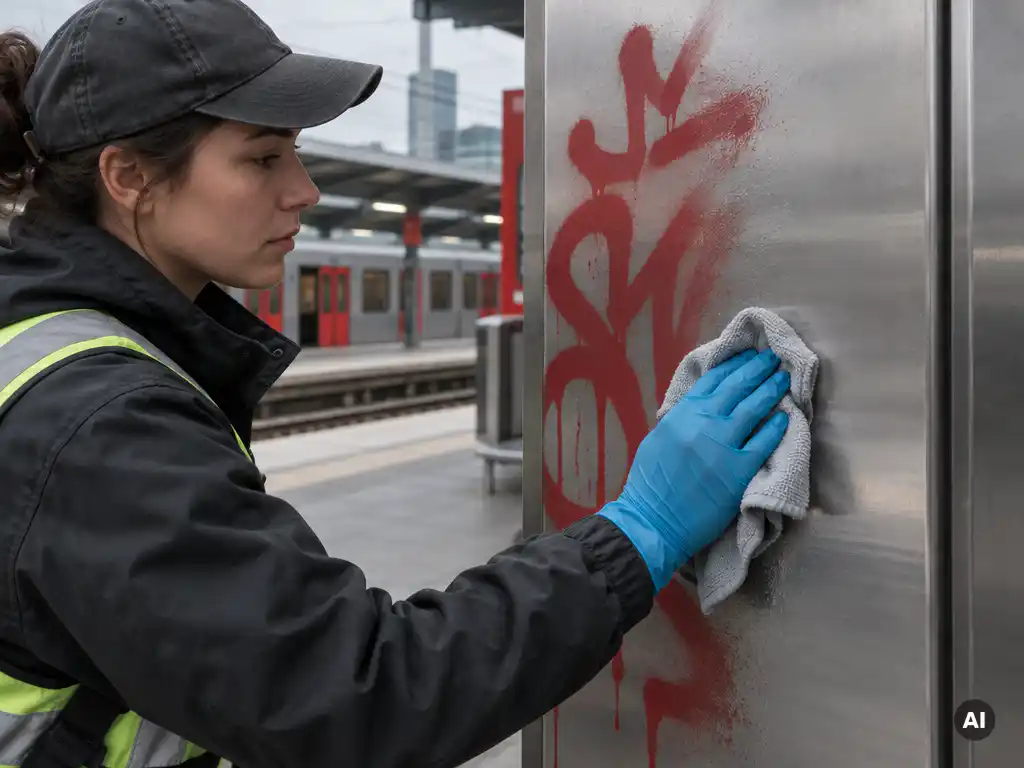
You remove graffiti from metal by applying a suitable gel-based graffiti remover, observing the dwell time and then thoroughly cleaning the surface with water. Metal is a non-porous substrate, which generally makes the removal process easier than with stone or concrete, but the wrong products or techniques can cause scratches or corrosion. In this article, we answer the most frequently asked questions about removing graffiti from metal, step by step.
Which methods work best on metal substrates?
On metal substrates, a chemical method using a specialized graffiti remover works best. A gel-based product has the advantage that it stays in place on vertical surfaces, giving the active ingredients enough time to envelop the paint or ink and loosen it from the surface, without the product running off.
Mechanical methods such as sanding or grinding are strongly discouraged on metal. They leave scratches, damage any paint layer and can promote rust formation. High-pressure washing without chemical support is also rarely sufficient for well-adhered paint layers. The combination of a suitable chemical product and controlled water pressure gives the best result on metal.
Graffiti on metal surfaces in public spaces, such as graffiti on public transport vehicles, calls for products that can also be applied safely to painted or coated metal surfaces. Always consult the product data sheet for the correct application on the specific type of metal.
Which graffiti removers are safe for metal?
Graffiti removers that are suitable for metal are specifically formulated for non-porous substrates and dissolve paint layers and inks without damaging the underlying paint layer or the metal itself. Gel-based products are particularly suitable because they can be applied in a controlled way and the dwell time can be managed precisely.
Not every graffiti remover is suitable for every type of metal or finish. Aggressive solvents can damage paint layers, while products that are too mild have insufficient effect on epoxy or polyurethane paints. Always check that the product is explicitly declared suitable for metal substrates and consult the label and product data sheet for specific application instructions.
Mavro’s GraffitiRemover Gel is a gel-based product that can be applied to non-porous substrates, including metal, glass and ceramics. The product is applied undiluted. For correct application and safety information, please refer to the accompanying product data sheet.
How do you remove graffiti from metal step by step?
Removing graffiti from metal follows a fixed sequence: preparation, applying the graffiti remover, observing the dwell time and rinsing. By following these steps, you prevent damage to the surface and achieve a complete result.
- Assess the surface. Determine what type of metal it is, whether a paint layer is present and how old the graffiti is. Fresh graffiti is generally easier to remove than dried layers.
- Apply the graffiti remover undiluted. Use a brush, roller or spray applicator to apply the product in an even layer over the graffiti. Make sure the coverage is sufficient.
- Observe the dwell time. Let the product work as indicated on the product data sheet. Do not remove the product too early, otherwise the result will be incomplete.
- Remove the product and the loosened paint. Rinse with water, preferably with light pressure. Do not use excessive pressure, which could damage the metal surface.
- Check the result. If paint residue remains, repeat the treatment. For stubborn graffiti ghosting, a second treatment may be necessary.
- Consider aftercare. After cleaning, it is wise to assess whether a protective coating makes sense to prevent recurrence.
Leave the work to specialists, especially for large surfaces, sensitive paint layers or metal with a specific finish.
What are the most common mistakes when removing graffiti from metal?
The most common mistakes when removing graffiti from metal are: using the wrong product, too short a dwell time, mechanical sanding and not testing on an inconspicuous area. Each of these mistakes can lead to permanent damage to the surface.
- Choosing the wrong product. A product that is suitable for concrete or stone is not automatically suitable for metal or a painted substrate. Always check the product specifications.
- Letting it work for too short a time. Anyone who removes the product too early only takes off the top layer. The paint then adheres again and the result is incomplete.
- Sanding or scraping. Mechanical removal leaves scratches and damages paint layers. This also increases the risk of rust formation on unprotected metal.
- Not doing a test patch. Every type of metal and every finish reacts differently. Always test the product first on a non-visible part of the surface.
- Diluting the product. Graffiti removers are applied undiluted. Diluting reduces effectiveness and leads to insufficient results.
- Not using protective equipment. Wear the appropriate personal protective equipment as indicated on the label during application.
When does an anti-graffiti coating make sense for metal surfaces?
An anti-graffiti coating makes sense for metal surfaces that are regularly targeted by graffiti, or that are located in hard-to-reach places where cleaning is costly or time-consuming. The coating ensures that paint and ink adhere less well, so that removing graffiti is easier and quicker.
Two main types of coating are relevant for metal:
- Semi-permanent anti-graffiti coating: This coating is removed with each graffiti removal and must then be reapplied. Suitable for locations where graffiti occurs only occasionally.
- Permanent anti-graffiti coating: This coating withstands multiple cleaning cycles. The exact number varies per system. Suitable for heavily affected locations such as stations, bridges and vehicles.
When choosing a coating, the type of metal and the existing finish are decisive. Consult a specialist for advice on the most suitable system for your situation. An anti-graffiti coating does not replace maintenance, but it structurally makes it easier to remove graffiti from buildings and structures without damage.
How we help with removing graffiti from metal
We develop and produce professional graffiti removers specifically tailored to the requirements of specialists in construction, infrastructure and facility services. For metal substrates, we offer, among other things:
- GraffitiRemover Gel: a gel-based product, suitable for non-porous substrates including metal, glass and ceramics, to be applied undiluted
- Anti-graffiti coatings in semi-permanent and permanent versions, matched to the type of substrate and the intensity of use
- Technical advice and support with product selection and application
- Training for specialists who want to use our products professionally
Would you like to know which product best suits your situation? Contact us via our contact form or call us directly on +31 (0) 418 680 680. Our specialists are happy to think along with you.