
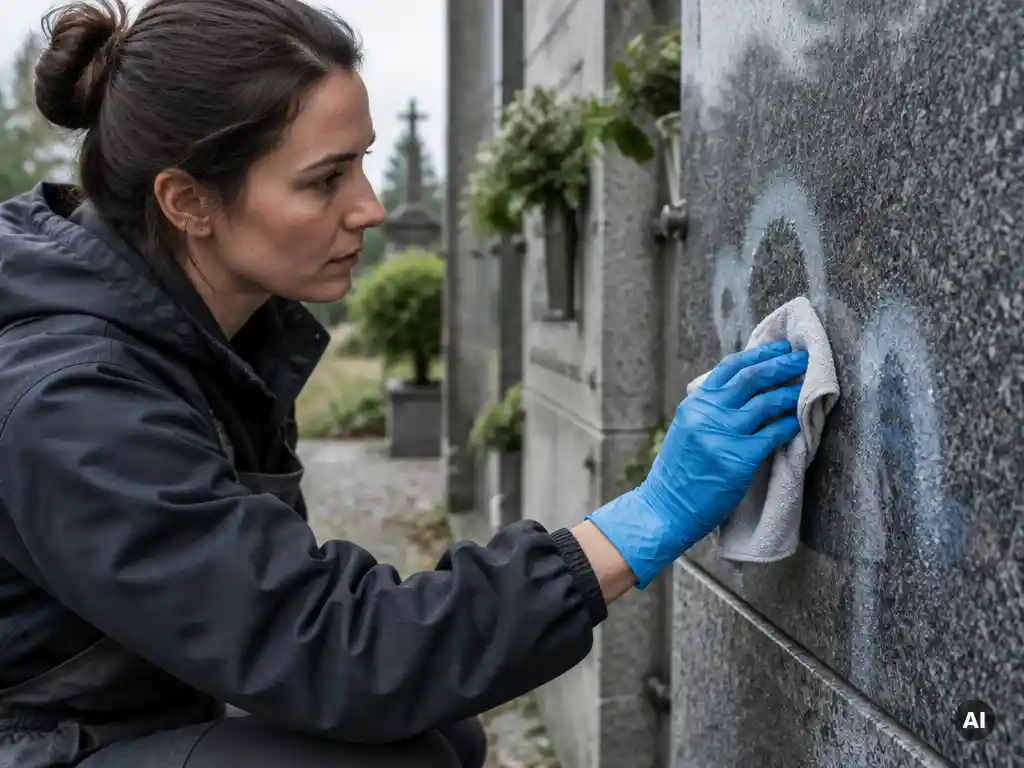
You remove graffiti from granite with a professional graffiti remover specifically suited to natural stone. Do not use aggressive acids or strongly alkaline agents: granite is a hard stone, but its mineral composition can be sensitive to certain chemicals. Below you will find a step-by-step approach, from choosing the right product to protection after cleaning.
What makes granite vulnerable to graffiti cleaning agents?
Granite is one of the hardest types of natural stone, but that does not mean it is resistant to all cleaning agents. The vulnerability lies in its mineral composition: granite contains, among other things, quartz, feldspar and mica. Strong acids can attack the feldspar minerals, while certain alkaline agents can damage the surface finish. Moreover, granite is porous enough to let paint and ink soak in, especially when it is unprotected.
In addition to chemical sensitivity, the finish also plays a role. Polished granite reacts differently to cleaning agents than honed or flamed granite. A product that works safely on polished granite can penetrate deeper into a rougher surface and react differently. Always match your choice of cleaning agent to the specific type of granite and its finish, and consult a specialist if in doubt.
Which graffiti remover is safe for granite?
For granite, choose a professional graffiti remover in gel form that is suitable for use on natural stone. A gel formulation has the advantage that the product stays on the surface, works in long enough and does not run off vertical surfaces. Always check that the product is explicitly suitable for natural stone, and test it first in an inconspicuous spot.
Avoid products based on strong acids or highly alkaline formulations that are not specifically suitable for natural stone. Use the product undiluted, as the manufacturer prescribes, and always consult the product data sheet and label for correct application and safety instructions. Not every graffiti remover is suitable for every substrate, even within the natural stone category.
How do you remove graffiti from granite step by step?
You remove graffiti from granite by applying the remover in a controlled manner, allowing sufficient dwell time and then removing it mechanically or with water. Always work methodically and make sure you do not leave the product on longer than the product data sheet indicates.
- Assess the substrate. Determine which type of granite it is, what the finish is like and how old the graffiti is. Fresh graffiti is easier to remove than dried-in or absorbed paint.
- Test in an inconspicuous spot. Apply a small amount of remover to a hidden part of the surface to assess the reaction before carrying out the full treatment.
- Apply the remover undiluted. Use a brush or spatula to spread the gel evenly over the graffiti. Ensure full coverage.
- Let the product work in. Observe the dwell time stated on the product data sheet. Do not remove the product too early.
- Remove the gel and the dissolved paint. Use a spatula, brush or pressure washer to remove the gel together with the loosened graffiti. Rinse the surface thoroughly with water.
- Assess the result. Check whether the graffiti has been completely removed. For stubborn stains, a second treatment may be necessary.
Leave complex situations, large surfaces or cases of doubt to trained specialists. Incorrect application can permanently damage the granite. You can find more information about removing graffiti from buildings on our application page.
What do you do if graffiti has already soaked into the granite?
If graffiti has already penetrated deeper into the granite, standard surface cleaning is often insufficient. Absorbed paint or ink has reached the pores of the stone, which means a stronger or longer treatment is required. In some cases a so-called graffiti ghost remains visible, even after the graffiti itself has been removed.
A graffiti ghost is the discoloration that remains in the stone surface after the top layer of paint has been removed. This is a known problem with unprotected, porous substrates. A specialized treatment aimed at removing this ghost can help. Consult a specialist for this and see our information about removing graffiti ghosts for more background.
In this case, prevention is easier than cure: timely treatment of fresh graffiti significantly reduces the chance of absorption. The longer graffiti stays on the surface, the deeper it can penetrate.
How do you protect granite after graffiti cleaning?
After graffiti cleaning, it is wise to protect the granite surface with an anti-graffiti coating. This prevents future graffiti from soaking directly into the stone and makes removal easier the next time it is attacked. Two main types are available: semi-permanent and permanent anti-graffiti coatings.
- Semi-permanent coating: This coating is removed during graffiti cleaning and must be reapplied after each treatment. It offers protection as long as the coating remains intact.
- Permanent coating: This coating withstands multiple cleanings. The exact number differs per system; consult the product data sheet for the specifications of the product in question.
- Graffitiguard Permanent: This is an impregnating agent with anti-graffiti properties that protects the stone from within.
Please note: anti-graffiti coatings can take over the function of facade impregnation, but do not recommend the combination of coating and impregnation as standard unless this has been specifically assessed for the situation. Match the choice of coating to the type of granite, the location and the expected load. A specialist can advise on this.
How we help with removing graffiti from granite
We develop and produce professional graffiti removers that are suitable for use on a wide range of substrates, including natural stone such as granite. Our products are applied undiluted and are available in gel form, so they stay effectively in place on vertical surfaces as well. What we offer:
- Professional graffiti removers in gel form, suitable for porous and non-porous substrates
- Anti-graffiti coatings, both semi-permanent and permanent, including Graffitiguard Permanent
- Technical advice and product support for specialists and professional clients
- Product data sheets and labels with precise application instructions per product
Would you like to know which product best suits your specific situation? Then get in touch via our contact form or call us directly on +31 (0) 418 680 680. Our specialists are happy to think along with you.