
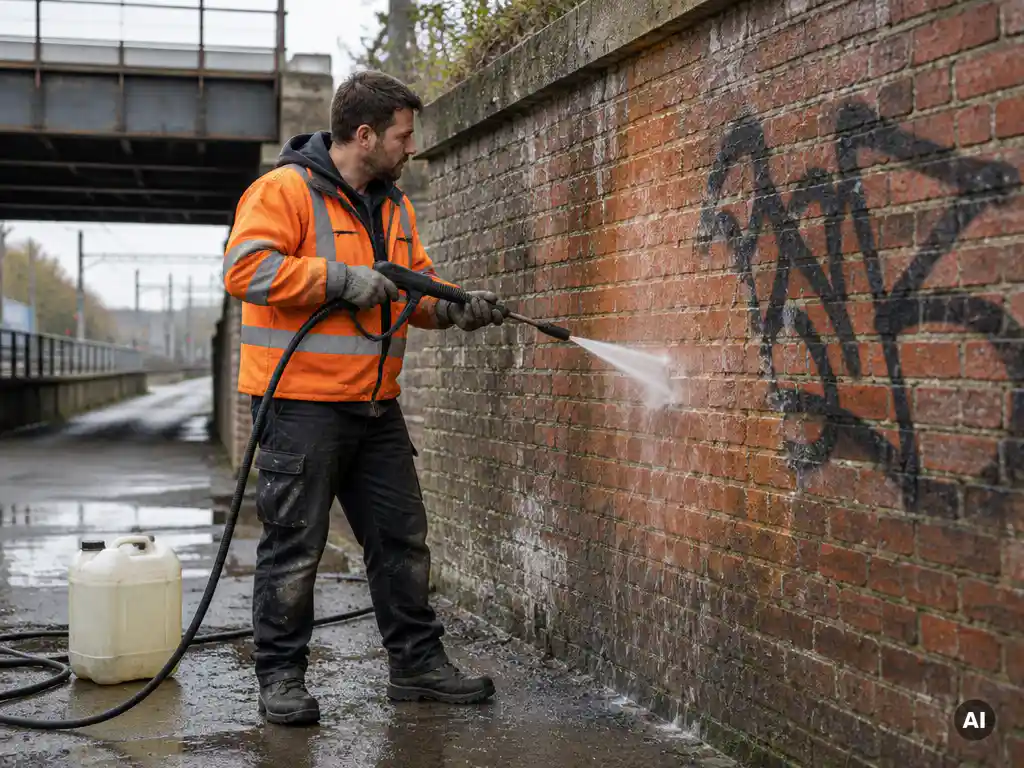
A professional graffiti remover differs from a consumer product through its engineered formulation, its ability to work on a wide range of substrates, and its suitability for repeated, large-scale use. While a consumer product is sufficient for the occasional removal of small areas, professional work requires products that perform reliably even on complex contamination. The questions below cover the properties, substrates, coatings, and standards that matter here.
Which properties distinguish a professional graffiti remover from consumer products?
A professional graffiti remover dissolves virtually all types of graffiti and ink without damaging the underlying substrate. This requires a formulation that acts in a controlled way, has sufficient dwell time, and can be applied undiluted. Consumer products are generally less powerfully formulated and suited to occasional use on limited surfaces.
Professional products are developed for repeated use on large surfaces and for application by specialists. Several characteristics make the difference:
- Gel form: a gel formulation stays on vertical surfaces for longer, allowing the product to work more effectively without running off.
- Undiluted application: professional graffiti removers are applied undiluted, which guarantees effectiveness and rules out dilution errors.
- Broad ink compatibility: the formulation is tuned to a wide range of graffiti types, from spray paint and permanent markers to stickers and inks.
- Documented product properties: every product comes with a technical data sheet and label containing technical specifications, safety instructions, and application guidelines.
Consumer products generally lack the technical depth and product documentation that specialists need to work responsibly and effectively. For professional applications, using products developed specifically for that purpose is therefore the right choice.
On which substrates does a graffiti remover work effectively?
Professional graffiti removers are suitable for both porous and non-porous substrates, including concrete, masonry, metal, glass, and ceramics. With natural stone such as granite, caution is required: not every type of natural stone reacts the same way to cleaning agents, and the composition of the stone partly determines which product is suitable.
Choosing the right product depends on the type of substrate and the nature of the contamination. When removing graffiti from buildings, specialists regularly encounter porous substrates such as brick and untreated concrete, where the graffiti has penetrated deeper into the material. On non-porous substrates such as glass or coated metal, graffiti adheres less deeply and removal is generally easier.
Always consult the product data sheet to confirm whether a specific product is suitable for the substrate in question. If in doubt, first test the product on an inconspicuous area before applying it to the entire surface.
What is the difference between a permanent and a temporary anti-graffiti coating?
The difference between a permanent and a temporary anti-graffiti coating lies in how the coating responds to graffiti removal. A temporary, semi-permanent coating disappears together with the graffiti during cleaning and must then be reapplied. A permanent coating withstands multiple cleaning cycles; the exact number varies per system.
Both types have their own area of application:
- Semi-permanent coating: suitable for situations where the coating will be replaced after a while anyway, or where the use of the substrate changes regularly. Retreatment is required after every graffiti removal.
- Permanent coating: offers long-lasting protection and is suitable for objects that are structurally exposed to vandalism. Graffitiguard Permanent is an example of an impregnating agent with anti-graffiti properties that withstands multiple cleaning cycles.
Anti-graffiti coatings can take over the function of facade impregnation. Therefore, do not combine them as standard with a separate impregnating agent, but assess per situation which protection the substrate needs. The service life of a coating is generally a maximum of ten years, unless product-specific information states otherwise.
How do you recognize a graffiti cleaner that meets environmental and safety standards?
A graffiti cleaner that meets applicable standards can be recognized by complete and transparent product documentation: a current safety data sheet, a detailed product data sheet, and a label with usage and safety instructions. These documents are the primary source for assessing a product’s properties and conditions of use.
Pay attention to the following points when assessing a product:
- Safety data sheet (SDS): mandatory for professional chemical products and contains information on hazardous components, storage, transport, and first aid.
- Product data sheet: describes the technical properties, suitable substrates, and correct method of application.
- Label: displays the hazard pictograms, H and P statements, and the instructions for use in accordance with applicable regulations.
Products without complete documentation are unsuitable for professional use, regardless of the claims on the packaging. Check that the documentation provided is current and relates specifically to the product you are applying. Always review the graffiti remover products together with the accompanying technical documentation.
When is professional training needed for applying graffiti removers?
Professional training is advisable when specialists work with powerful cleaning agents on sensitive or valuable substrates, or when the application is part of a larger maintenance program. Training ensures that products are applied correctly and safely, which prevents damage to the substrate and inefficient use.
Situations in which training is particularly relevant:
- Application on sensitive substrates such as natural stone, where a wrong choice or method can cause damage that is difficult to repair.
- Use in combination with anti-graffiti coatings, where the sequence and method of application determine the effectiveness of the protection.
- Large-scale projects for municipalities or public transport operators, where removing graffiti from public transport requires specific knowledge of material types and cleaning frequency.
- Situations where graffiti ghosting remains after removal; removing graffiti ghosting calls for an adapted approach and sometimes a specific product.
Consult the product data sheet and label as a starting point for safe application. If there is any doubt about the right method or suitable product, it is advisable to seek advice from a specialist beforehand.
How we help you choose the right graffiti remover
We develop and produce professional graffiti removers tailored to the practice of specialists, contractors, municipalities, and managers of buildings and infrastructure. Our products are applied undiluted, are available in gel form for vertical surfaces, and work effectively on both porous and non-porous substrates. What we offer:
- Professional graffiti removers with complete technical documentation (product data sheet, safety data sheet, and label)
- Anti-graffiti coatings in both semi-permanent and permanent versions, including Graffitiguard Permanent
- Tailored advice on the right product choice per substrate and application
- Training and support in the application of our products
Would you like to know which product best suits your situation? Get in touch via our contact form or call us directly on +31 (0) 418 680 680. We are happy to think along with you.