
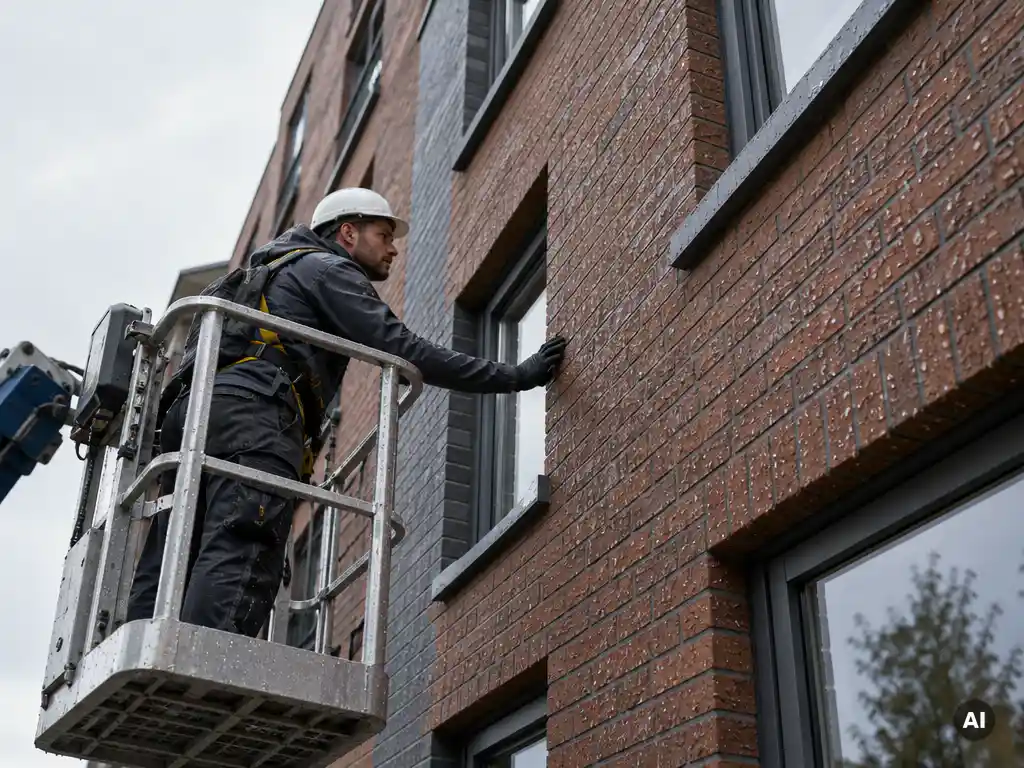
Facade coating demonstrably lowers a building’s maintenance costs. By applying a protective layer to the facade, you reduce the need for frequent cleaning, repairs and material replacement. The exact savings depend on the facade material, the local weather conditions and the type of coating you choose. In this article, we answer the most frequently asked questions about the financial effects of facade coating.
How much lower are maintenance costs after applying facade coating?
After a professional facade coating has been applied, annual maintenance costs are structurally lower than for an untreated facade. A treated facade absorbs less moisture, dirt adheres less strongly and facade cleaning is needed less often. Over a period of five to ten years, this can result in significant savings on labor costs, cleaning products and repairs.
The actual savings vary from situation to situation. Relevant factors include exposure to rain, wind and pollution, the type of substrate and the quality of the applied coating. Buildings in urban environments or near industrial areas generally benefit the most, because pollution levels there are higher. A coating that repels moisture and dirt means you don’t have to schedule cleaning sessions every year.
What damage does facade coating prevent that would otherwise cause expensive repairs?
Facade coating prevents several types of damage that, without protection, can escalate into costly repairs. The main types of damage a coating guards against are moisture penetration, frost damage, algae and moss growth, and surface contamination from graffiti. Without protection, each of these problems sooner or later requires extensive and expensive restoration work.
- Moisture penetration: Water that seeps deep into the facade causes cracking, efflorescence and, over time, structural weakening of the brickwork or substrate.
- Frost damage: Trapped moisture that expands in freezing weather splits the facade material open. This leads to spalling and cracks that specialists have to repair.
- Algae and moss growth: A damp, unprotected facade offers ideal conditions for biological growth. Removal is labor-intensive and must be repeated regularly.
- Graffiti: On an untreated facade, graffiti soaks deep into the material. Removal is then destructive and sometimes impossible without damaging the substrate.
A coating that repels moisture, oils and solvents breaks these chains of damage at the source. That makes prevention financially more attractive than repair.
What are the total costs of facade coating compared to regular maintenance?
The initial investment in facade coating is higher than a single cleaning session, but lower than the cumulative costs of regular maintenance over several years. You pay once for preparation, application and materials. After that, recurring maintenance costs drop noticeably, because you need to clean less often and repairs are avoided.
With regular maintenance without a coating, costs for cleaning, repairing frost damage, removing growth and possibly graffiti recur every year or every two years. Over a period of ten years, these costs add up to an amount that in many cases exceeds the one-time investment in a high-quality coating. The comparison therefore almost always favors the treatment, especially for buildings with high pollution levels or vulnerable facade materials.
How long does a professional facade coating last?
A professionally applied facade coating generally lasts up to ten years, depending on the type of product, the substrate and the degree of exposure to the elements. Some semi-permanent systems have a shorter lifespan and require retreatment after a certain period. Permanent color-restoring coatings can perform closer to the upper limit of ten years.
The lifespan is strongly determined by the quality of the preparation. A facade that has been thoroughly cleaned before coating and whose moisture content is at the right level offers better adhesion and therefore a longer period of protection. Specialists check the substrate before application to ensure the coating can perform optimally. Always consult the product data sheet of the specific coating for the applicable lifespan indication.
For which facade types does coating deliver the greatest cost savings?
Coating delivers the greatest cost savings on facades that are naturally porous or heavily exposed to weather and pollution. Brickwork, concrete, natural stone and rendered facades readily absorb moisture without treatment, which leads to the types of damage mentioned earlier. Facades in urban environments with an increased risk of graffiti vandalism also benefit greatly from a coating.
Non-porous facade cladding and window frames can also benefit from protective coatings, particularly when the material has aged and the original color or finish has deteriorated. In that case, a coating not only restores the appearance but also extends the lifespan of the cladding. For porous substrates, facade impregnation with a combination of alkylsilanes and (poly)siloxanes is a proven approach that effectively limits moisture absorption.
When is it financially wise to have facade coating applied?
It is financially wise to have facade coating applied when a facade shows signs of aging but has not yet suffered structural damage. If you wait too long, expensive repairs are needed before a coating can sensibly be applied. Acting at an early stage is more cost-efficient.
Specific situations in which coating is financially attractive:
- After a thorough facade cleaning, when the substrate turns out to be in good condition
- For new construction or renovation, as part of the finishing
- When a building is regularly targeted by graffiti vandalism
- For facades that visibly develop moisture problems or growth
- When the existing coating is nearing the end of its lifespan and retreatment is needed
Have a specialist assess the facade before you make a choice. The condition of the substrate, the moisture content and the type of facade material together determine which product and which timing are most suitable.
How we help you with facade coating and cost savings
We offer an extensive product range for the renovation and protection of facades, tailored to professional applications. Our solutions are developed for specialists who work on both homes and commercial real estate. Here is what we offer:
- Semi-permanent coatings such as Nitowax, Nitoshield and Nitocryl® that repel moisture, oils, solvents and graffiti
- Permanent color-restoring coatings such as Nitocolour, with a lifespan of up to ten years, that restore and protect aged facades
- Facade impregnation for porous substrates that effectively prevents moisture penetration
- Professional advice and support with product selection and application, including training for specialists
Would you like to know which coating best suits your facade situation and what the expected cost savings are? Then get in touch with us via our contact form or call us directly on +31 (0) 418 680 680. Our specialists will be happy to help you.