
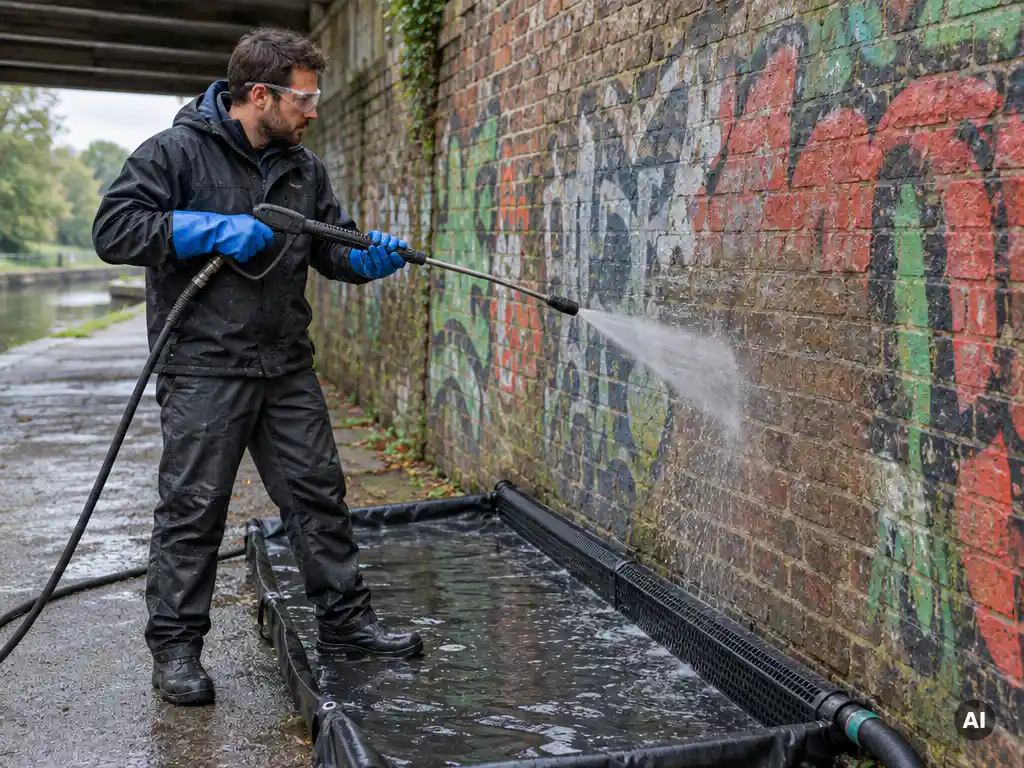
A professional graffiti remover must comply with legal requirements for hazardous substances, be classified in accordance with the CLP Regulation, and be accompanied by a safety data sheet. The specific requirements that apply depend on the composition of the product, the substrate, and the location where you use it. In this article, we answer the most frequently asked questions about environmental requirements for professional graffiti removers.
Which environmental standards and certifications apply?
Professional graffiti removers are primarily subject to the European REACH Regulation and the CLP Regulation. REACH governs which chemical substances may be placed on the market and under what conditions. CLP requires manufacturers to correctly classify, label, and package hazardous substances. In addition, products used on public roads or near water are subject to additional national and local rules.
An ISO 9001 certification says something about the manufacturer’s quality management system, not about the properties of the product itself. When purchasing, always check that the product has a current safety data sheet (SDS) that meets the requirements of REACH Annex II. That document is the legal basis for safe use and disposal.
Which harmful substances must not be present in a graffiti cleaner?
Substances identified under REACH as substances of very high concern (SVHC) may not be used in professional cleaning products without authorization. In practice, this concerns substances such as N-methylpyrrolidone (NMP) above certain concentrations, certain chlorinated hydrocarbons, and aromatic solvents classified as carcinogenic, mutagenic, or toxic for reproduction.
Products used in locations with an increased risk to surface water, such as bridges, quays, or railway infrastructure, must not contain substances classified as hazardous to aquatic organisms, unless appropriate protective measures are taken. Always consult the safety data sheet of the specific product to know its exact composition and restrictions. Do not use a graffiti remover whose SDS is missing or outdated.
We’ll find out for you!
Want to talk through your challenge?
Our advisors will gladly help you find a practical solution.
What does biodegradable mean for a graffiti remover?
Biodegradability means that the active substances in the product are converted by micro-organisms in the environment into harmless compounds such as water and carbon dioxide. Whether a graffiti remover is biodegradable depends on its specific chemical composition and must be demonstrable using test methods such as OECD 301.
It is important to understand that a biodegradable product is not automatically plant-based, safer to use, or less harmful to the user. Biodegradability says something about how the substance behaves in the environment after discharge, not about its toxicity during application. Read the safety data sheet to assess whether a product is suitable for your location and application.
How does the application environment influence the environmental choice?
The location where you use a graffiti remover largely determines which product requirements are relevant. For applications near surface water, in protected nature reserves, or in locations with a sewer system that discharges directly into surface water, stricter requirements apply to the composition and use of the product.
For graffiti removal on public transport such as train stations, platforms, and tunnels, additional requirements from the managing authority often apply. With graffiti removal from buildings in urban areas, you have to take sewage discharges and the nature of the substrate into account. In all cases, the rule is: match your product choice to the specific location and, if in doubt, ask a specialist for advice.
What does the safety data sheet say about the environment?
Section 12 of the safety data sheet (SDS) contains the ecotoxicological information for a graffiti remover. Here you will find data on toxicity to aquatic organisms, biodegradability, bioaccumulation potential, and mobility in soil and water. Section 13 describes how to dispose of waste and residues responsibly.
Section 15 states which legal provisions apply to the product, including REACH registrations and any restrictions. With every purchase, check that the SDS is up to date; manufacturers are required to update it if the composition or classification changes. An outdated SDS offers no legal cover in the event of incidents or inspections.
When does a graffiti cleaner require a permit?
A graffiti remover requires a permit when the application falls under the Dutch Environmental Management Act or when you work at a location with an environmental permit that sets specific requirements for the use of chemical substances. This is particularly relevant for applications in or near Natura 2000 areas, water extraction areas, or national monuments.
In addition, municipalities or provinces may set additional rules through the Activities Decree or the Environment and Planning Act. For professional specialists working for municipalities, housing associations, or infrastructure managers, it is advisable to check in advance whether the planned application requires notification or a permit. Consult the competent authority or an environmental law specialist if you have doubts about this.
How we help you choose the right graffiti remover
At Mavro International, we develop and produce professional graffiti removers that meet the requirements of business specialists. Our products, including the GraffitiRemover Gel, are suitable for use on various substrates such as concrete, metal, glass, and ceramics, and are applied undiluted. With every product, we supply a current safety data sheet and product sheet, so you always have the information you need for responsible use.
What we do for you:
- Current safety data sheets with every product, in accordance with REACH Annex II
- Product-specific documentation on composition and conditions of use
- Tailored advice for specific locations and substrates, including removing graffiti ghosting
- Training and support for professional application
Get in touch via our contact form or call +31 (0) 418 680 680 directly for advice on the right graffiti remover for your situation.