
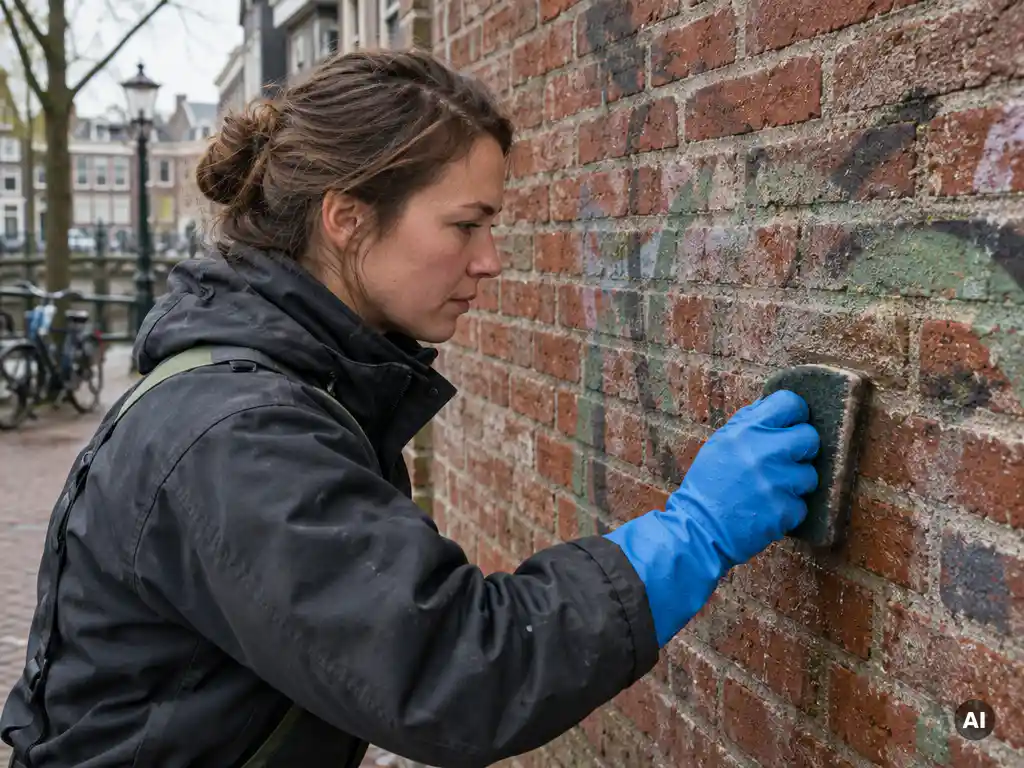
Removing graffiti without causing damage isn’t always possible, because paint, substrate, and cleaning agent are three variables that rarely align perfectly. The composition of the graffiti, the porosity of the material, and the chosen cleaning method together determine whether you keep the substrate intact or damage it. The questions below explain exactly where things go wrong and how to prevent that.
What makes graffiti so difficult to remove without causing damage?
Graffiti is difficult to remove without damage because spray paint, markers, and other inks penetrate deep into the pores of a substrate. The more porous the material, the further the paint penetrates. A cleaning agent strong enough to break down the paint can at the same time attack the underlying structure if it isn’t matched to that specific substrate.
On top of that, graffiti rarely consists of a single type of product. Acrylic-based spray paint behaves differently from alkyd paint or permanent marker ink. A professional graffiti remover is therefore formulated to dissolve multiple types of paint and ink without attacking the substrate. General cleaning products are not, and they often cause problems.
Which substrates are most vulnerable when removing graffiti?
The most vulnerable substrates when removing graffiti are untreated concrete, sandstone, calcium silicate brick, historic masonry, and uncoated wood. These materials are highly porous and absorb paint quickly and deeply. Aggressive cleaning agents or mechanical methods such as high-pressure washing can cause irreparable damage to these substrates.
Natural stone is a category of its own. Granite is an example of natural stone, but not every type of natural stone reacts the same way to acids or alkaline agents. Limestone and marble are sensitive to acidic products, while certain types of bluestone are more resistant. Metal, glass, and ceramics are generally less porous and therefore easier to treat, but here too the wrong agent can cause scratches or oxidation.
Specialists always assess the substrate before choosing an agent. This is not an extra step, but a prerequisite for a damage-free result.
Why do the wrong cleaning agents cause permanent damage?
The wrong cleaning agents cause permanent damage because they act chemically on the material itself, not just on the paint. An acid that is too strong dissolves lime from concrete or stone. A solvent that is too aggressive can attack coatings, impregnating agents, or the binder in the material. The result is a surface that looks worse after cleaning than it did with the graffiti on it.
Another common problem is the so-called graffiti ghost: the paint is gone, but a discoloration remains. This happens when an agent doesn’t fully dissolve the paint but smears it, or when the ink has already penetrated so deeply that surface cleaning is insufficient. Specialists who deal with graffiti ghosting know that this requires a separate approach.
Always consult the product data sheet and label of a cleaning agent before applying it. The information there is specific to the product and the substrate, not generic.
How does the age of graffiti affect the removal result?
The older the graffiti, the harder the removal. Fresh paint still sits largely on the surface and hasn’t yet completely filled the pores. Over time, binders cure further, the paint penetrates deeper into the material, and it responds less well to cleaning agents. Graffiti that is months or years old requires more intensive treatment and sometimes multiple applications.
UV radiation speeds up this process. Sunlight breaks down the top layer of paint, but the pigments and binders deeper in the pores remain and become harder to dissolve. The sooner you act after graffiti has been applied, the greater the chance of a completely damage-free result. Acting quickly is therefore one of the most effective measures for graffiti on buildings.
When is an anti-graffiti coating the better choice?
An anti-graffiti coating is the better choice when an object or facade is regularly targeted by graffiti. The coating forms a protective layer that prevents paint from penetrating the substrate, making removal considerably easier. This is particularly relevant for public buildings, infrastructure, and public transport.
Semi-permanent versus permanent coating
Semi-permanent anti-graffiti coatings offer protection, but wear away during the cleaning process and must be reapplied afterwards. Permanent anti-graffiti coatings withstand multiple cleanings; the exact number varies per system. Which type you choose depends on the intensity of use and the nature of the substrate.
Graffitiguard Permanent as an impregnating agent
Graffitiguard Permanent is an impregnating agent with anti-graffiti properties. It works differently from a surface coating: it soaks into the material and protects from the inside out. Anti-graffiti coatings can take over the function of facade impregnation. For that reason, don’t combine them by default without assessing the specific situation.
What are the professional standards for damage-free graffiti removal?
Professional standards for damage-free graffiti removal are based on three principles: the right product choice for the specific substrate, correct application by trained specialists, and intervening as soon as possible after the graffiti has been applied. Anyone who meets these three conditions significantly minimizes the risk of damage.
In practice, this means:
- Always identify and assess the substrate before choosing a product
- Apply the cleaning agent undiluted, as the product prescribes
- Consult the product data sheet and label for dwell time and application
- Don’t experiment with general cleaning products on vulnerable substrates
- When in doubt, call in a specialist instead of improvising yourself
Working without causing damage is not a matter of luck, but of knowledge about materials, products, and working methods. Anyone who lacks that knowledge increases the risk of irreversible damage to the surface.
How we help with professional graffiti removal
We develop and produce professional graffiti removers tailored to a wide range of substrates, from concrete and masonry to metal, glass, and ceramics. Our products, such as GraffitiRemover Gel in gel form, dissolve virtually all types of graffiti and inks without attacking the underlying substrate. What you can expect from our range:
- Products specifically formulated for porous and non-porous substrates
- Graffiti removers that are applied undiluted for maximum effectiveness
- Anti-graffiti coatings for structural protection against recurring vandalism
- Technical advice and support with product selection and application
- Training and guidance for specialists working with our products
Want to know which product best suits your situation? Get in touch or call us directly at +31 (0) 418 680 680. We’re happy to think along with you.