
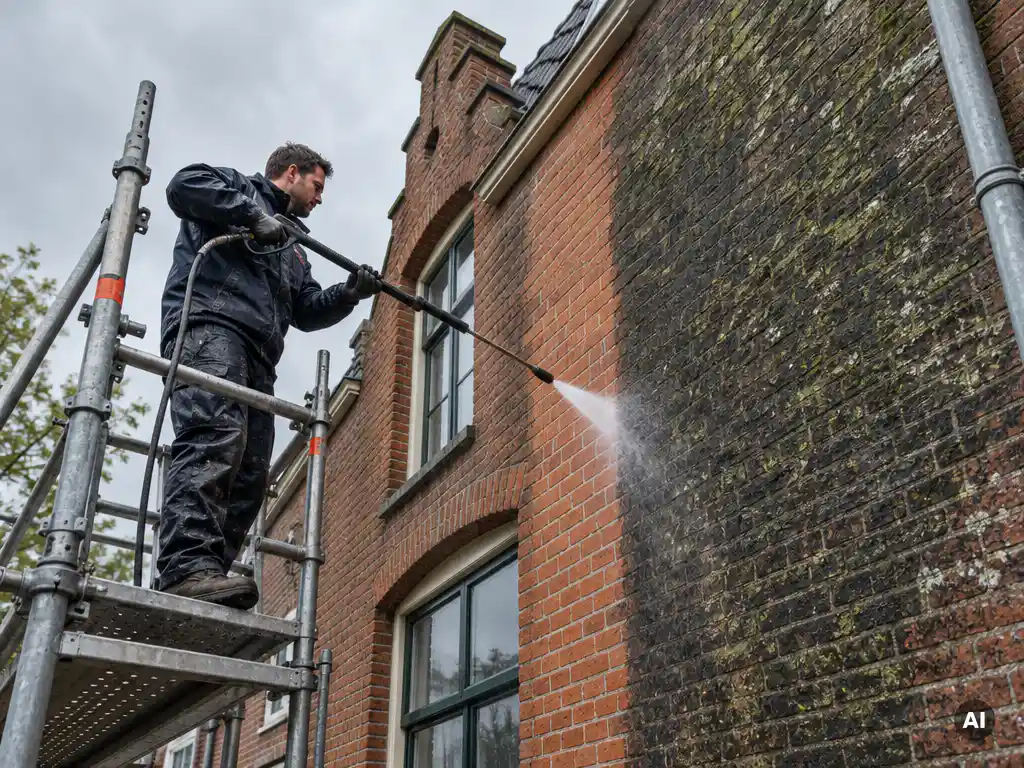
Facade cleaning is not always a legal obligation for building owners, but municipalities can enforce maintenance under the Housing Act (Woningwet) and the Building Decree (Bouwbesluit) when a facade harms public order, safety or the appearance of the surroundings. The obligation depends on the condition of the facade, the designated use of the building and local regulations. In this article, we answer the most frequently asked questions about cleaning obligations, enforcement and a professional approach.
What does the law say about facade maintenance?
The law requires building owners to keep their property in a condition that is safe, healthy and usable. The Building Decree 2012 (Bouwbesluit 2012) and its successor, the Buildings and Living Environment Decree (Besluit bouwwerken leefomgeving, Bbl), set requirements for the condition of structures. A facade that is severely soiled, damaged or weathered may conflict with these requirements. Facade cleaning as such is not a separate obligation in the law, but it falls under the owner’s broader maintenance obligation.
Municipalities translate these national frameworks into local enforcement through their own building regulations and environmental plans. This means the threshold for intervention can differ from one municipality to another. Owners of listed buildings also have to comply with additional rules under the Heritage Act (Erfgoedwet), where the appearance of the facade also plays a role in granting permits for maintenance or restoration.
When can a municipality enforce facade cleaning?
A municipality can enforce facade cleaning when a building is in such a condition that it undermines safety or the appearance of the surroundings. This can be done on the basis of the Housing Act, under which a municipality can issue a notice if a building does not meet the minimum maintenance requirements. If the owner refuses to act, the municipality can intervene itself and recover the costs.
Specific situations in which municipalities take action include:
- Severe contamination from graffiti or biological growth that damages the streetscape
- Facades whose state of maintenance poses a risk to passers-by, for example due to loose materials
- Buildings in protected urban or village conservation areas where aesthetic standards carry more weight
- Vacant or neglected buildings covered by a municipal enforcement program
In practice, municipalities first send a warning or notice before resorting to administrative enforcement. The owner is then given a period of time to take action themselves.
Is there a cleaning obligation for rental properties and owners’ association buildings?
For rental properties, the maintenance obligation for the exterior of the building, including the facade, rests in principle with the landlord. The tenant is responsible for minor day-to-day maintenance, but structural facade maintenance is the responsibility of the owner or housing association. This is laid down in the Dutch Civil Code and the Minor Repairs Decree (Besluit kleine herstellingen).
For buildings with an owners’ association (Vereniging van Eigenaars, VvE), the situation is organized differently. The VvE is collectively responsible for the maintenance of the common areas, including the exterior facade. Decisions about facade cleaning are made at the owners’ meeting, and the costs are divided through the service charges or the maintenance fund. An active VvE with a multi-year maintenance plan (meerjarenonderhoudsplan, MJOP) will usually include facade maintenance as a recurring item.
How often does a facade have to be cleaned to meet the standards?
There is no legally prescribed cleaning frequency for facades. The standard is functional: a facade must be free of contamination that undermines safety, structural integrity or appearance. How often cleaning is needed depends on the type of material, environmental factors and the degree of exposure to pollution.
In practice, the following factors play a role in determining the frequency:
- Location: facades in urban environments or near busy roads become dirty faster due to soot and fine particulate matter
- Material: porous substrates such as brick or concrete absorb dirt faster than non-porous cladding
- Biological growth: moss, algae and lichens can return quickly after cleaning in damp climates
- Protective coating: impregnating the facade with a water-repellent layer slows dirt accumulation and extends the interval between cleanings
A professional maintenance program takes all of these factors into account and records the cleaning frequency in a maintenance plan, tailored to the specific building and its surroundings.
What are the consequences of not cleaning a facade?
Failing to clean a facade can lead to structural damage, legal notices and a loss of property value. Dirt, moisture and biological growth attack the underlying material over time. Lime deposits, moss and algae trap moisture against the facade, which can lead to frost damage, cracking and efflorescence in porous materials such as brick or concrete.
In addition to the structural risks, there are also legal and financial consequences:
- A municipal notice with a penalty payment if the owner does not act in time
- Administrative enforcement, where the municipality cleans the facade itself and recovers the costs from the owner
- Liability if contamination or loose facade materials cause damage to third parties
- A drop in the value of the property at sale or appraisal due to visible neglect
Preventive maintenance is generally more cost-efficient than repairing consequential damage caused by long-term neglect.
What professional approach is required for facade cleaning?
Facade cleaning requires an approach tailored to the type of substrate, the nature of the contamination and the condition of the material. The wrong method or an unsuitable cleaning agent can damage the facade cladding, leading to higher repair costs. Specialists first assess the substrate and the contamination before choosing a cleaning method.
Common professional methods include high-pressure cleaning, chemical cleaning with agents matched to the substrate, and gentle cleaning for sensitive materials such as natural stone or historic facades. After cleaning, it is advisable to protect the facade against future contamination. This can be done by impregnating the facade with a water-repellent treatment based on alkylsilanes and (poly)siloxanes, which repels moisture and dirt without affecting the vapor permeability of the substrate. The service life of such a treatment is generally up to ten years, depending on the product and the substrate.
Graffiti contamination calls for a separate approach. For this, consult the graffiti cleaning products that are matched to the specific facade cladding and the type of graffiti.
How we help with facade cleaning and facade maintenance
We develop and produce professional products for facade cleaning, facade impregnation and facade protection, tailored to the needs of building owners, contractors and maintenance companies. Our range offers concrete solutions for the challenges discussed in this article:
- Facade cleaning products matched to a wide range of substrates and types of contamination, from biological growth to industrial dirt
- Water-repellent impregnation products based on alkylsilanes and (poly)siloxanes for long-lasting moisture repellence after cleaning
- Semi-permanent and permanent coatings such as Nitowax, Nitoshield, Nitocryl and Nitocolour, for facade cladding and window frames that provide protection against moisture, dirt and graffiti, with a service life of up to ten years
- Graffiti removers for professional application undiluted on the substrate
All products are developed for professional application by specialists. Always consult the product data sheet and label for the correct procedure. Want to know which product suits your specific situation? Then get in touch via our contact form or call us directly on +31 (0) 418 680 680.