
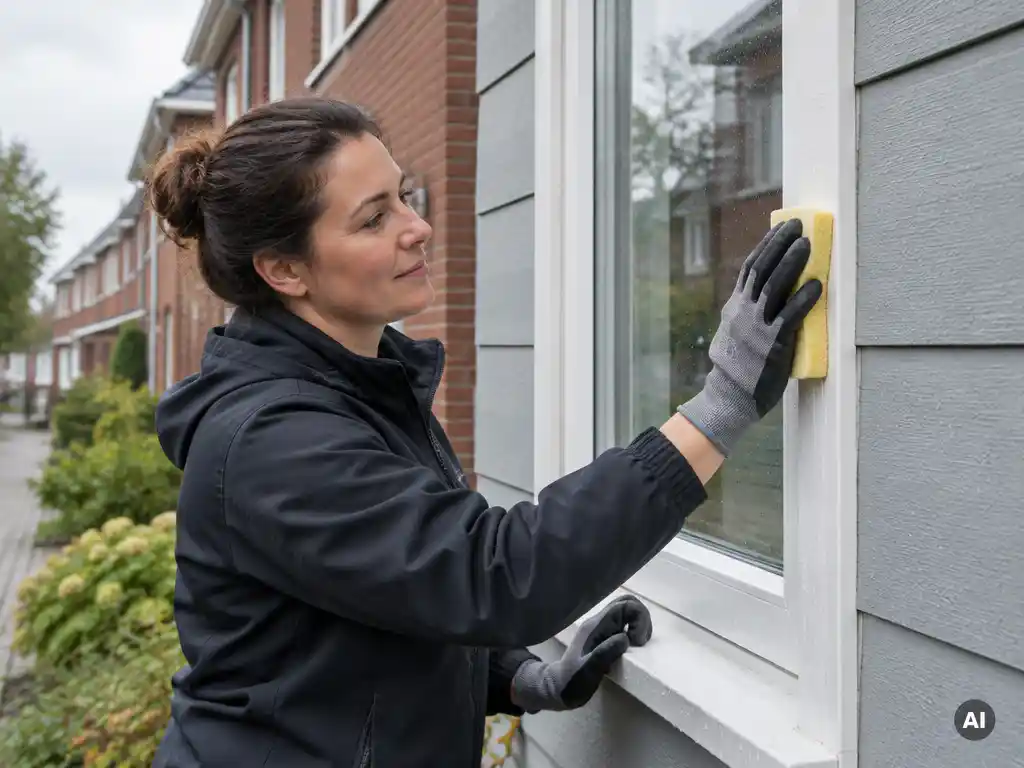
You can clean window frames and facade cladding safely by choosing the right cleaning agent for the material, soaking the dirt loose first, and then removing it with gentle pressure. Never use abrasive agents or high pressure on sensitive materials such as plastic or wood. The method differs per material type and type of dirt. Below we answer the most frequently asked questions about cleaning window frames and facade cladding.
Which cleaning agents are safe for window frames and facade cladding?
Safe cleaning agents for window frames and facade cladding are neutral or mildly alkaline cleaning products that are matched to the material. For plastic and aluminium, mild, non-abrasive agents are sufficient. Facade cladding made of concrete, stone or fibre cement has different requirements. Always use a product that is approved for the substrate in question and consult the product data sheet for the correct application.
Not every cleaning agent is suitable for every material. Strongly acidic agents can attack aluminium and damage metal oxide layers. Strongly alkaline agents can open up wood or attack coatings. For professional facade cleaning, the choice of agent always starts with an analysis of the substrate and the nature of the dirt.
- Neutral cleaning agents: suitable for most facade cladding and window frames during regular maintenance cleaning
- Mildly alkaline agents: effective against greasy deposits, soot and organic dirt on mineral substrates
- Acidic agents: only use on specific substrates such as brick or concrete, never on aluminium or glass
- Abrasive agents or steel wool: always avoid on plastic, lacquered aluminium and coated surfaces
Always test a cleaning agent first on an inconspicuous spot. This prevents discolouration, residue or damage to the finish.
How do you clean plastic window frames without scratches or discolouration?
You clean plastic window frames without scratches by using soft cloths or sponges in combination with a mild, non-abrasive cleaning agent. Avoid hard brushes, scouring pads and solvents such as acetone or thinner. Work with little pressure and rinse thoroughly with clean water to remove cleaning agent residue.
Plastic, also known as PVC, is sensitive to scratches and chemical attack. Solvents can damage the gloss layer and lead to a matte or grainy surface texture. Discolouration occurs when residue of the cleaning agent remains in the pores of the material or when UV damage is accelerated by aggressive substances.
- Use lukewarm water with a mild cleaning agent
- Work with a soft microfibre cloth or sponge
- Wipe in the direction of the frame profiles, not in circular motions
- Rinse with clean water and dry the profiles to prevent water streaks
- Do not use a pressure washer directly on the joints or seals
For stubborn deposits such as limescale or green growth, a specialised cleaning agent may be needed. Always consult the label and product data sheet for the correct application on plastic.
We’ll figure it out for you!
Want to talk through your challenge?
Our advisers will gladly help you with a practical solution.
What is the right method for cleaning wooden and aluminium window frames?
You clean wooden window frames with a soft brush or cloth and a mild cleaning agent, followed by thorough rinsing. Aluminium window frames tolerate slightly more pressure, but require pH-neutral agents to keep the oxide layer intact. Both materials are sensitive to prolonged exposure to moisture and aggressive chemicals.
Wooden window frames
Wood is a living material that reacts to moisture and chemicals. Use a mild cleaning agent and work quickly so that the wood absorbs as little moisture as possible. Preferably clean in the shade and in dry weather. Allow the wood to dry completely before applying a protective coating or varnish. After cleaning, check the condition of the paint or stain and repair damaged spots promptly.
Aluminium window frames
Aluminium has a natural oxide layer that offers protection. Acidic or strongly alkaline agents attack this layer, leading to stains or corrosion. Use only pH-neutral cleaning agents and avoid abrasive materials. Extra care is needed with powder-coated aluminium: aggressive agents can damage the powder coating. Always rinse thoroughly and remove all cleaning agent residue.
How do you remove stubborn dirt such as algae, soot and deposits from facade cladding?
You remove stubborn dirt such as algae, soot and limescale deposits from facade cladding by first pre-soaking the dirt with a suitable cleaning agent, allowing sufficient dwell time, and then removing it with a brush or low-pressure sprayer. The approach differs per type of dirt and substrate.
- Algae and green growth: Use a biocidal cleaning agent matched to the substrate. Allow the agent sufficient time to work so that the organic layer comes loose. Avoid high-pressure spraying on soft or porous substrates.
- Soot and exhaust fumes: Mildly alkaline cleaning agents are effective against soot deposits on mineral facades. Work from top to bottom to prevent streaks from run-off.
- Efflorescence and white deposits: Mildly acidic cleaning agents are suitable for this, but only on substrates that are acid-resistant. Consult the product data sheet and always test on a small area.
- Graffiti: For graffiti removal, specialised graffiti removers are available that are applied undiluted. The choice of agent depends on the substrate and the type of graffiti.
With stubborn dirt, always work systematically and test the cleaning agent first on an invisible spot. Wrong choices can permanently damage the substrate.
When is professional cleaning of facade cladding necessary?
Professional cleaning of facade cladding is necessary when the dirt has penetrated deep into the substrate, when the facade covers large surfaces, or when the nature of the dirt requires specific chemical knowledge and equipment. For historic facades or sensitive materials too, calling in specialists is strongly recommended.
Private cleaning with consumer products is sufficient for regular maintenance of small surfaces. But in the following situations, professional execution is advisable:
- Extensive algae or moss growth across large facade surfaces
- Graffiti on porous or unprotected substrates
- Deposits resulting from industrial pollution or long-term neglect
- Facade cladding made of sensitive materials such as natural stone or fibre cement
- Situations that require working at height or with high-pressure spraying equipment
- Facades that also need to be impregnated or protected after cleaning
Specialists have the right knowledge of cleaning agents, substrates and application techniques. They prevent damage and deliver a result that lasts longer.
How do you protect window frames and facade cladding after cleaning?
After cleaning, you protect window frames and facade cladding by applying a suitable protective coating or impregnation. For facade cladding, facade impregnation is an effective method to keep out moisture, dirt and biological growth. For window frames, specific coatings apply depending on the type of material.
Facade impregnation works on the basis of a combination of alkylsilanes and (poly)siloxanes. These substances penetrate the pores of the substrate and make the surface water-repellent without affecting vapour permeability. As a result, rainwater penetrates the facade less readily, which slows the growth of algae and moss and protects the substrate better.
- Apply impregnation only to a clean, dry substrate
- Check the moisture content of the substrate beforehand
- The service life of facade impregnation is generally a maximum of ten years, depending on the substrate and conditions
- For window frames: use a coating matched to the material (plastic, aluminium or wood)
- Preferably have protective treatments carried out by specialists for a uniform and durable finish
How Mavro helps with cleaning and protecting window frames and facade cladding
We offer a complete product range for the cleaning, renovation and protection of facade cladding and window frames. Our products are developed for professional applications and are used by contractors, maintenance companies and facility managers. Specifically, we offer:
- Specialised cleaning agents for a wide range of substrates and types of dirt
- Facade impregnation products based on alkylsilanes and (poly)siloxanes for durable moisture protection
- Semi-permanent and permanent coatings for facade cladding and window frames, such as Nitowax, Nitoshield, Nitocryl® and Nitocolour, with a service life of generally a maximum of ten years
- Graffiti removers for unprotected and protected substrates
- Technical advice and support with product selection and application
Want to know which product best suits your situation? Contact us or call +31 (0) 418 680 680 directly. Our specialists will be happy to think along with you.