
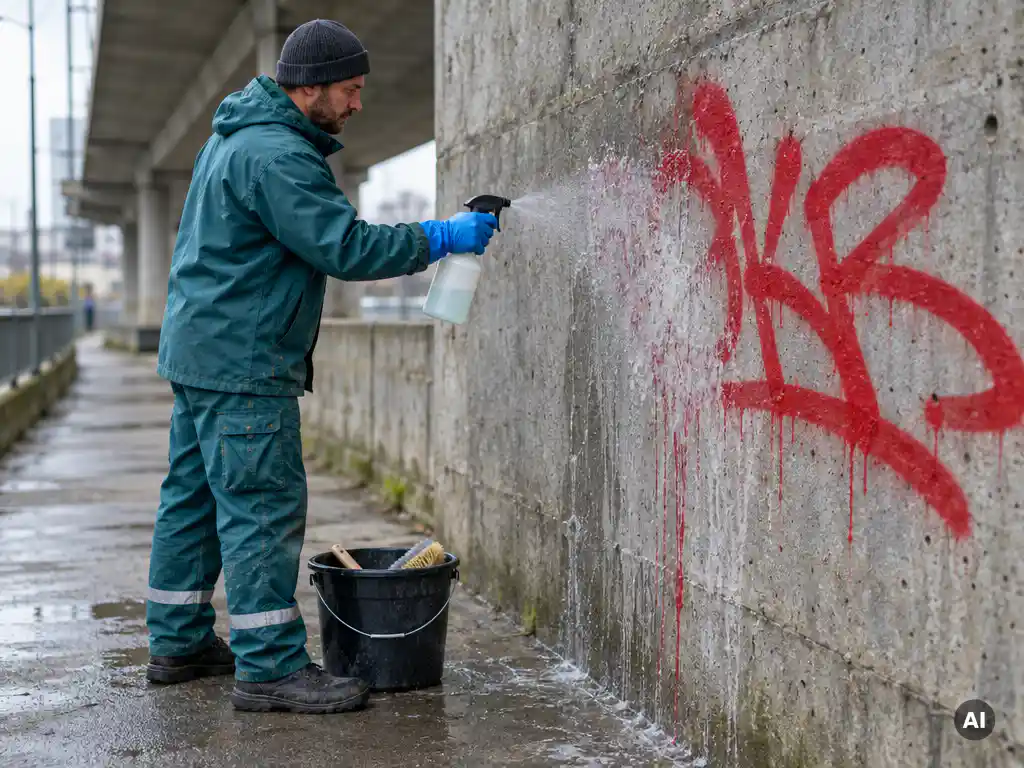
A graffiti remover is a product specifically developed to chemically loosen paint, ink or other graffiti layers from a surface. A regular cleaner removes dirt, deposits or surface contamination, but lacks the chemical strength to break down graffiti layers that have penetrated the material. The difference lies in the formulation and the purpose: a graffiti remover dissolves the bond between the graffiti layer and the substrate, whereas a cleaner removes surface dirt. In practice, the nature of the contamination determines which product you need. Below, we answer the most frequently asked questions about this distinction.
When do you use a graffiti remover and when a cleaner?
You use a graffiti remover when paint, ink, stickers or other graffiti layers have been applied to a surface and need to be removed chemically. You use a cleaner to remove surface dirt such as soot, grease, algae or deposits. The distinction is simple: if it involves applied graffiti layers, you need a graffiti remover.
In practice, specialists regularly see a regular cleaner being used on graffiti, with the result that the paint fades but does not disappear completely. This leaves behind what is known as a graffiti ghost. That ghost is not only visually disturbing, but can also be harder to treat than the original graffiti. Removing graffiti ghosts requires a specific approach and sometimes additional products.
Conversely, a graffiti remover is not intended as a replacement for a cleaner for everyday maintenance. Its chemical action is too targeted and too intensive for regular cleaning tasks. Use the right product for the right purpose.
How does a graffiti remover work chemically?
A graffiti remover works by chemically breaking the bond between the graffiti layer and the substrate. The active components in the product penetrate the paint layer, dissolve the binding molecules and detach the graffiti layer from the surface. This is a fundamentally different mechanism from removing dirt mechanically or physically.
Many professional graffiti removers are formulated as a gel. This gel form has a practical advantage: the product stays in place on the treated area and does not run off vertical or sloping surfaces. This ensures an even reaction across the entire treated surface. Specialists apply the product undiluted, let it work, and then remove the loosened graffiti layer.
The exact chemical composition differs per product and per manufacturer. Always consult the product data sheet and label for the specific action, required protective equipment and application instructions of the product you are using.
Does the type of surface make a difference when choosing a product?
Yes, the type of surface is a determining factor when choosing a graffiti remover. Not every product is suitable for every surface. Porous materials such as concrete, brickwork and natural stone absorb graffiti layers differently from non-porous materials such as glass, metal or ceramics, and therefore require a product that is matched to them.
Extra caution is needed with natural stone. Granite, for example, is a natural stone, but not every type of natural stone reacts the same way to chemical cleaning products. Some types of stone are sensitive to acids or strongly alkaline agents. It is important to know which material you are working with before you choose and apply a graffiti remover.
Professional graffiti removers are often formulated for use on both porous and non-porous surfaces. Even so, the rule always applies: test the product first on an inconspicuous spot and consult the product data sheet for the list of suitable surfaces. Leave doubtful cases to specialists who can substantiate the right product choice.
What are the risks of using the wrong product?
Using the wrong product can lead to damage to the surface, incomplete removal of the graffiti or a graffiti ghost being left behind. In the worst case, an unsuitable product attacks the surface itself, leading to discoloration, leaching or surface damage that is costly to repair.
A regular cleaner used on graffiti will rarely remove the paint layer completely. The result is a faint discoloration that sits deeper in the pores of the material and is harder to treat than the original graffiti. This problem occurs particularly on porous surfaces such as concrete and untreated brickwork.
Conversely, an overly aggressive graffiti remover can cause damage to sensitive materials. Think of discoloration of natural stone or damage to coatings and finishing layers. Always use a product that is specifically approved for the surface in question and follow the instructions on the product data sheet strictly. If in doubt, it is wise to call in a specialist, especially for graffiti on buildings with special facade materials.
What role does an anti-graffiti coating play in all of this?
An anti-graffiti coating protects the surface so that graffiti penetrates less deeply and is easier to remove. The coating forms a barrier between the substrate and the graffiti layer. This makes future removal more effective and protects the underlying material from chemical stress during repeated cleanings.
There are two main types of anti-graffiti coatings that you encounter in practice:
- Semi-permanent coating: This coating disappears together with the graffiti during removal and must be reapplied after every treatment. It is a deliberate choice for locations where graffiti occurs regularly and where the coating acts as a sacrificial layer.
- Permanent coating: This withstands multiple cleaning cycles. The exact number differs per system. After a period of time, generally a maximum of ten years, even a permanent coating must be renewed or reapplied.
In addition, there is a category of impregnating agents with anti-graffiti properties. These penetrate the substrate and give the material a certain degree of protection, without forming a visible film layer on the surface. Consult the product data sheet for the specific properties and areas of application of the chosen system. At locations such as public transport, an anti-graffiti coating is often a standard part of the maintenance concept.
How we help with graffiti removal
We develop and produce professional graffiti removers for specialists who deal with graffiti problems every day on a wide variety of surfaces and objects. Our products are aimed at effective removal without unnecessary damage to the substrate. This is what we offer:
- Graffiti removers in gel form, suitable for both porous and non-porous surfaces
- Products that are applied undiluted for a controlled and targeted action
- Anti-graffiti coatings, both semi-permanent and permanent, matched to the type of surface and the frequency of use
- Technical advice and product support for specialists and professional clients
- Guidance on product selection based on the specific situation, the material and the degree of contamination
Would you like to know which product best suits your situation? Contact us via our contact form or call +31 (0) 418 680 680 directly. Our specialists are happy to think along with you.