
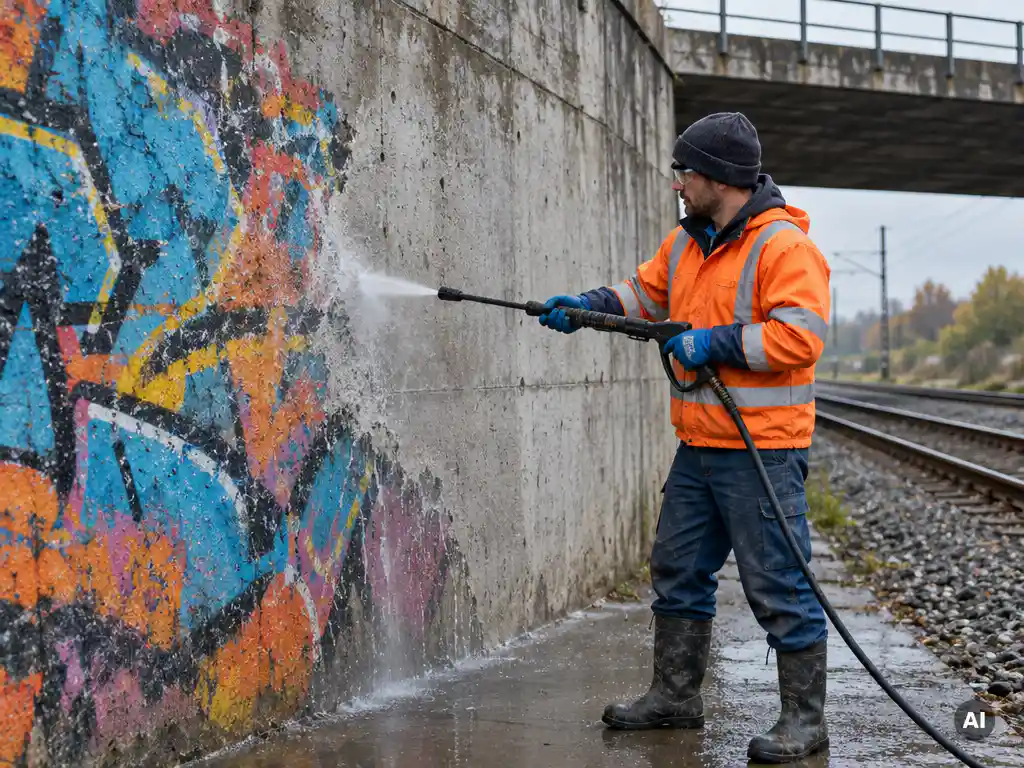
A graffiti remover plays a concrete and practical role in infrastructure maintenance: it makes it possible to remove graffiti promptly and completely, limiting damage to the substrate and keeping the object in good condition. For professional managers of buildings, public transport and public spaces, this is not an occasional measure, but a recurring part of a broader maintenance process. The following questions go into more depth on the practical application, the limitations and the structural integration of graffiti removal.
What are the consequences of untreated graffiti on infrastructure?
Untreated graffiti not only detracts from the appearance of infrastructure, but can also damage the substrate. With prolonged exposure, paint compounds penetrate deeper into porous materials, making removal more complex and more costly. In addition, visible graffiti increases the likelihood of further vandalism: dirty objects attract new graffiti more often than well-maintained surfaces.
For managers of public infrastructure, housing associations and municipalities, this has direct consequences. The longer graffiti remains on a substrate, the harder it becomes to remove. On porous materials such as concrete, brickwork or natural stone, paint soaks into the pores of the material. On metal or coated surfaces, the underlying finish can be damaged by the chemical compounds in the paint. In both cases, cleaning costs rise the longer the response time. Timely use of a professional graffiti remover prevents a simple cleaning job from growing into a costly restoration operation.
How does a professional graffiti remover work on different substrates?
A professional graffiti remover dissolves the bond between the graffiti paint layer and the substrate, so that the paint can be removed without damaging the underlying structure. How it works differs per type of substrate and per formulation. Gel-based products are particularly suitable for vertical surfaces and porous materials, because they stay in contact with the surface for longer.
On non-porous substrates such as glass, ceramics and metal, removal is generally easier: the paint adheres less deeply and the cleaner can dissolve the graffiti effectively. On porous materials, such as concrete, brickwork and certain types of natural stone, the application requires more attention. Not every type of natural stone reacts the same way to cleaning agents, and it is important that specialists choose the right product based on the specific substrate and the type of graffiti. Gel products are applied undiluted and offer more contact time on vertical or textured surfaces. Always consult the product data sheet and label for the correct application and safety measures. You can find more information about the available professional graffiti removers in our product overview.
We’ll figure it out for you!
Want to talk through your challenge?
Our advisors will be happy to help you find a practical solution.
When is a graffiti remover alone not enough?
A graffiti remover is not always sufficient if the paint has penetrated deep into the substrate, if the substrate is already damaged or if no protective coating is present. In those cases, additional treatment or restoration of the surface is needed alongside the cleaning.
This occurs with graffiti that has been left untreated for a long time on porous substrates. The paint compounds have then soaked in so deeply that cleaning alone does not give a complete result. On sensitive substrates too, such as certain types of natural stone or historic brickwork, the cleaning step may be insufficient without prior material testing. Furthermore, repeated graffiti damage on unprotected surfaces can, over time, weaken the structure of the material. In such situations, it is advisable to apply an anti-graffiti coating after cleaning, so that future removal is easier and the substrate is better protected. For specific applications, such as removing graffiti from buildings, additional steps are sometimes necessary.
What is the difference between a permanent and a sacrificial coating for graffiti protection?
The main difference is the lifespan of the coating after graffiti removal. A sacrificial coating (also called a semi-permanent coating) is removed together with the graffiti and must then be reapplied. A permanent anti-graffiti coating withstands multiple cleaning cycles; the exact number differs per system.
With a semi-permanent coating, the system is simple and relatively inexpensive to purchase, but the recurring reapplication requires structural maintenance and increases management costs in the longer term. This system is suitable for locations with occasional graffiti damage.
A permanent coating, such as an impregnating agent with anti-graffiti properties, offers longer-lasting protection and is better suited to objects that are regularly targeted, such as tunnel walls, viaducts or rolling stock. A permanent coating can also take over the function of facade impregnation, which means that a separate impregnation treatment is not standard in that case. The lifespan of anti-graffiti coatings is generally up to ten years, unless product-specific information states otherwise. Specialists determine which system is appropriate based on the substrate, the degree of damage and the desired maintenance frequency. For public transport applications, see also our information on removing graffiti in public transport.
How do you integrate graffiti removal into a structural maintenance plan?
You integrate graffiti removal into a structural maintenance plan by including it as a fixed inspection and cleaning task, linked to clear response times, the right product choice per location and a well-considered choice of protective coatings. This prevents graffiti from accumulating and removal from becoming ever more complex.
A good maintenance plan describes, per object or location, which type of substrate is present, which graffiti remover is suitable for it and how quickly a response is needed after an incident. A fast response reduces the risk of deep paint penetration and limits the cleaning effort. In addition, the plan makes clear whether and which protective coating needs to be reapplied after cleaning.
For managers of large assets, such as municipal infrastructure or housing associations with multiple properties, it makes sense to standardize cleaning protocols and to engage specialists who are familiar with the specific substrates and products. This keeps the quality of execution assured and makes costs easier to control. When graffiti also leaves ghosting after cleaning, additional treatment is sometimes needed. You can read more about this in our information on removing graffiti ghosting.
How we help with professional graffiti removal
We develop and produce professional graffiti removers for specialists working on buildings, infrastructure and rolling stock. Our range offers concrete solutions for the challenges discussed in this article:
- Gel-based graffiti removers for use on both porous and non-porous substrates, applied undiluted
- Permanent anti-graffiti coatings that withstand multiple cleaning cycles and offer long-lasting protection
- Semi-permanent systems for locations with occasional damage
- Product data sheets and technical support per product, so that specialists can always make the right choice for the specific substrate and situation
Want to know which products best suit your maintenance situation? Then get in touch via our contact form or call directly on +31 (0) 418 680 680. We’re happy to think along with you.