
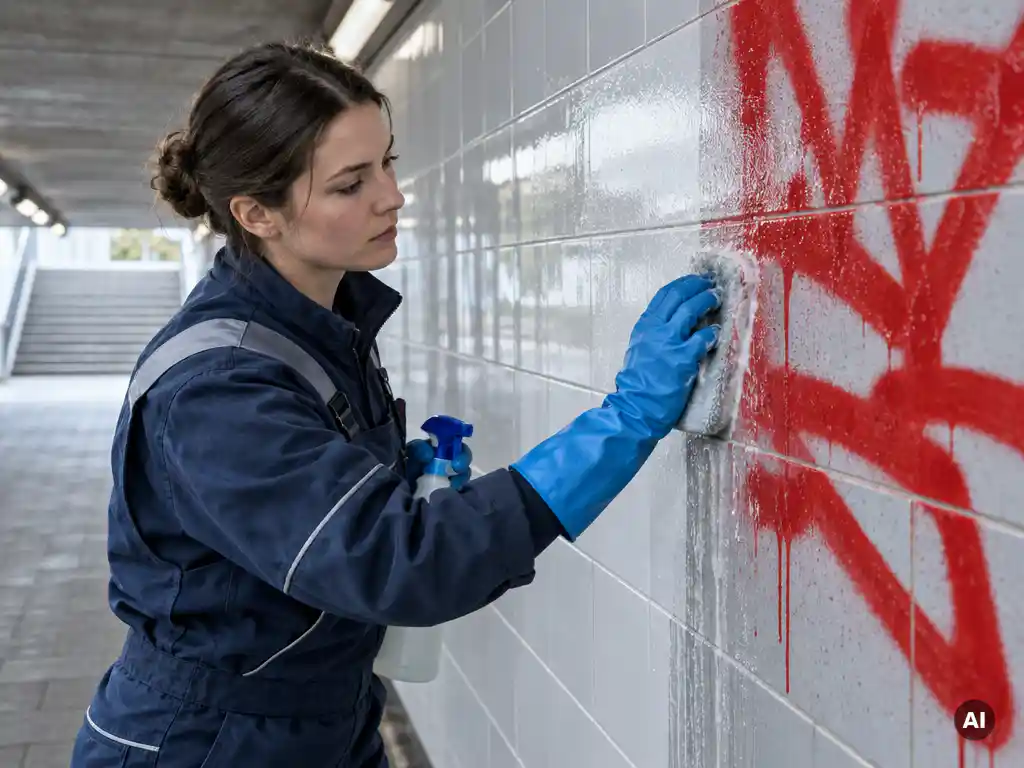
Removing graffiti from non-porous surfaces works differently than from porous substrates: paint or ink barely penetrates the material, but instead bonds to the smooth surface. That is why choosing the right graffiti remover and the right working method is decisive for a clean result without damage. In this article, we answer the most frequently asked questions about removing graffiti from smooth surfaces.
Why does graffiti adhere differently to non-porous surfaces?
On non-porous surfaces such as glass, metal, ceramic tiles, and glazed stone, paint or ink cannot soak into the material. Graffiti adheres exclusively to the outer layer of the surface. That may sound like an advantage, but it also means the paint layer sits on the smooth substrate like a tough film, which places different demands on the cleaning agent and the technique.
On porous substrates such as untreated concrete or brick, the paint soaks deep into the pores, so a graffiti remover has to work for a long time to loosen the paint from the inside out. On smooth surfaces, the aim is to chemically break down the bond between the paint film and the material surface. An agent that is too aggressive can damage the top layer of the material, while an agent that is too weak leaves the paint film intact.
Which chemical products work on non-porous substrates?
On non-porous substrates, solvent-rich or specifically formulated gel cleaning agents work best. A gel graffiti remover is particularly well suited to smooth surfaces: the gel stays in place on the vertical or smooth surface, so the active components make sufficient contact with the paint layer without running off immediately.
Products such as the GraffitiRemover Gel have been developed to dissolve virtually all types of graffiti and inks. They are applied undiluted and are suitable for use on metal, glass, and ceramic material, among others. Always consult the product data sheet and the label for the correct application on a specific substrate, because not every product is suitable for every material.
What you want to avoid on non-porous surfaces are strongly acidic or strongly alkaline agents without product-specific backing for that substrate. Some types of metal and coated surfaces are sensitive to certain chemical components, which can cause the top layer to discolor or become matte.
We’ll figure it out for you!
Want to talk through your challenge?
Our advisors will be happy to help you find a practical solution.
How do you remove graffiti from non-porous surfaces step by step?
Removing graffiti from non-porous surfaces consists of a number of fixed steps: applying the cleaning agent, letting it work, mechanically loosening the paint, and rinsing. By following this order, you increase the chance of a completely clean result without damaging the underlying material.
- Assess the substrate and the graffiti. Determine which material is involved (metal, glass, ceramic) and which type of graffiti has been applied (spray can, marker, ink). This determines which product and which working method you use.
- Apply the graffiti remover undiluted. Use a brush, spatula, or spray bottle to apply the product in an even layer over the graffiti. Make sure there is full contact between the product and the paint layer.
- Let the product work. The dwell time differs per product and per type of graffiti. Consult the product data sheet for the specific dwell time. Do not remove the product too early.
- Rub or scrape the paint film loose. Use a soft brush or a plastic scraper to remove the softened paint. On sensitive surfaces such as glass or polished metal, caution is required to avoid scratches.
- Rinse thoroughly with water. Remove all residues of the cleaning agent and the softened paint. Check that the surface is completely clean and repeat the treatment if necessary.
For larger objects or hard-to-reach locations, such as graffiti on public transport vehicles, professional execution by specialists is recommended.
What are the risks of using the wrong removal methods on smooth surfaces?
Using the wrong graffiti remover or an incorrect technique on non-porous surfaces can lead to visible damage: discoloration, matte patches, scratches, or damage to coatings and paint layers. Because smooth surfaces have no pores to hide damage, any damage to the top layer is immediately visible.
Common mistakes include:
- Using abrasive cleaning agents or steel wool on glass or polished metal, which causes scratches.
- Applying a product that is not suitable for the specific substrate, which damages the top layer or paint.
- Letting the product work for too long without consulting the product data sheet, which can cause the product to damage the material.
- Insufficient rinsing, leaving residues of the cleaning agent behind that can damage the surface.
Another risk is a so-called graffiti ghost: a faint discoloration that remains after the graffiti has been removed. This occurs more often with dark or deeply pigmented graffiti and on surfaces that are already slightly weathered. Specialists have additional techniques and products to treat this.
When does an anti-graffiti coating make sense after removal?
An anti-graffiti coating makes sense when a surface is regularly targeted by graffiti, or when you want to make future removal easier and less stressful on the material. By applying a coating after cleaning, you prevent new graffiti from bonding directly to the material.
There are two main types relevant to non-porous surfaces:
- Semi-permanent anti-graffiti coatings: These disappear during graffiti removal and must be reapplied after every treatment. They are suitable for locations where graffiti occurs only occasionally.
- Permanent anti-graffiti coatings: These withstand multiple cleaning cycles; the exact number differs per system. They are suitable for objects that are structurally targeted, such as infrastructure and vehicles.
Consult a specialist to determine which system suits the specific substrate and the frequency of graffiti at the location. Not every coating system is suitable for every material, and the choice directly affects effectiveness during future removal.
How we help with graffiti removal on non-porous surfaces
We develop and produce professional graffiti removers tailored specifically to the requirements of specialists in construction, infrastructure, and facility services. Specifically, we offer:
- Gel graffiti removers, applicable undiluted on non-porous substrates such as metal, glass, and ceramic.
- Products that dissolve virtually all types of graffiti and inks without damaging the underlying substrate, provided they are applied correctly.
- Anti-graffiti coatings, both semi-permanent and permanent, tailored to the type of object and frequency of use.
- Technical advice and product support, so specialists use the right product for the right substrate.
View our full range for buildings and facades or contact us directly for tailored advice. Call us on +31 (0) 418 680 680 or send a message via our contact form.