
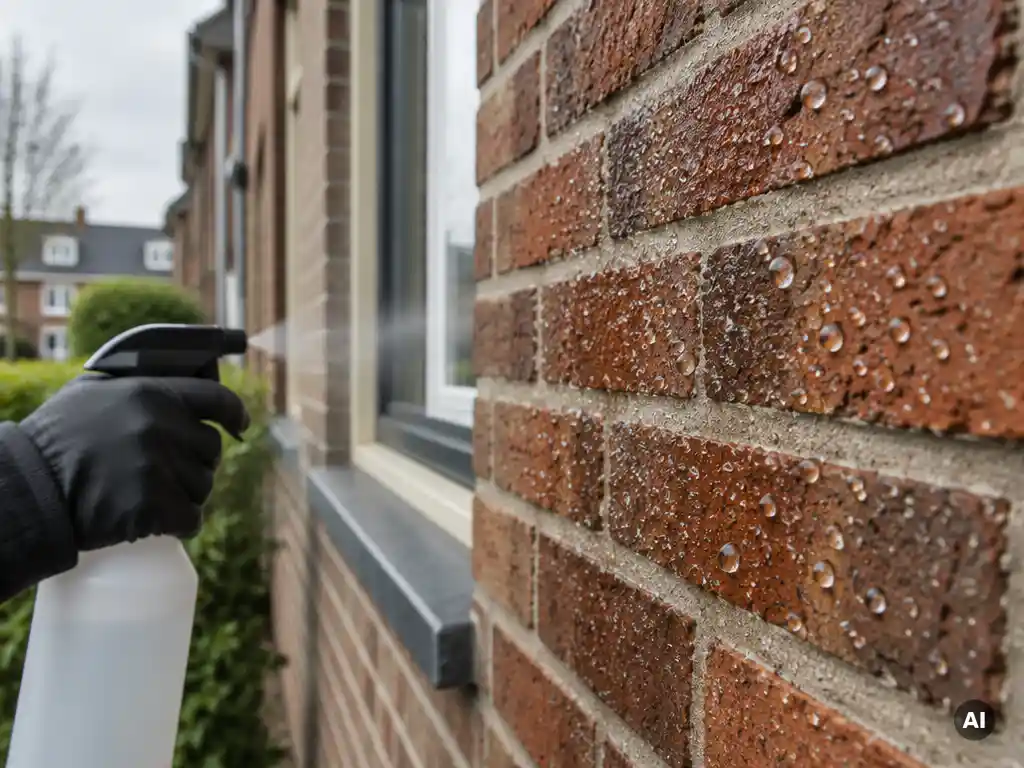
A façade is sufficiently impregnated when water beads up on it as droplets without soaking in. The most reliable way to check this is the water droplet test: apply a small amount of water to the surface and see whether it beads and runs off. If the water soaks in, the impregnation has worn off or was not applied properly. Below, we answer the most frequently asked questions about testing façade impregnation.
How does façade impregnation work and what does it do to stone?
Façade impregnation penetrates deep into the porous material of a façade and makes the substrate water-repellent without blocking vapor permeability. The active ingredients, usually a combination of alkylsilanes and (poly)siloxanes, react chemically with the substrate and form a hydrophobic barrier inside the material. As a result, rainwater no longer soaks in but beads off instead.
This has a direct impact on the durability of the façade. Moisture is one of the main causes of damage: it causes frost damage, promotes algae and moss growth, and accelerates the weathering of joints and masonry materials. By keeping the moisture content in the substrate low, good impregnation protects the structure from the inside out. At the same time, the façade remains vapor-permeable, which means that moisture reaching the wall from the inside can still escape. That is what distinguishes an impregnating agent from a coating, which seals the surface.
The lifespan of façade impregnation is generally up to ten years, depending on the product used, the substrate, and the weather conditions the façade is exposed to. Regular checks are therefore worthwhile.
What is the water droplet test and how do you perform it?
The water droplet test is the simplest way to check whether a façade impregnation is still active. Throw or sprinkle a small amount of water onto the façade surface and observe what happens. Does the water bead up as droplets and run off without soaking in? Then the impregnation is working. Does the water soak in immediately and does the stone turn dark? Then retreatment is needed.
Perform the test at several spots on the façade, because impregnation does not wear off at the same rate everywhere. Areas that are heavily exposed to rain, wind, or direct sunlight lose their effectiveness sooner than sheltered zones. Preferably test on a dry surface and at a temperature at which the water does not evaporate immediately, as this can give a false positive result.
Also pay attention to the reaction speed. Water that first hesitates and then soaks in anyway indicates impregnation that is nearly worn out. Fully beading behavior is the only reliable sign of active protection.
What other methods exist for checking impregnation?
In addition to the water droplet test, there are supplementary methods for assessing the condition of a façade impregnation. They are particularly useful when the water droplet test gives mixed results or when you want to carry out a thorough inspection ahead of a maintenance program.
- Visual inspection: Look at the façade after a rain shower. A properly impregnated façade dries quickly and shows no dark patches of moisture. A façade that stays wet for a long time or dries unevenly indicates that the impregnation has worn off in places.
- Moisture measurement: Specialists can use a moisture meter to measure the moisture content of the substrate. A high moisture content in the upper layers of the brickwork or stone indicates insufficient water repellency.
- Surface comparison: Compare treated and untreated zones of the same façade. Are there clear differences in color or drying visible? Then that tells you which zones lack protection.
For a professional inspection of larger façades, or when in doubt about the cause of moisture problems, an on-site assessment by a specialist is the most reliable approach.
When is a façade due for retreatment?
A façade is due for retreatment when the water droplet test shows that water no longer beads off, or when a visual inspection after rain shows that the surface stays wet for a long time. As a rule of thumb, façade impregnation generally remains effective for up to ten years, but this varies greatly by product, substrate, and exposure.
Factors that shorten the lifespan more quickly include:
- Intensive exposure to rain and wind
- Strong temperature fluctuations, particularly freeze-thaw cycles
- Pollution from exhaust fumes, dust, or biological growth
- Mechanical damage to the surface, such as sanding or aggressive cleaning
It is worthwhile not to wait until visible damage occurs. Retreatment is easier and cheaper than repairing frost damage or washed-out joints. Preferably schedule an inspection every three to five years, depending on the location and the type of façade material.
What are common mistakes when testing façade impregnation?
One of the most common mistakes is performing the water droplet test on a wet or recently dampened façade. Water applied to a wet surface can sometimes appear to bead off even though the impregnation has actually worn out. Always test on a dry, clean surface for reliable results.
Other mistakes that distort the picture:
- Testing in one spot only: Impregnation wears unevenly. If you only test the sheltered side of the façade, you may miss problems in the most exposed zones.
- Drawing conclusions too quickly: Water that stays put for a moment before soaking in is sometimes wrongly judged as “good”. True beading behavior is visible immediately.
- Skipping façade cleaning before retreatment: A new impregnation on a dirty façade adheres poorly. Façade cleaning is a necessary step before retreatment, not an optional one.
- Wrong product choice: Not every impregnating agent is suitable for every façade material. Applying a product to an unsuitable substrate leads to an unreliable test result at the next inspection.
Should you call in a professional to test façade impregnation?
For a simple water droplet test, you do not need a specialist. You can perform that test yourself in a few minutes. But for a full assessment of the façade’s condition, the selection of the right impregnating agent, and the professional execution of the treatment, calling in specialists is strongly recommended.
Specialists assess not only whether the impregnation has worn off, but also why. They look at moisture content, the condition of the joints, and the façade material, and assess whether other problems, such as cracks or biological growth, need to be addressed first. That prevents you from applying a new impregnation to a substrate that is not yet suitable for it.
For larger properties, such as apartment complexes, office buildings, or historic buildings, professional advice is not only useful but also relevant from the standpoint of long-term maintenance and cost control.
How Mavro helps with façade impregnation and protection
We offer professional solutions for cleaning, impregnating, and protecting façades, tailored to the specific requirements of the substrate and the application. Our products are developed for use by specialists in construction, property management, and facility services.
What we offer for façade impregnation and protection:
- Impregnating agents based on alkylsilanes and (poly)siloxanes for water-repellent protection of porous substrates
- Semi-permanent and permanent coatings such as Nitowax, Nitoshield, and Nitocryl® for non-porous façade cladding and window frames
- Color-restoring protective coatings such as Nitocolour, with a lifespan of generally up to ten years
- Professional façade cleaners as preparation for impregnation or coating
- Technical advice and support with product selection and application
Want to know which product best suits your façade or project? Get in touch or call us directly on +31 (0) 418 680 680. We would be happy to think along with you.