
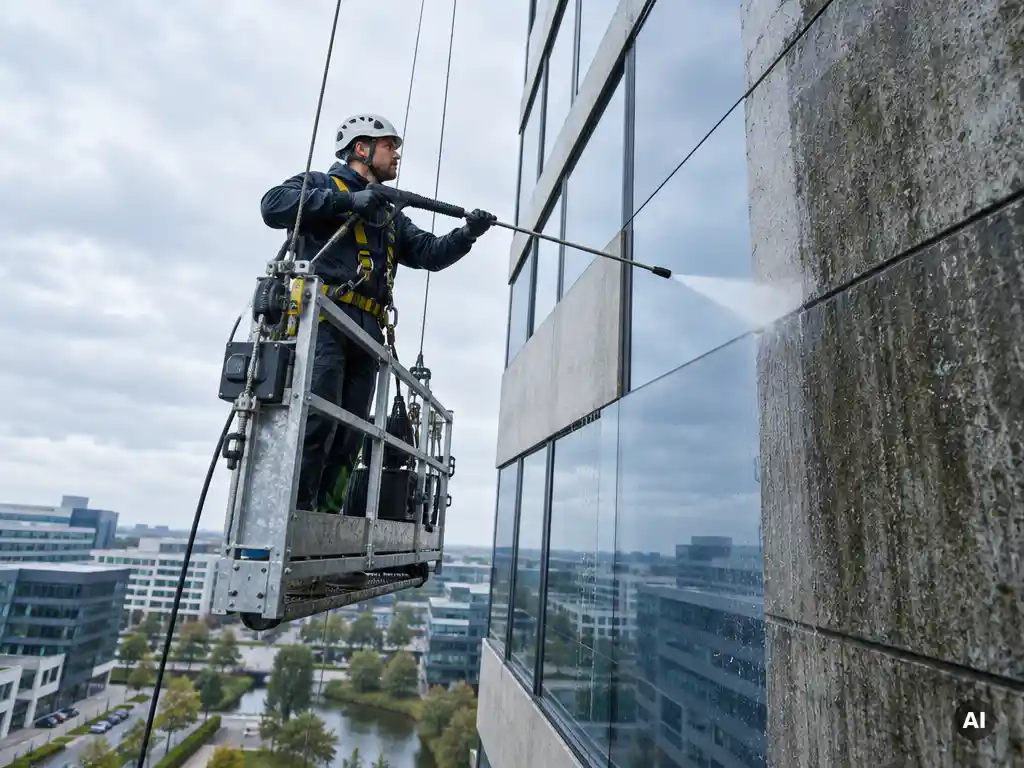
For commercial real estate, professional facade cleaning is important to protect the appearance, value and lifespan of the property. Dirt, biological growth and pollution attack facade materials and create a neglected impression, something business tenants, customers and visitors notice immediately. In this article we answer the most frequently asked questions about facade cleaning for commercial real estate: from common types of contamination and cleaning methods to choosing a suitable product and the benefits of facade protection after cleaning.
Which types of contamination are most common on commercial building facades?
On commercial building facades, biological growth, atmospheric pollution and graffiti are the most common problems. Biological growth such as algae, moss and lichen occurs on facades that receive little sunlight or stay damp. Atmospheric dirt consists of particulate matter, soot and oily compounds from traffic and industry.
In addition to these two main categories, the following types of contamination are frequently found on commercial facades:
- Graffiti and vandalism marks on facades along busy streets or in urban environments
- Efflorescence on concrete and brickwork, caused by moisture transporting salts to the surface
- Rust streaks from metal fixings or gutters
- Oil stains and deposits near loading docks or parking garages
The type of contamination determines which cleaning method and which product you use. The wrong approach can damage the facade material instead of cleaning it.
Which cleaning methods are used for facade cleaning?
The most commonly used methods for professional facade cleaning are high-pressure cleaning, chemical cleaning and a combination of both. The choice depends on the facade material, the nature of the contamination and the condition of the surface. Not every method is suitable for every material.
High-pressure cleaning
High-pressure cleaning effectively removes loose dirt, biological growth and surface soiling. Specialists use this method on sturdy substrates such as concrete and fired brick. On porous or fragile facade materials, caution is required: excessive pressure can damage the surface or force water into the structure.
Chemical cleaning
Chemical cleaning agents dissolve specific contamination that water alone cannot remove, such as biological growth, rust streaks or efflorescence. Specialists choose the product based on the facade material and the contamination. Acidic agents act differently on limestone than on concrete; alkaline agents are better suited to grease and oil contamination. Always consult the product data sheet for the correct application.
How often should a commercial facade be professionally cleaned?
There is no universal cleaning frequency that applies to every commercial property. The required frequency depends on the location, the facade material, the degree of exposure to pollution and the presence of a protective coating. Facades in urban environments or near busy arterial roads become dirty faster than facades on industrial estates or in rural areas.
As a guideline, specialists in commercial real estate recommend an inspection at least once a year. Based on that inspection, you determine whether cleaning is necessary. Facades with a protective impregnation or coating are generally easier to clean and require less frequent intervention, because dirt adheres less readily to the treated surface.
What are the risks of improper facade cleaning?
Improper facade cleaning can structurally damage the facade material, disrupt the facade’s moisture balance and shorten the lifespan of the property. These are real risks that also have financial consequences for commercial real estate.
The most common mistakes and their consequences are:
- Wrong product for the facade material: an acidic cleaning agent on limestone or marble can attack and discolor the surface
- Water pressure that is too high: damages the pointing mortar and drives moisture deep into the structure
- Insufficient rinsing: chemical residues remain and gradually attack the surface
- Cleaning in unfavorable conditions: in frost or direct sunlight, a cleaning agent dries too quickly, causing stains
Always have facade cleaning carried out by specialists who choose the right products and methods based on the facade material and the contamination. Consult the product data sheet and label for the correct procedure.
When is a facade coating worthwhile after cleaning?
A facade coating or impregnation is worthwhile after cleaning when the facade material is porous, when the facade regularly deals with moisture, biological growth or pollution, or when you want to reduce cleaning frequency and maintenance costs. A treatment protects the surface and prolongs the effect of the cleaning.
There are two main categories for facade protection:
- Facade impregnation: penetrates the substrate and makes the surface water-repellent without changing its appearance. Products based on a combination of alkylsilanes and (poly)siloxanes are suitable for this. Facade impregnation is particularly useful for porous substrates such as brick and concrete.
- Facade coating: applies a protective layer to the surface, suitable for non-porous facade cladding and window frames. Semi-permanent and permanent coatings offer varying levels of protection and a lifespan of generally up to ten years, depending on the system.
Do not combine facade impregnation and anti-graffiti coating as a matter of course. Anti-graffiti coatings can take over the function of an impregnation; consult a specialist for the right choice in each situation.
What should you look for when choosing a facade cleaning product?
When choosing a facade cleaning product, the facade material, the nature of the contamination and the condition of the surface are the determining factors. A product that works well on concrete is not necessarily suitable for natural stone. Granite is a type of natural stone, but not every natural stone reacts the same way to acids or alkaline agents.
Pay attention to the following points when choosing a product:
- Suitability for the facade material: check whether the product is suitable for the specific substrate
- Specificity for the contamination: choose a product aimed at the type of dirt, such as biological growth, rust or efflorescence
- Product data sheet and label: always consult these for the correct application, dilution and safety measures
- Professional application: some products require specific knowledge or equipment for a correct result
For graffiti removal, specialists apply the dedicated removers undiluted. Consult the product data sheet for the right product choice or ask a specialist for advice.
How Mavro helps with facade cleaning and protection
We develop and produce professional products for facade cleaning and facade protection, tailored to the requirements of commercial real estate. Our range offers solutions for a wide variety of situations:
- Cleaning products aimed at specific contamination such as biological growth, rust, efflorescence and graffiti
- Graffiti removers for professional application on facades
- Coatings for non-porous facade cladding and window frames, including semi-permanent and permanent systems such as Nitowax, Nitoshield, Nitocryl® and Nitocolour
- Facade impregnation for porous substrates, based on alkylsilanes and (poly)siloxanes
All products are developed for professional application and are backed by technical advice. Would you like to know which product best suits your facade and situation? Contact us or call directly on +31 (0) 418 680 680.