
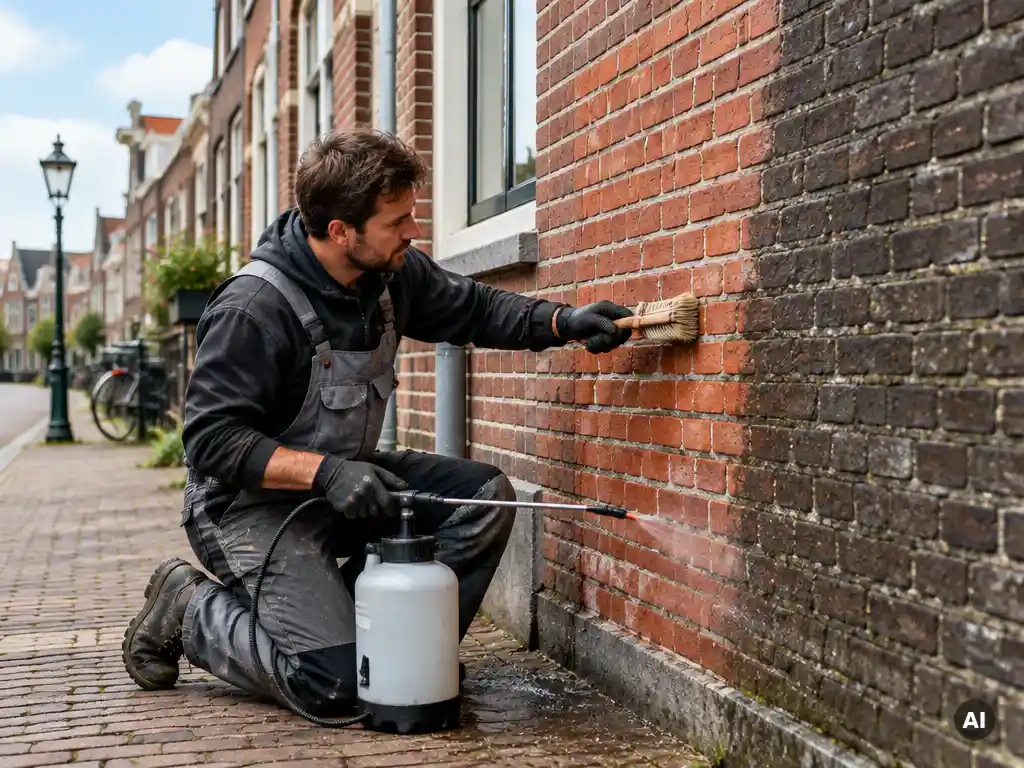
Contractors choose professional facade cleaning products because consumer products simply do not offer the cleaning power, material compatibility or technical specificity that professional facade projects require. The right product choice determines not only the cleaning result, but also the long-term condition of the facade material. In this article, we answer the most frequently asked questions about facade cleaning for professional applications.
What results do professional facade cleaning products deliver?
Professional facade cleaning products deliver a thorough, material-safe result that standard consumer cleaning agents cannot match. They completely remove growth, dirt and deposits without damaging the underlying material, and they restore the visual appearance of a facade in a way that remains visible in the long term.
The difference lies in the formulation. Professional products are developed for specific types of contamination and substrates, which makes them more targeted and effective. A specialist who applies a professional facade cleaning product achieves an even result across the entire facade surface, without staining, residues or damage to joints, coatings or finishing layers.
In addition, professional products offer reproducibility: the same product delivers the same result time after time under comparable conditions. This is an important advantage for contractors and maintenance companies, especially for large-scale projects or recurring maintenance assignments.
Which types of contamination require a specialized facade cleaner?
Not every type of dirt calls for the same cleaning agent. Specialized facade cleaning products are needed for contamination that is chemically bonded to the surface or has penetrated deeper into the material, such as biological growth, efflorescence, rust, graffiti and industrial deposits.
- Biological growth: Algae, moss and fungi attach themselves to porous substrates and require a biocidal action that standard cleaning agents do not provide.
- Efflorescence and salt deposits: These mineral deposits are alkaline in nature and call for an acid-based cleaning agent that is compatible with the facade material.
- Rust and metal stains: Rust streaks from fasteners or gutters require a specific formulation that dissolves the iron oxide without damaging the substrate.
- Graffiti: Paint residues and markings call for a graffiti remover that is matched to the type of paint and the substrate. Our graffiti removers are applied undiluted.
- Industrial contamination: Soot, exhaust fumes and oily deposits adhere strongly to facade materials and require products with a high dissolving capacity for organic compounds.
Correctly identifying the type of contamination is the first step toward effective facade cleaning. The wrong product choice can make the problem worse or damage the material.
We’ll figure it out for you!
Want to talk through your challenge?
Our advisors will gladly help you find a practical solution.
How do you choose the right facade cleaning product for the material?
You choose the right facade cleaning product based on two factors: the nature of the contamination and the type of underlying facade material. Every material has a specific chemical sensitivity, and a product that works excellently on concrete can cause damage to natural stone or aluminum.
Concrete and mineral substrates generally tolerate both acidic and alkaline cleaning agents, depending on the type of contamination. Natural stone calls for extra caution: limestone and marble are sensitive to acids, while other types of stone such as granite may react differently. Not every natural stone reacts the same way to the same chemical agents, which makes a product-specific assessment by a specialist necessary.
Facade cladding made of plastic, aluminum or painted substrates requires products with a neutral pH or a specific formulation that does not damage the finishing layer. Always consult the product data sheet and test the product on an inconspicuous spot before applying it to the entire facade surface. For correct application, refer to the label and the technical documentation of the product in question.
What is the difference between facade cleaning and facade impregnation?
Facade cleaning removes contamination from the surface of a facade. Facade impregnation is a follow-up step in which a protective substance penetrates the pores of the material to make it water-repellent and protect it against new contamination and moisture penetration. They are two separate processes with different purposes.
Facade impregnation generally uses combinations of alkylsilanes and (poly)siloxanes. These components penetrate deep into the pores of the material and form a water-repellent barrier without visibly changing the appearance of the facade. A good impregnation typically has a service life of up to ten years, depending on the system used and exposure to weather conditions.
It is important to know that anti-graffiti coatings can in some cases take over the function of facade impregnation. Therefore, do not recommend a combination of both systems as a default, but assess per situation which system is most suitable. Consult the product data sheet for the specific properties and application guidelines.
Why are consumer products not suitable for professional facade projects?
Consumer products are formulated for occasional use on light contamination by non-specialist users. They lack the chemical specificity, concentration and technical substantiation needed for professional facade projects, where the scale, the material and the nature of the contamination are considerably more complex.
In professional facade projects, several factors play a role that consumer products cannot handle:
- Concentration and cleaning power: Professional products contain higher concentrations of active components that effectively tackle deeper or more stubborn contamination.
- Material specificity: Professional facade cleaning products have been tested on specific substrates and contamination types, with documented results.
- Technical documentation: Every professional product is supplied with a product data sheet and safety data sheet, so that specialists can guarantee correct application.
- Scalability: Professional products are available in packaging sizes and concentrations suitable for large-scale use on construction projects.
Using an unsuitable product can lead to surface damage, discoloration or insufficient cleaning, which ultimately results in higher repair costs than if the right product had been used from the start.
Which environmental and safety standards apply to professional facade cleaners?
Professional facade cleaning products must comply with the applicable European regulations for chemical products, including the CLP Regulation on classification, labelling and packaging. This determines how hazardous properties are communicated via the label and the safety data sheet, which must be available to every professional user.
Specialists working with professional facade cleaning products must always consult the information on the product data sheet and the safety data sheet before application. These documents state the required personal protective equipment, the correct processing conditions and the instructions for safe use and disposal of residual products.
Do not make assumptions about the safety or risk profile of a product based on its name or appearance. The technical documentation is decisive. If in doubt, consult the supplier or the manufacturer for additional advice on correct application and safety measures.
How we help with professional facade cleaning and protection
We develop and produce professional facade cleaning and protection products for contractors, maintenance companies and other specialists carrying out demanding projects. Our range includes products for a wide variety of contamination types and facade materials, supported by technical documentation and expert advice.
- Facade cleaning products for specific contamination types and substrates
- Impregnating agents based on alkylsilanes and (poly)siloxanes for water-repellent treatment of porous facade materials
- Semi-permanent and permanent coatings for facade renovation and protection, such as Nitowax, Nitoshield, Nitocryl® and Nitocolour
- Graffiti removers for professional use, to be applied undiluted
- Technical support and training for the correct application of our products
Want to know which product best suits your project or material? Get in touch with us or call our specialists directly on +31 (0) 418 680 680.