
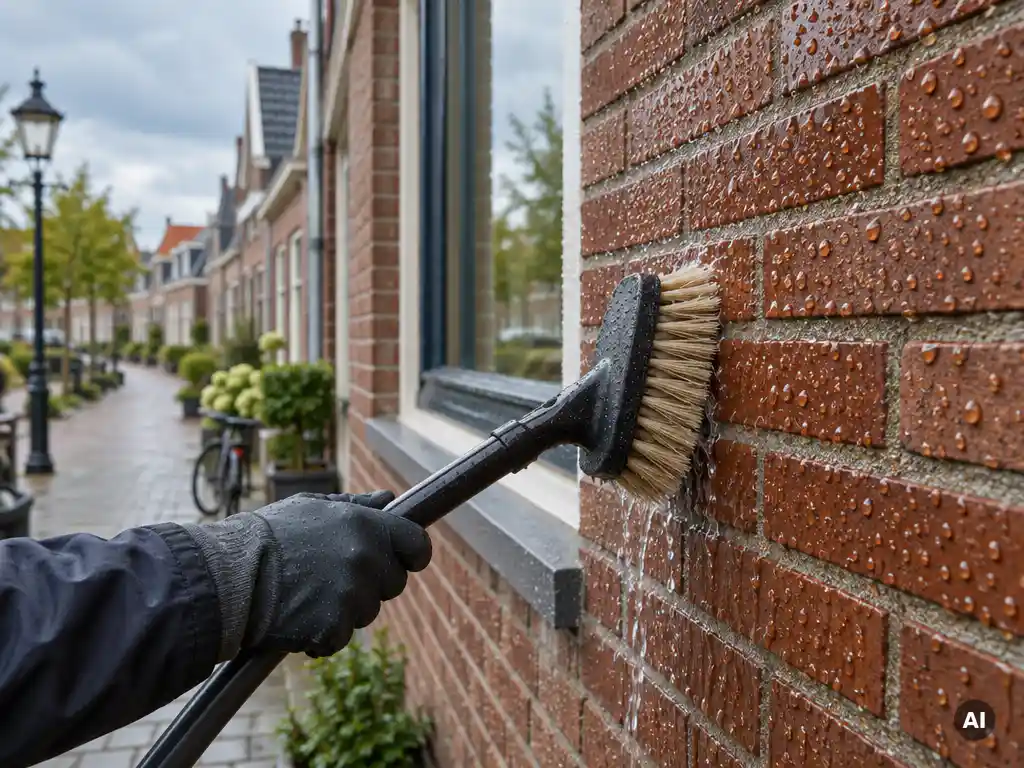
You maintain an impregnated facade over the long term through regular cleaning with suitable products, timely inspection for wear of the impregnation, and reassessment of the treatment when the water-repellent effect declines. Facade impregnation based on alkylsilanes and (poly)siloxanes penetrates deep into the substrate and protects from within, but its effectiveness decreases over time due to weathering, soiling and mechanical stress. The questions below help you determine, step by step, what your impregnated facade needs.
How long does facade impregnation last?
Facade impregnation based on alkylsilanes and (poly)siloxanes generally lasts up to ten years, depending on the substrate, the quality of the application and the degree of exposure to the weather. This is not a fixed guarantee, but a guideline that can vary from one situation to another.
Factors that influence its lifespan include the porosity of the substrate, the orientation of the facade in relation to the sun and precipitation, and the quality of the initial application. A facade that is heavily exposed to rain, wind and temperature fluctuations will show signs of wear sooner than a sheltered facade. Professional application by specialists, with the right product ratio and under the right conditions, contributes to a longer service life.
How do you know if an impregnated facade needs maintenance?
The clearest sign that an impregnated facade needs maintenance is the loss of its water-repellent effect. Water that no longer beads and runs off the facade but is absorbed straight into the substrate indicates that the impregnation has worn out or has declined significantly.
Besides how water behaves on the surface, there are other signs to watch for:
- Visible soiling that penetrates deeper into the substrate and is harder to remove than before
- Damp patches or dark discolorations after rainfall that remain visible for a long time
- Moss growth, algae formation or biological deposits in places that used to stay dry
- Surface damage such as cracks or erosion of the pointing that breach the protection
Carry out periodic visual inspections, preferably after the winter and after periods of heavy rainfall. This way you can recognize early on when action is needed, before moisture can cause damage to the structure.
We’ll figure it out for you!
Want to talk through your challenge?
Our advisors are happy to help you find a practical solution.
What type of cleaning is suitable for an impregnated facade?
For an impregnated facade, use cleaning products that do not damage the impregnation. Strongly alkaline or acidic products can reduce the effectiveness of the impregnation or damage the substrate. Always choose a cleaner that is suited to the type of facade material, and consult the product data sheet of the cleaning product.
When it comes to professional facade cleaning of impregnated facades, a number of principles apply:
- Do not use high-pressure cleaning with excessive pressure, as this can mechanically damage the impregnation
- Choose a cleaner that is suitable for the specific type of soiling, such as algae, limescale or rust, without damaging the substrate
- Always test the cleaning product first on an inconspicuous spot to check whether the material tolerates the cleaning
- Have the cleaning carried out by specialists who can determine the right method and products for your specific situation
For every application, consult the product data sheet and label of the cleaning product used.
How often should an impregnated facade be cleaned?
There is no universal cleaning frequency for impregnated facades. The required cleaning frequency depends on the location of the building, the degree of soiling and the type of facade material. Facades in urban environments or near busy roads become soiled faster than facades in quieter locations.
As a practical rule of thumb: clean the facade as soon as visible soiling appears that affects the appearance or function of the surface. Do not wait until soiling has penetrated deep into the substrate, because that makes cleaning more complex. A periodic inspection, combined with targeted cleaning based on the actual condition of the facade, is more effective than a fixed cleaning cycle that ignores the circumstances.
When should an impregnated facade be treated again?
An impregnated facade should be treated again when the water-repellent effect has demonstrably declined and cleaning does not restore it. This is the case when water no longer beads off but is absorbed straight in, or when moisture damage becomes visible despite a previously applied impregnation.
Before you impregnate the facade again, a number of steps are important:
- Clean the facade thoroughly to remove soiling, algae and loose particles
- Check the pointing and repair any damage, so that the impregnation is applied to an intact substrate
- Make sure the moisture content of the substrate is low enough for good adhesion and penetration of the impregnating agent
- Have the reassessment and treatment carried out by specialists who can use the right products and methods
You can find more information about the possibilities on the page about facade impregnation and water-repellent treatment.
What are common mistakes when maintaining an impregnated facade?
The most common mistakes in maintaining an impregnated facade are using the wrong cleaning products, postponing maintenance until damage has already occurred, and re-impregnating without first preparing the substrate properly. All of these mistakes can shorten the effectiveness of the impregnation or damage the facade.
Other common mistakes include:
- High-pressure cleaning at too high a pressure, which mechanically damages the impregnation
- Using aggressive cleaning products that break down the components of the impregnation
- Re-impregnating on a damp or dirty substrate, resulting in insufficient penetration and adhesion
- Not taking the type of substrate into account when choosing a cleaner or impregnating agent
- Skipping inspections, so that wear is discovered too late
Have maintenance of impregnated facades carried out by specialists who correctly assess the condition of the facade and use the right products and methods. Always consult the product data sheet and label for the correct application and safety measures.
How we help with the maintenance of impregnated facades
We develop and produce professional products for facade cleaning, facade impregnation and facade protection, tailored to the requirements of specialists in construction, property management and facility services. Our range includes:
- Impregnating agents based on alkylsilanes and (poly)siloxanes for durable water repellency
- Facade cleaning products for a wide variety of soiling types and substrates
- Semi-permanent and permanent coatings such as Nitowax, Nitoshield, Nitocryl® and Nitocolour for facade protection and color restoration on non-porous facade cladding and window frames
All products are developed, tested and produced in-house. We don’t just supply products, we also think along with you about the right approach for your specific situation. Get in touch via our contact form or call +31 (0) 418 680 680 directly for tailored advice.