
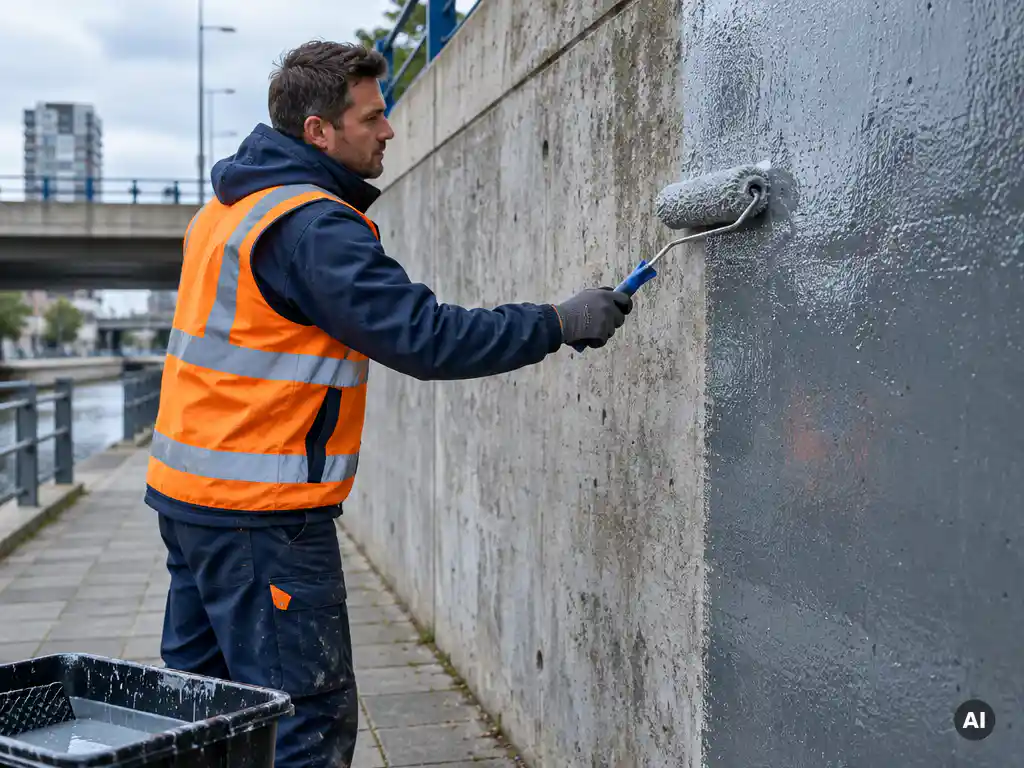
A permanent coating offers more protection than impregnation when a surface is exposed to intensive mechanical stress, aggressive contamination or graffiti, and when a long-lasting, visible protective layer is desired. Impregnation, on the other hand, works better on porous substrates where vapor permeability must be preserved. Below, we answer the most frequently asked questions about the difference between the two treatments, so you can make the right choice for your situation.
What is the difference between a coating and impregnation?
A coating is a protective layer that is applied to the surface of a substrate and remains there as a film. Impregnation, on the other hand, penetrates the pores of the substrate and works from within. With impregnation, the appearance of the substrate barely changes, whereas a coating can visibly alter the surface in terms of gloss, color or texture.
For facade impregnation, alkylsilanes and (poly)siloxanes are generally used. These substances react chemically with the substrate and make the pores water-repellent, without sealing them completely. As a result, the substrate remains vapor permeable, which is important for brickwork and concrete to prevent moisture problems from within.
A coating forms a closed, mechanically protective layer. Depending on the type of coating, that layer can be transparent or colored, matte or glossy, and resistant to chemicals, graffiti or weather influences. Coating and impregnation are therefore fundamentally different techniques, each with its own area of application.
When does a permanent coating offer more protection than impregnation?
A permanent coating offers more protection than impregnation on surfaces exposed to graffiti, oils, solvents or intensive mechanical wear. Whereas an impregnation treatment makes the substrate hydrophobic but does not create a film-forming barrier, a permanent coating creates a continuous protective shield that withstands multiple cleaning cycles.
Specific situations in which a permanent coating is preferable:
- Facades and surfaces in urban environments with a high level of graffiti vandalism
- Non-porous substrates such as facade cladding and window frames, where impregnation is technically ineffective
- Situations where color restoration of weathered facades is desired in addition to protection
- Locations with regular exposure to chemicals or oils
For non-porous facade cladding and window frames, products such as Nitocolour provide permanent color restoration with a service life of generally up to ten years. In those cases, this makes a permanent coating not only functional but also economically attractive thanks to lower long-term maintenance costs.
We’ll find out for you!
Want to talk through your challenge?
Our advisors will gladly help you with a practical solution.
In which situations is impregnation the better choice?
Impregnation is the better choice when the substrate is porous, vapor permeability must be preserved and the appearance of the surface must remain unchanged. Think of brickwork, concrete, sandstone and other mineral substrates, where moisture penetration from outside is prevented without blocking vapor release from within.
Impregnation is also suitable when:
- The substrate is in good condition and only needs to be protected against rain and moisture penetration
- The surface is not subject to heavy mechanical or chemical stress
- An invisible treatment is required that preserves the natural appearance of the facade
Keep in mind that an impregnation treatment offers no protection against graffiti or oils. For those applications, a coating is the appropriate solution.
Which substrates are suitable for a coating versus impregnation?
Impregnation works on porous, mineral substrates such as brick, concrete, calcium silicate brick and certain types of natural stone. Please note: not every natural stone reacts the same way to impregnation treatments. Granite, for example, is a dense, non-porous stone on which impregnation has little effect. If in doubt, always have a specialist assess the substrate before treatment.
Coatings can be applied to a wider range of substrates, including:
- Non-porous facade cladding and plastic or metal window frames
- Painted or previously treated surfaces
- Porous substrates where extra protection is desired on top of any impregnation treatment
- Concrete and stone substrates with a risk of graffiti vandalism
The choice between a coating and impregnation depends heavily on the nature and porosity of the substrate. Always consult the product data sheet and a specialist for the right product selection and application method.
How long does a permanent coating last compared to an impregnation treatment?
A permanent coating generally has a service life of up to ten years, depending on the specific product, the substrate and the degree of exposure. An impregnation treatment has a comparable or shorter service life, but this varies greatly by product and environmental conditions.
The difference lies not only in service life, but also in maintenance intensity. A permanent coating withstands multiple cleaning cycles without needing to be reapplied, which reduces the total maintenance costs over the period of use. An impregnation treatment must be repeated over time to maintain its protective effect.
Semi-permanent coatings behave differently: when graffiti is removed, the coating disappears with it and must be reapplied. This makes semi-permanent systems less suitable than permanent systems for locations with frequent graffiti contamination.
Can a coating be applied to a previously impregnated surface?
In principle, a coating can be applied to a previously impregnated surface, but this requires careful preparation and the right product choice. An impregnation treatment makes the substrate water-repellent, which can affect the adhesion of a coating. Have a specialist assess whether the substrate is suitable and which coating system is compatible with the existing treatment.
Important to know: anti-graffiti coatings can take over the function of facade impregnation. It is therefore not automatically necessary to combine both treatments. When you apply a permanent coating to facade cladding, that coating in many cases already provides sufficient moisture protection without the need for a separate impregnation layer.
For the correct order and combination of treatments, always consult the product data sheet of the specific coating system and engage a specialist for proper execution.
How we help you choose between a coating and impregnation
Choosing the right treatment for a facade or surface requires knowledge of the substrate, the environmental conditions and the desired duration of protection. We offer a wide range of products for both facade cleaning and facade treatment, tailored to professional application:
- Permanent coatings such as Nitocolour for color restoration and long-lasting protection of non-porous facade cladding and window frames
- Semi-permanent coatings such as Nitowax, Nitoshield and Nitocryl® for renovation and protection of weathered facades
- Impregnation products based on alkylsilanes and (poly)siloxanes for porous, mineral substrates
- Professional facade cleaning as preparation for any protective treatment
Our specialists will gladly think along with you about the best approach for your project. Get in touch via our contact form or call us directly on +31 (0) 418 680 680.