
When buying graffiti removers in bulk, you should look at five things: how well the product suits your surfaces, the actual cost per square metre, the safety data sheet, the supplier’s quality assurance and the shelf life in storage. A low price per litre says little about what a project ultimately costs.
Consumption varies by product, surface and type of graffiti. Specialists who test this beforehand avoid wrong choices when buying large volumes. Below, you can read what to look for per question.
Which type of graffiti remover suits which surface?
The surface determines which type of graffiti remover you buy. Hard, non-porous surfaces such as metal and glass require a different formula than porous materials such as brick and concrete. So don’t buy a single product for all applications, but match your choice to the surface and the type of contamination.
The wrong product can even make removal harder. That is why we develop several types of graffiti removers, tailored to the surface and the contamination. A gel product such as Graffiti Remover Gel, for example, is intended for both porous and non-porous surfaces, while Graffiti Remover Wipes are made specifically for small, quick touch-ups on hard, non-porous surfaces such as doors, traffic signs and painted areas.
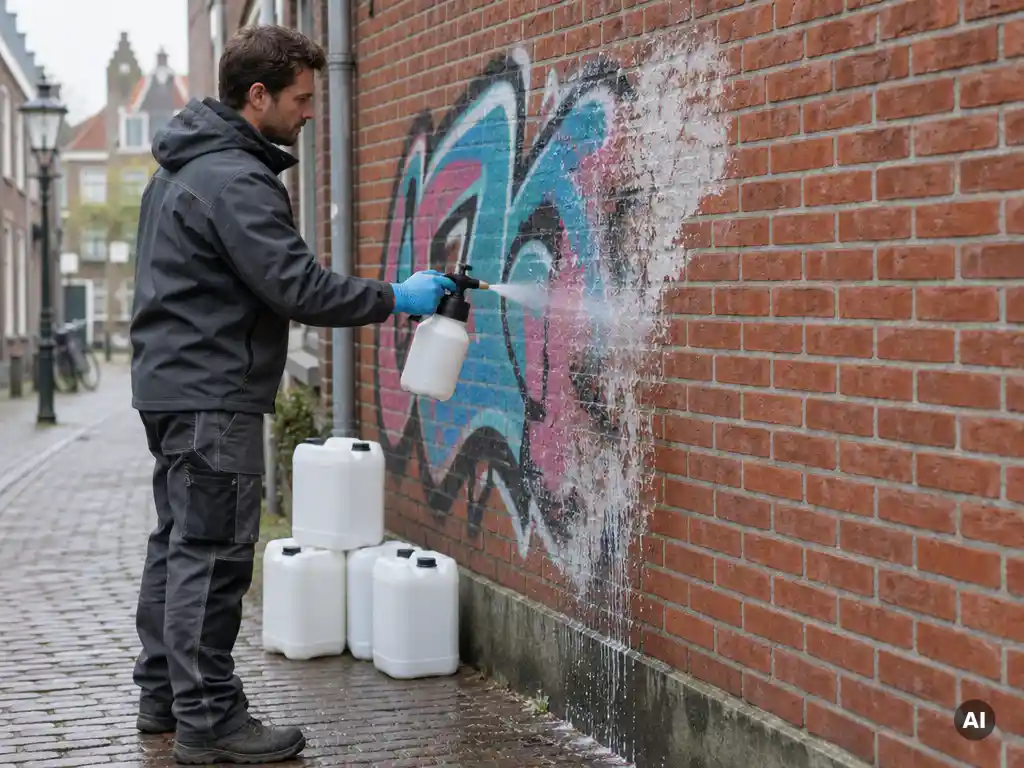
The application matters too. Graffiti on buildings calls for a different approach than graffiti on buses, trains and metros. Read more about removing graffiti from buildings and about removing graffiti in public transport to determine which products you need. If a silhouette remains visible on brick or concrete after cleaning, you are dealing with a graffiti ghost. That requires a separate treatment with a special remover, as you can read in removing graffiti ghosting.
Success also depends on three factors: the complexity of the graffiti (a single layer is removed more quickly than layered pieces), the type of surface and the temperature. When in doubt, do a test patch first. On delicate surfaces, this is especially important.
How do you assess the actual cost per square metre?
You calculate the actual cost per square metre by dividing the price per litre by the consumption in m² per litre. A cheaper remover with high consumption or low effectiveness can end up more expensive per square metre than a product that goes further.
So always ask suppliers for the theoretical consumption per product. Our product documentation shows that this varies:
- Graffiti Remover Gel: 5 to 10 m² per litre on porous surfaces and 5 to 15 m² per litre on non-porous surfaces.
- Graffiti Remover Lite: 5 to 15 m² per litre, depending on the surface and the graffiti.
- Graffiti Remover Wipes: consumption depends heavily on the amount and type of contamination.
Keep in mind that actual consumption always depends on the surface and the graffiti. So calculate with a range rather than a single fixed figure. Also factor in the packaging size: the gel, for example, comes in 1 and 10 litres, Lite in 1 and 5 litres. Also consider labour time. A product that works faster or requires less rework saves hours for specialists, and those hours often weigh more heavily than the product price.
What safety and environmental requirements must the product meet?
A graffiti remover must come with a current safety data sheet and a clear label, and specialists must be able to use the product safely with the prescribed protection. So request the safety data sheet before you buy, not only upon delivery.
The sheet tells you how to store the product safely, what personal protection is needed and how to handle residues. For our graffiti removers, for example, the instructions apply to avoid skin and eye contact and to wear suitable gloves, protective clothing and safety goggles. For application and safety, always consult the product sheet and the label.
Also pay attention to the properties of the product itself. A property such as biodegradability says something about the product, but does not automatically make it safer or milder. So ask suppliers for product-specific substantiation and do not simply accept general claims.
Don’t forget the waste. The graffiti you remove is itself harmful. Collect the residues and dispose of them as chemical waste. This belongs in your purchasing agreements and work instructions.
How do you check the quality of a supplier?
You check the quality of a supplier by looking at demonstrable quality assurance, product documentation for each product and the possibility of testing products in practice. An ISO 9001 certificate is a useful indication, but also ask for technical data sheets and a test patch.
Use these points as a checklist:
- Is there a technical product sheet for each product with instructions for use, consumption, storage and shelf life?
- Is a safety data sheet available?
- Does the supplier test products thoroughly, and are they applied in practice by professional users?
- Can you do a test patch on your own surfaces?
- Does the supplier have its own R&D department and technical advisers who answer your questions?
A supplier that develops and produces in-house can also help you find a solution if a standard product doesn’t fit your issue. We are ISO 9001 certified, and our technical advisers and R&D department are happy to help you with your challenge.
What do you need to arrange regarding delivery, storage and shelf life?
For large quantities, arrange the packaging sizes, delivery frequency, storage location and shelf life in advance. Store products in the original, unopened packaging in a cool, frost-free place. According to our product documentation, the product then remains usable for at least 24 months.
This applies to the graffiti removers for which we have established the shelf life, such as Graffiti Remover Gel, Lite and Wipes. For other products, always check the shelf life on the product sheet.
Also make clear agreements on:
- The packaging size that suits your way of working, such as 1, 5 or 10 litres, or a tub of 50 wipes.
- The number of deliveries per year, so that you don’t hold more stock than necessary.
- A storage location that stays frost-free, because frost falls outside the recommended storage conditions.
- The order in which you use stock, so that older batches are used first.
Also take on-site practice into account. Low temperatures can slow down the effectiveness of the products, and application on hot surfaces or in direct sunlight is not recommended. This affects your planning and therefore also the quantity you need at any given time.
Are training and application support worth the extra cost?
Yes, training and application support are worth the extra cost for large volumes, because a product only works well if specialists use it correctly. Good guidance prevents wrong product choices, overconsumption and rework, and on large projects that quickly saves more than it costs.
A successful result remains a combination of products and craftsmanship. Our technical advisers are in the field every day to inspect surfaces and contamination, do test patches and support customers when starting large projects. Good training shows you how to keep to the right work sequence, for example applying, letting it soak in, polishing it off and rinsing with clean water. Optionally, you then apply an anti-graffiti coating.
With these coatings, you make your choice based on the desired result. A semi-permanent coating disappears during graffiti removal and has to be reapplied. A permanent coating withstands multiple cleaning rounds, with the number varying per system. Get advice on this, so that you don’t unnecessarily duplicate work or costs.
How we help you buy graffiti removers
We develop, test and produce our graffiti removers ourselves, and support you at every step of the purchasing process. That way you can buy large quantities with confidence. This is what you can expect from us:
- A range of graffiti removers with products for porous and non-porous surfaces.
- Product sheets with consumption, storage, shelf life and safety instructions for each product.
- Advice from technical advisers and our R&D department, even if a standard solution doesn’t fit.
- Test patches on your own surfaces.
- Training in the correct use of our products.
- ISO 9001-certified quality in product and advice.
Want to know which graffiti remover suits your surfaces and volumes? Contact us or call +31 (0) 418 680 680. We are happy to help.