
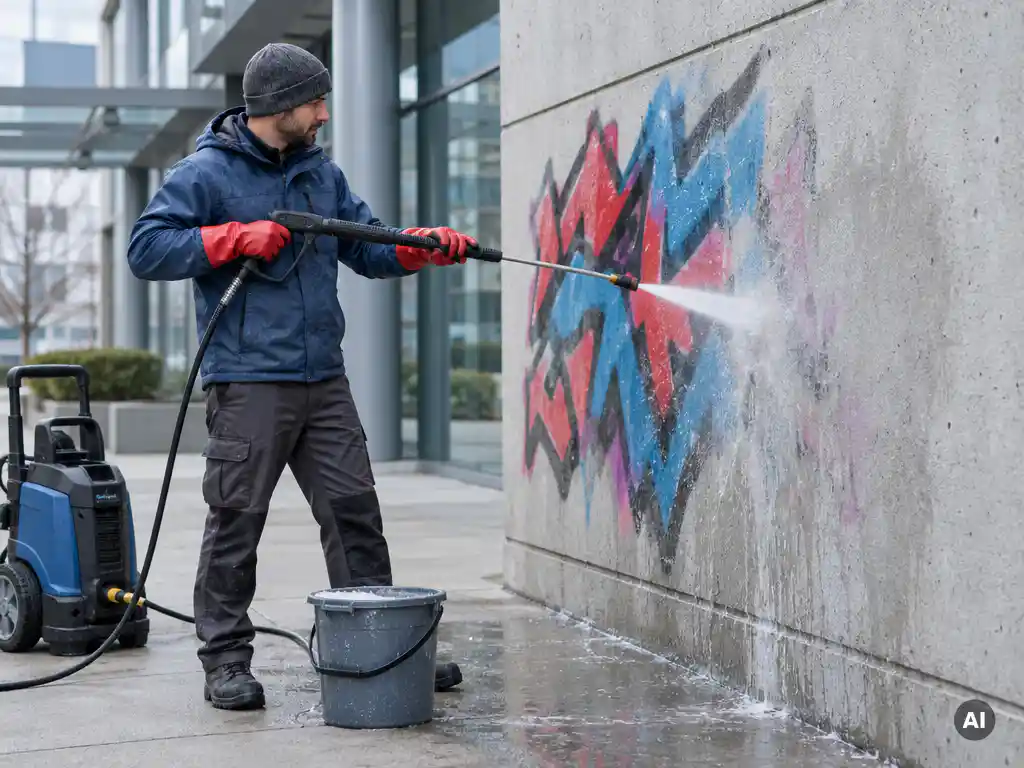
The right graffiti remover for a commercial building depends on two things: the substrate (porous or smooth) and the type of graffiti or the ghosting that remains. For most facades, you choose a gel-type graffiti remover, supplemented with a specialized ghost remover for stubborn residues.
Application conditions also play a role, such as the season and the sensitivity of the material. Below you can read how to make the choice step by step, from product selection to application and aftercare.
Which factors determine the choice of a graffiti remover?
You choose a graffiti remover mainly on the basis of the substrate, the type of graffiti, and the application conditions. A product that works well on concrete can damage a plastic panel or traffic sign. So look at the material first and only then at the product.
These factors are relevant:
- Substrate: porous materials such as masonry, brick, and concrete require a different approach than smooth or sensitive surfaces such as acrylic glass or traffic signs.
- Type of graffiti: paint, markers, and ink react differently. After removal, ghosting often remains on porous substrates.
- Application conditions: some products are used from spring to autumn, others also at lower temperatures. Always check this on the product data sheet.
- Sensitivity of the material: not every natural stone reacts the same way to alkaline or acidic products. Therefore, always do a test patch first.
- Application: small touch-ups during a maintenance round call for a different product than cleaning an entire facade.
In our range of graffiti removers you will find products for all these situations, from gel-type products to wipes for quick touch-ups.
Which graffiti remover works on porous and smooth substrates?
For porous substrates such as brick, concrete, and facades, you use a gel-type graffiti remover, for example Graffiti Remover Gel Strong. For sensitive, smooth surfaces such as traffic signs and acrylic glass, a milder variant is suitable, such as Graffiti Remover Extra Lite. Gel stays in place on vertical surfaces and can therefore work in effectively.
Porous substrates: facades, concrete, and masonry
Graffiti Remover Gel Strong works on vertical, porous surfaces such as brick, facades, and concrete. The gel form prevents the product from running off immediately. On porous substrates, a ghost often remains after the graffiti has been removed. For this we developed separate ghost removers, such as Shadow Remover Strong, a paste-like product that contains sodium hypochlorite and therefore has a strong bleaching effect. Only use this on substrates that can withstand bleaching, such as concrete, stone, and many types of natural stone. On metal substrates, this product can cause damage.
Sensitive and smooth surfaces
For sensitive surfaces such as traffic signs and acrylic glass, we developed Graffiti Remover Extra Lite. For doors, waste bins, and electrical cabinets, there are Graffiti Remover Wipes. You take these wipes along during a cleaning or maintenance round for quick touch-ups. For rolling stock such as trains, trams, and buses, you use Graffiti Remover RS. Read more about removing graffiti in public transport if you work with vehicles.
What is the difference between solvent-based and environmentally friendly graffiti removers?
The difference lies in the composition and the way they work. Solvent-based removers dissolve graffiti by means of solvents, while other products work differently, for example by bleaching pigments. A biodegradable product is not automatically milder or safer. Therefore, always consult the product data sheet.
A few examples from our range make this concrete:
- Graffiti Remover RS: a gel-type remover for rolling stock based on solvents that are biodegradable. It works quickly and respects the original finishing material.
- Shadow Remover Strong: contains sodium hypochlorite and has a strong bleaching effect. It is intended for ghosting, not for dissolving layers of paint.
A sustainability claim such as biodegradability applies per product and says nothing about safety during the work. All products require suitable personal protective equipment and a test patch beforehand. Specialists consult the safety data sheet and the label for this.
How do you remove graffiti from a facade step by step?
You remove graffiti from a facade by first assessing the substrate, making a test patch, applying the product undiluted, letting it work in, and then rinsing off the result. Always follow the product data sheet for contact times and rinsing conditions, because these differ per product.
- Assess the substrate: determine whether it is brick, concrete, natural stone, or a coated facade and choose the appropriate product.
- Make a test patch: test the product on an inconspicuous spot to check that the substrate is not damaged.
- Apply the product undiluted: you use our graffiti removers undiluted. Do not mix them with other products.
- Let the product work in and rinse off: follow the contact time and rinsing method from the product data sheet.
- Treat ghosting afterwards: if a ghost remains, use a ghost remover that suits the substrate.
With Shadow Remover Strong, for example, you apply a thick layer with a brush or chemically resistant scrubbing brush. If the result is insufficient, let the product work in for longer, covered with plastic film to prevent it from drying out. You can read more about this approach under removing graffiti ghosting. For cleaning entire buildings, you will find additional information about removing graffiti from buildings.
Preferably have this work carried out by specialists. They wear gloves, protective clothing, and safety glasses, and know how to handle products that can cause burns or eye injuries.
When is an anti-graffiti coating wiser than repeated removal?
An anti-graffiti coating is wiser when a building is defaced again and again and you want to protect the facade against repeated removals. The coating forms a protective layer, which makes graffiti easier to remove. Choose between a semi-permanent and a permanent coating.
- Semi-permanent anti-graffiti coating: disappears when graffiti is removed and must then be reapplied.
- Permanent anti-graffiti coating: withstands multiple cleanings. The number varies per system.
Graffitiguard Permanent is an impregnating agent with anti-graffiti properties. Anti-graffiti coatings can take over the function of facade impregnation, so we do not recommend a combination as standard. Facade impregnation usually consists of a combination of alkylsilanes and (poly)siloxanes. The lifespan of a protective layer is generally a maximum of ten years, unless the product data sheet states otherwise.
A coating therefore makes the most sense for facades that are defaced more often. A practical example is a facade that we cleaned and then treated with a colorless coating, so that new graffiti has less grip. If you want to deal with a one-off incident of defacement, removal alone is often sufficient.
When is professional advice or training on graffiti removal needed?
Professional advice or training is needed when you are unsure about the substrate, are working with strongly alkaline or bleaching products, or have to clean a large or sensitive facade. Specialists prevent damage to the material and work more safely with products that can cause severe burns or permanent eye injuries.
Advice is especially useful in these situations:
- you do not know the substrate precisely or it is a sensitive natural stone;
- you need to remove a ghost with a strong product such as Shadow Remover Strong;
- you want to choose an anti-graffiti coating that suits the facade and the expected defacement;
- your team needs an explanation of application, product choice, and safety.
If in doubt, always consult the safety data sheet, the label, and the product data sheet. The user remains responsible for product choice, application, and result.
How we help with removing graffiti from commercial buildings
We develop, produce, and test our graffiti removers in-house. This way you will find the right product with us for every substrate and every phase of the work. Our range includes:
- gel-type graffiti removers for vertical, porous surfaces such as brick, facades, and concrete;
- Graffiti Remover Extra Lite and Graffiti Remover Wipes for sensitive surfaces and quick touch-ups;
- ghost removers for stubborn residues after graffiti removal;
- anti-graffiti coatings and impregnating agents to limit repeated defacement.
Our technical advisors and our R&D department will work with you on product choice, application, and training for your specialists. We are ISO 9001 certified. Would you like to know which solution suits your commercial building? Contact us or call +31 (0) 418 680 680.