
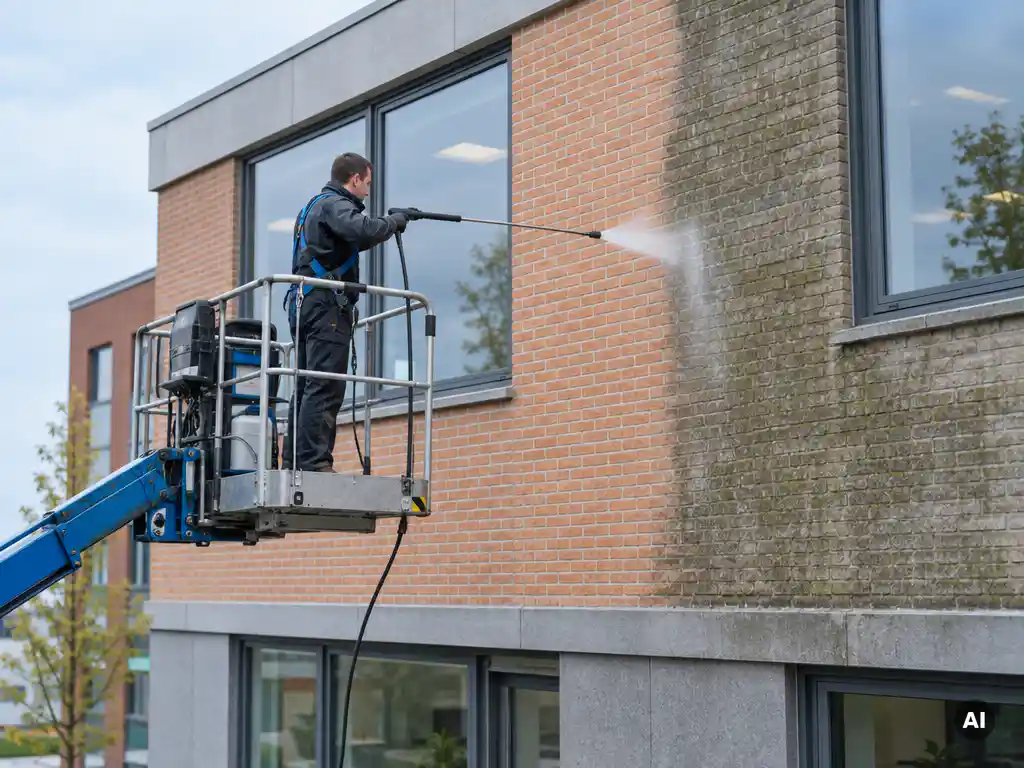
Facade cleaning has a direct impact on property value. A clean, well-maintained facade inspires confidence, strengthens the appearance of a building, and prevents contamination from damaging the underlying structure. For professional property owners and managers, regular facade maintenance is not a cost item but an investment that pays for itself. The questions below give you a concrete picture of what facade cleaning delivers and when it is best to take action.
How much can a clean facade increase property value?
A clean facade demonstrably increases the perceived value of a building. Appraisers and prospective tenants or buyers judge the exterior first. A weathered, discolored, or soiled facade gives the impression of deferred maintenance, which leads to lower offers and longer vacancy. A well-maintained facade reinforces that first impression and justifies a higher asking price.
The effect is strongest for commercial properties and rental homes in visible locations. There, appearance weighs heavily in the decisions of tenants and buyers. But for industrial and public-sector properties too, a clean facade signals professional management and contributes to the credibility of the owner or manager. Preventive cleaning also stops surface contamination from developing into structural damage, which reduces maintenance costs in the long term.
Which types of contamination damage a facade the most?
Biological growth such as algae, moss, and lichen causes the most structural damage to facades. These organisms anchor themselves in the pores of the material and slowly break down the surface. In addition, atmospheric pollution, soot deposits, and salt efflorescence are harmful to both the appearance and the integrity of the facade material.
Graffiti is a category of its own. Without a protective coating, paint penetrates deep into the surface, and removal is labor-intensive and costly. On porous substrates such as concrete, brick, and natural stone, untreated contamination can lead to flaking and cracking through moisture and frost. The longer contamination is left untreated, the more damage it causes and the higher the cleaning and repair costs climb.
For facades that regularly deal with graffiti or stubborn contamination, it is wise to consider a protective layer in addition to cleaning.
We’ll find the answer for you!
Want to talk through your challenge?
Our advisors will gladly help you find a practical solution.
We’ll find the answer for you!
Want to talk through your challenge?
Our advisors will gladly help you find a practical solution.
What is the difference between professional and DIY facade cleaning?
Professional facade cleaning differs from DIY cleaning on three points: choosing the right cleaning agent for the specific substrate, the application technique, and securing the result. Specialists select products based on the facade material, the nature of the contamination, and the condition of the surface. This prevents damage that can actually occur when consumer products are used incorrectly.
With DIY cleaning, knowledge about dwell times, pressure, and the combination of products is often lacking. High-pressure cleaning on porous substrates without the right settings can damage the surface or worsen moisture problems. Professional execution also produces a more uniform result, which is visible in the final inspection. For larger buildings, historic facades, or facades with coatings, professional execution is the right choice.
How often should a facade be cleaned for optimal maintenance?
The cleaning frequency depends on the location, the facade material, and the degree of exposure to contamination. There is no general rule, but facades in urban environments, near busy roads, or in a humid climate need attention more often than facades in sheltered locations. Regular inspection is the starting point for a good maintenance plan.
For facades with a protective impregnation layer or coating, contamination builds up more slowly and cleaning is needed less frequently. Professional facade cleaning combined with a maintenance schedule gives you control over the condition of the building and prevents small problems from growing into costly interventions. Have specialists assess the condition of the facade to determine the right frequency.
What is the effect of facade cleaning on protective coatings?
Facade cleaning affects any protective coatings present, depending on the type of coating and the cleaning agent used. Semi-permanent coatings disappear during graffiti removal and must be reapplied after cleaning. Permanent coatings withstand multiple cleaning cycles, but the exact number differs per system and requires product-specific information.
For facades with an impregnation layer based on alkylsilanes and (poly)siloxanes, aggressive cleaning agents or excessive pressure can impair the effectiveness of the impregnation. It is therefore important to take the existing coating into account when choosing a cleaning agent. Always consult the product data sheet and the label of the cleaning agent used, and have specialists assess whether a coating needs to be reapplied after cleaning.
Want to know more about protecting facades after cleaning? Then take a look at the options for facade impregnation and water repellent treatment.
When is it worth investing in professional facade cleaning?
Investing in professional facade cleaning pays off when the condition of the facade visibly deviates from the desired level, when there is biological growth or stubborn contamination, or when a building is being prepared for sale, rental, or renovation. Cleaning is also a prerequisite for a good result before painting work or applying a coating.
From a real estate perspective, the investment in cleaning generally outweighs the loss of value that occurs with visibly neglected facades. For property managers and housing associations, proactive maintenance also extends the lifespan of the facade material and limits unexpected repair costs. The sooner contamination is addressed, the lower the total maintenance costs over the lifespan of the building.
How we help with facade cleaning and facade maintenance
We develop and produce professional products for facade cleaning, facade impregnation, and facade renovation, aimed at durable results for professional applications. What we offer:
- Professional cleaning products tailored to different facade types and types of contamination
- Impregnation solutions based on alkylsilanes and (poly)siloxanes for water repellency and protection of porous substrates
- Semi-permanent and permanent coatings for facade renovation and protection, including Nitowax, Nitoshield, Nitocryl® and Nitocolour, with a lifespan of generally up to ten years
- Advice and guidance on product selection and application, supported by product data sheets and technical documentation
- Training and support for specialists who apply our products
Want to know which approach suits your situation? Get in touch via our contact form or call us directly on +31 (0) 418 680 680. We’re happy to think along with you.