
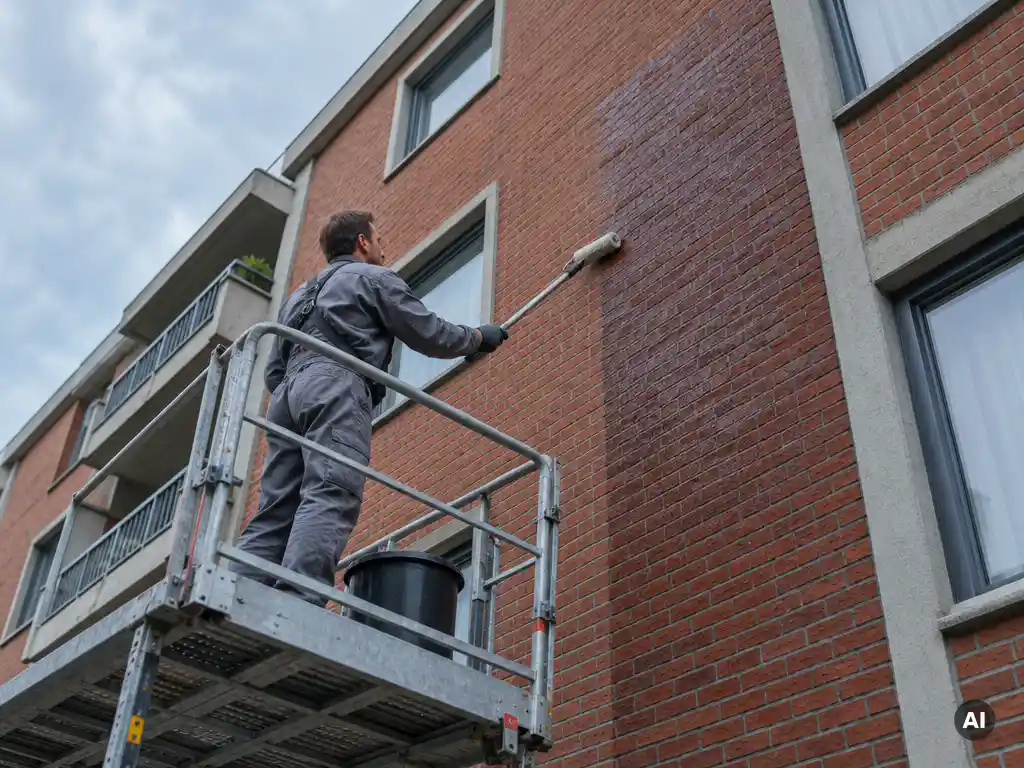
You optimize the consumption of impregnating agent on large-scale façade projects by first setting a test area for each substrate, checking the moisture content and absorbency of the masonry, and matching the application method to the façade. The product data sheet and the specific substrate determine the guideline value. Below you can read which factors drive consumption and how to keep it under control.
What causes excessive consumption of impregnating agent on the façade?
Excessive consumption usually occurs because the substrate is highly absorbent, the application is too generous or uneven, or because the façade has not been properly prepared. Losses through dripping, wind and unnecessary repeated application also increase consumption without improving protection.
The main causes can be seen on site:
- Differences in absorbency: porous or absorbent masonry takes up far more product than a dense brick. Within a single façade, pointing, brick and concrete can vary greatly.
- Too much product per coat: over-application does not add any extra penetration depth, but leaves product on the surface or lets it run off.
- Insufficient preparation: dirt, algae or old residues disrupt absorption. Specialists therefore clean the façade first. You can read more about that process on our page about façade cleaning.
- Unsuitable conditions: wind, rain or an overly warm substrate cause losses or poor absorption.
How do you determine the right consumption per m² with a test area?
You determine consumption per m² by treating a test area on a representative section of the façade, weighing or measuring the amount of product used, and converting this to the surface area. At the same time, the test area shows how the substrate reacts to the impregnating agent.
Work with a fixed approach so that the result is usable for the entire façade:
- Choose a test area for each type of substrate. If a façade has brick, concrete and pointing, set up several test areas.
- Choose a spot that reflects the average condition of the façade, so not the dirtiest or the most sheltered corner.
- Measure the moisture content of the substrate beforehand so that you use comparable conditions.
- Apply the product according to the product data sheet and note the amount used and the area treated.
- After curing, check the result, for example the water-repellent effect and any discoloration or gloss.
On large projects, set up several test areas on different sides of the façade. This lets you see differences in absorbency and exposure before you order the full quantity of product. For a good estimate, it is also useful to take into account the difference in absorbent masonry within a single façade.
Which application method gives the lowest consumption on large façades?
The method with the lowest consumption is the one that applies the product to the façade in a controlled and even manner, without dripping or loss due to wind. For façade impregnation, this is usually done with a low-pressure sprayer. Specialists match the method to the type of substrate and the instructions on the product data sheet.
A good application is characterized by a few fixed points:
- Low pressure and coarse droplets: this limits mist loss and drift, especially on tall façades.
- Even passes: work systematically from bottom to top or as indicated on the product data sheet, so that you get no overlap and no missed spots.
- Adjusted dosage: adapt the number of passes and the quantity to what the test area showed.
- Shielding adjacent parts: keeping glass, window frames and plants out of range prevents waste and rework.
For a detailed explanation of how the product works and how it is applied, read more about façade impregnation and water-repellent treatment. Façade impregnating agents generally consist of a combination of alkylsilanes and (poly)siloxanes. Always consult the product data sheet and the label for the exact application.
Which conditions and substrate preparation influence consumption the most?
The moisture content of the substrate, the temperature, wind and the cleanliness of the façade influence consumption the most. A wet or dirty substrate absorbs the impregnating agent poorly. An overly warm substrate or full sun causes the product to be drawn in or evaporate too quickly.
Substrate and moisture content
A façade must be sufficiently dry before you start impregnating. Therefore, measure the moisture content and let the façade dry longer if necessary. If you use a façade cleaner beforehand, such as Facadeclean HC, rinse the substrate thoroughly afterwards and let it dry completely before applying a coating or impregnating agent. Keep in mind that Facadeclean HC is corrosive to metals. Protect exposed metal surfaces and use only application equipment made of chemically resistant plastic.
Weather conditions and timing
Schedule the work during dry periods and avoid rain immediately after application. Do not apply products to hot substrates or in full sun. In strong winds you lose product through drift and end up with an uneven layer. Planning per side of the façade, adjusted to sun and wind, helps you keep consumption under control.
How do you check and monitor consumption during execution?
You monitor consumption by recording the amount of product used every day, dividing it by the area treated, and comparing the result with the value from the test area. If consumption deviates clearly, check the substrate, the dosage and the application method.
Use a simple checking routine:
- Note the liters used and the m² treated per day and per side of the façade.
- Compare the consumption per m² with the guideline value from the test area.
- In case of deviations, first check the moisture content, the weather conditions and the equipment settings.
- Have the same specialists work on each side of the façade so that the working method remains constant.
- Store the product according to the product data sheet, in its original packaging in a suitable place, so that quality is guaranteed until use.
If consumption is structurally higher than expected, stop first and find the cause before continuing. This is more cost-effective than treating an entire façade with too much product.
How Mavro helps optimize consumption on façade projects
On large façade projects, we work together with your specialists on controlled and well-founded consumption. Our technical advisors regularly visit projects to inspect substrates and contamination, set up test areas and guide customers at the start of large projects. This helps you to:
- estimate the absorbency and condition of the substrate in advance;
- choose the right product and the right application method for your façade;
- set up a test area and assess the result;
- align the working method and safety measures with the product data sheet and label.
Would you like to know which impregnating agent suits your façade and what consumption you can expect? Contact us or call us on +31 (0) 418 680 680. Our advice is free of charge and we are happy to think along with you.