
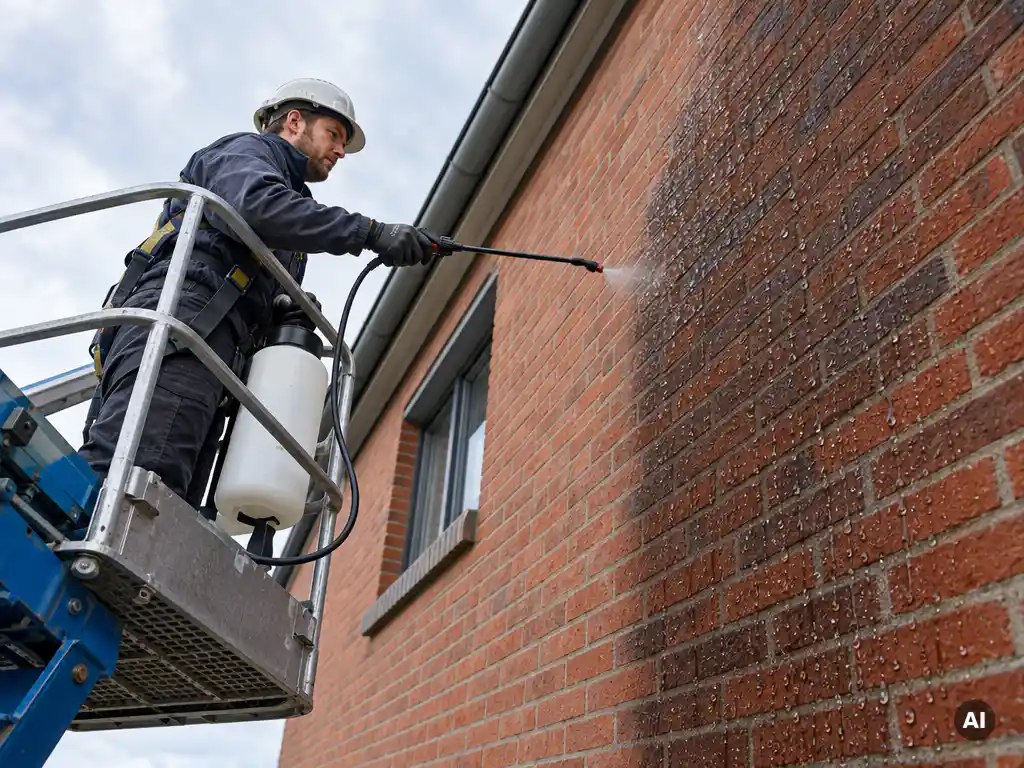
When purchasing facade impregnation products, you should pay particular attention to the composition (alkylsilanes and (poly)siloxanes), compatibility with your substrate, the moisture content of the facade at the time of application, and the supplier’s technical support. A good product repels water without impairing the vapor permeability of the masonry.
For a maintenance company, the wrong choice makes the difference between a facade that stays protected for years and a recurring complaint. Below you can read which criteria, substrates, safety points, and supplier questions will help you make a well-founded choice.
Which technical criteria determine the choice of a facade impregnation product?
The most important technical criteria are the active components, compatibility with the substrate, the water-repellent effect, and the retention of vapor permeability. A professional facade impregnation product usually contains a combination of alkylsilanes and (poly)siloxanes, which penetrate the substrate and make the pore walls water-repellent.
For each product, review the technical data sheet. It contains the information you need to make a good comparison:
- Active components: which alkylsilanes and (poly)siloxanes does it contain, and in what concentration?
- Suitable substrates: brick, concrete, pointing, or natural stone, as named by the manufacturer.
- Consumption: consumption per m² depends on the porosity of the substrate, so ask for product-specific guideline values.
- Service life: generally expect up to ten years, unless the manufacturer states otherwise for the specific product.
- Application conditions: moisture content of the substrate, weather conditions, and temperature according to the data sheet.
A facade must also be properly prepared. Dirt, algae growth, or cement haze limit the penetration of the product. Therefore, first schedule a professional facade cleaning and only impregnate afterwards.
What is the difference between solvent-based and water-based impregnation products?
The difference lies in the carrier of the active components. With solvent-based impregnation products, the active substances are dissolved in an organic solvent; with water-based products, they are in water or an emulsion. This carrier determines, among other things, penetration, application, and safety considerations.
Both types can contain alkylsilanes and (poly)siloxanes. What you want to compare per product:
- Penetration and application: check in the data sheet how the product must be applied to your substrate.
- Moisture content of the substrate: the permissible moisture level differs per product. Adhere to the manufacturer’s conditions.
- Safety and storage: solvent-based products are subject to different regulations than water-based products. Consult the label and the safety data sheet.
Do not base your choice on the product type alone. A well-matched product of either type performs better than a poorly chosen product of the other type. Ask your supplier for well-founded advice for your project.
Which impregnation product suits which facade substrate?
The right impregnation product depends on the porosity, composition, and condition of the substrate. Brick, concrete, pointing, and natural stone each react differently to impregnation products. Therefore, never make absolute assumptions: check per product which substrates it is intended for and test on a trial area.
When choosing, pay attention to these points:
- Brick and pointing: assess the condition of the joints and repair cracks or open joints beforehand. Impregnation does not solve existing defects.
- Concrete: density varies greatly, so consult the data sheet for suitable application and consumption.
- Natural stone: not every natural stone reacts the same way. Calcareous stone types require extra attention, also when cleaning prior to impregnation.
- Non-porous facade cladding: for facade cladding and window frames that are not porous, separate renovation and protection systems exist, such as the semi-permanent coatings Nitowax, Nitoshield, and Nitocryl® and the permanent color-restoring coating Nitocolour.
Unsure about a substrate? Have a specialist assess a trial area before you purchase for a full project. You can read more about facade impregnation and hydrophobing on our application page.
Which safety and environmental requirements apply to professional facade impregnation?
Professional facade impregnation requires compliance with the instructions on the data sheet, the label, and the safety data sheet. This applies to personal protective equipment, ventilation, storage, and disposal of residues. The exact requirements differ per product, so check them before you purchase.
Ask your supplier for these documents in advance:
- Safety data sheet: with hazard statements, required protective equipment, and measures in case of contact.
- Technical data sheet: with application conditions, shelf life, and storage conditions.
- Label: with current warnings for the specific product.
Do not make assumptions about environmental properties. A product is not automatically safer or milder because of a certain claim. Rely only on product-specific, verifiable information from the manufacturer. Always leave the execution to specialists who work with the right equipment and knowledge.
What should you look for when choosing a supplier?
Choose a supplier that combines product knowledge, technical support, and consistent quality. You want a partner who thinks along with your project, provides complete product documentation, and gives quick advice on questions about substrates or application. That prevents mistakes and repair work.
Use this checklist when comparing suppliers:
- Quality system: does the supplier work with a certified quality system, such as ISO 9001?
- In-house development: does the supplier develop and produce in-house, so that they can answer technical questions substantively?
- Documentation: are data sheets and safety data sheets complete and up to date?
- Training and advice: does the supplier offer support in applying products?
- Delivery formats: can you purchase in bulk, and are package sizes suitable for your work?
- Broad range: can you source cleaning, impregnation, and, if needed, graffiti protection from the same party, such as graffiti removers alongside facade products?
Pay attention to the combination of products. Anti-graffiti coatings can take over the function of facade impregnation, so do not advise clients to use both by default. A supplier who can explain that distinction knows their products.
How do you avoid mistakes when applying facade impregnation products?
You avoid mistakes by properly preparing the facade, checking the moisture content of the substrate, following the data sheet closely, and making a trial area. Most problems arise from dirty or overly damp substrates and from deviations from the prescribed application.
Work through these steps:
- Inspect the facade: repair cracks, loose joints, and other defects beforehand.
- Clean the substrate: remove dirt, algae, cement haze, and other deposits, and allow the facade to dry sufficiently.
- Check the moisture content: adhere to the limits on the data sheet.
- Make a trial area: assess penetration and appearance before you start the entire project.
- Follow the data sheet: for application method, consumption, conditions, and drying time.
- Document the work: note batch numbers, weather conditions, and quantities used.
Do you have doubts about any step? Then have a technical advisor look over it before you begin. That costs less than repair work afterwards.
How Mavro helps with the purchase of facade impregnation products
We develop, produce, and test our products ourselves and work with an ISO 9001-certified quality system. This means you can come to us with technical questions and that we think along with you about the right approach for your substrate and project.
This is what you can expect from us:
- Advice from technical advisors and our R&D department on products and application.
- Training and support in the use of our products.
- A broad range for cleaning, impregnating, and protecting facades.
- Delivery in bulk to businesses, and on request we can discuss private label options.
Would you like to know which facade impregnation product suits your project? Contact us or call +31 (0) 418 680 680. We are happy to think along with you, from challenge to application.