
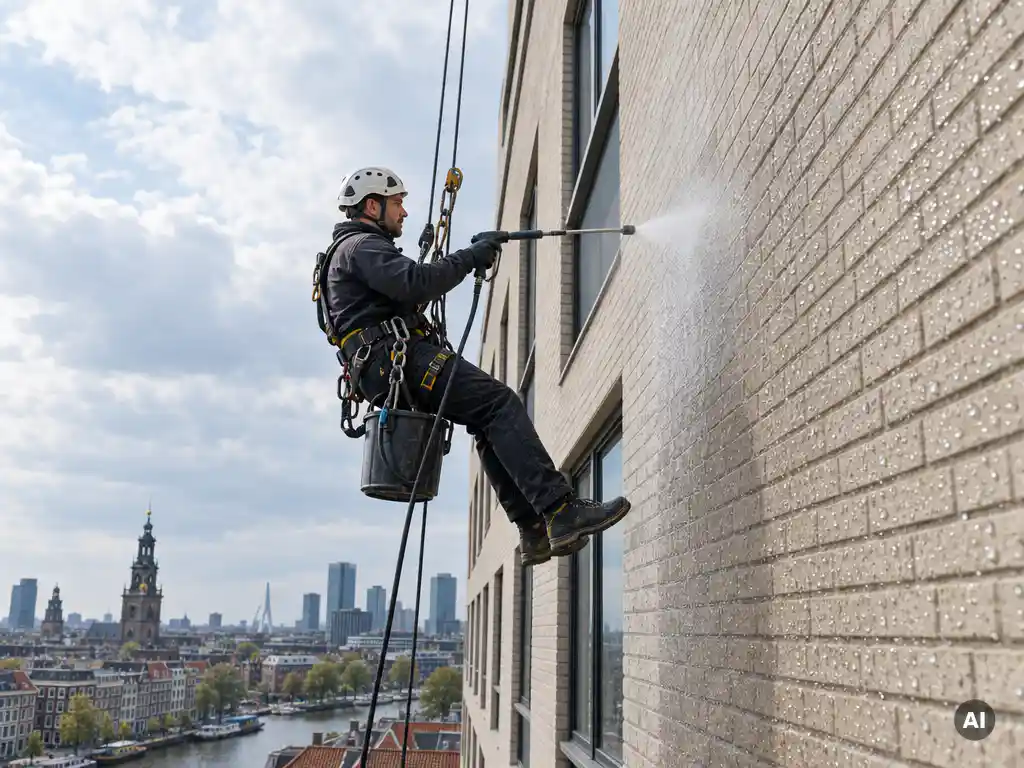
You determine the right application method for facade impregnation on large buildings by looking at the porosity of the substrate, the accessibility of the facade and the weather conditions. On large surfaces, specialists usually choose low-pressure spraying, supplemented with rolling or brushing for detail work. Below you can read how to substantiate that choice.
Which factors determine the choice of application method?
The choice of application method depends on four factors: the nature and porosity of the substrate, the size of the facade surface, accessibility and the weather conditions. Together they determine how quickly you can work, how much product the facade absorbs and how even the final result will be.
The substrate weighs the heaviest. Brick, concrete and natural stone each absorb a different amount of impregnating agent, and not every natural stone reacts the same way. A highly absorbent stone requires a method that delivers enough product in one go. A denser substrate, on the other hand, requires controlled application so that the product does not remain on the surface. The moisture content of the facade also matters: a wet or heavily damp substrate absorbs the agent less well.
You also look at the condition of the facade. A soiled facade must be clean before you impregnate, otherwise dirt and deposits block absorption. On our page about facade cleaning you can read how to prepare the substrate for this. Always apply a test patch to check whether the method and the product suit the substrate.
Which application methods are there for facade impregnation?
For facade impregnation, specialists use three common methods: spraying with a low-pressure sprayer or airless equipment, rolling and brushing. Spraying covers large surfaces quickly, rolling gives control on smaller surfaces and brushing works best for detail work, corners and edges.
- Low-pressure or airless spraying: suitable for large, open facade surfaces where speed and even distribution matter.
- Rolling: suitable for limited surfaces and situations where overspray poses a risk, for example next to glazing or parts you do not want to treat.
- Brushing: suitable for details, edges, connections and places you cannot reach well with a sprayer or roller.
The aim of the impregnation is hydrophobing: the agent penetrates the stone and makes the facade water-repellent, while the facade remains vapor-permeable. For facade impregnation, we work where relevant with a combination of alkylsilanes and (poly)siloxanes. You can find more background on the product under facade impregnation and hydrophobing. For the exact application, always check the product data sheet and the label.
Spraying or rolling: which is better for large facades?
Spraying is usually the best choice for large facades, because it lets you treat a large surface evenly in a short time. Rolling is slower and is better suited to small surfaces or sensitive zones. In practice, specialists combine both methods on a single project.
When spraying, you work at low pressure so that the agent can penetrate the stone without too much atomization. In wind, overspray increases, so cover adjacent parts such as window frames, glass and plants thoroughly. Rolling has the advantage that you can dose precisely. The drawback is the labor time: on a facade of several storeys it adds up quickly.
Choose spraying if the facade is large and open and the substrate absorbs well. Choose rolling or brushing if you have many details, small surfaces or sensitive connections. Consumption per m2 depends on the product and the porosity of the substrate. Therefore, take that figure from the product data sheet of the chosen agent and not from a general guideline.
How do you reach the facade safely and efficiently?
You reach a large facade safely with an aerial work platform, a cherry picker basket or scaffolding, depending on the height, the ground conditions and the duration of the project. Choose the access equipment that lets you work evenly, without constantly having to reposition.
An aerial work platform is flexible and quick to set up, especially on facades with few obstacles and a stable ground. Scaffolding is better suited to long, multi-layered projects where you work in the same place for days and want to plan the work tightly. On very high facades, rope access can be an option, but that requires certified specialists.
When choosing, pay attention to the order of the work. You preferably work from top to bottom, so that you do not soil or splash treated parts. Always have the work carried out by qualified specialists and follow the applicable safety regulations for working at height. For the product itself, consult the safety data sheet.
Which weather conditions affect the application of impregnation?
Rain, frost, strong wind, high temperatures and damp substrates affect the application of facade impregnation the most. You therefore impregnate in dry weather and on a dry facade, so that the agent can penetrate the stone and cure properly.
- Rain and moisture: a wet or damp surface absorbs the agent poorly. Let the facade dry before you start.
- Frost and low temperatures: cold slows the action and can disrupt absorption.
- Sun and heat: on hot substrates or in full sun the agent evaporates too quickly, which reduces penetration.
- Wind: when spraying, wind increases overspray and causes uneven distribution.
The exact limit values for temperature and drying time differ per product. Therefore, take them from the product data sheet of the agent you use. Plan the work with a multi-day weather forecast and allow for work interruptions.
How do you check whether the impregnation has been applied correctly?
You check facade impregnation by looking, after the curing time, at whether water beads off the facade instead of soaking into the stone. You also assess the evenness of the result and check that no spots have been missed.
Carry out the check in several steps:
- Visual inspection: look for glossy spots, stains, runs or missed areas, especially at details and edges.
- Water test: spray or pour water on a treated section and see whether it beads off. Compare this with an untreated reference piece.
- Substrate check: make sure the facade was dry at the time of application and that the treatment of damp zones was postponed in time.
- Documentation: record the date, the product, the weather conditions and the consumption, so that you can trace the result later.
Facade impregnation generally has a service life of up to ten years, unless the product data sheet states otherwise. Therefore, schedule a periodic check so that you can retreat in time.
How Mavro helps with the right application method for facade impregnation
We think along with you from question to application. Our technical advisors are in the field every day to inspect substrates, apply test patches and assist customers when starting up large projects.
- Inspection of the substrate and advice on the suitable impregnating agent
- Test patches to check the method and product in advance
- Support at the start of large projects
- Training and advice for specialists on the application
Want to know which application method suits your building? Contact us or call +31 (0) 418 680 680. Good advice is free with us.