
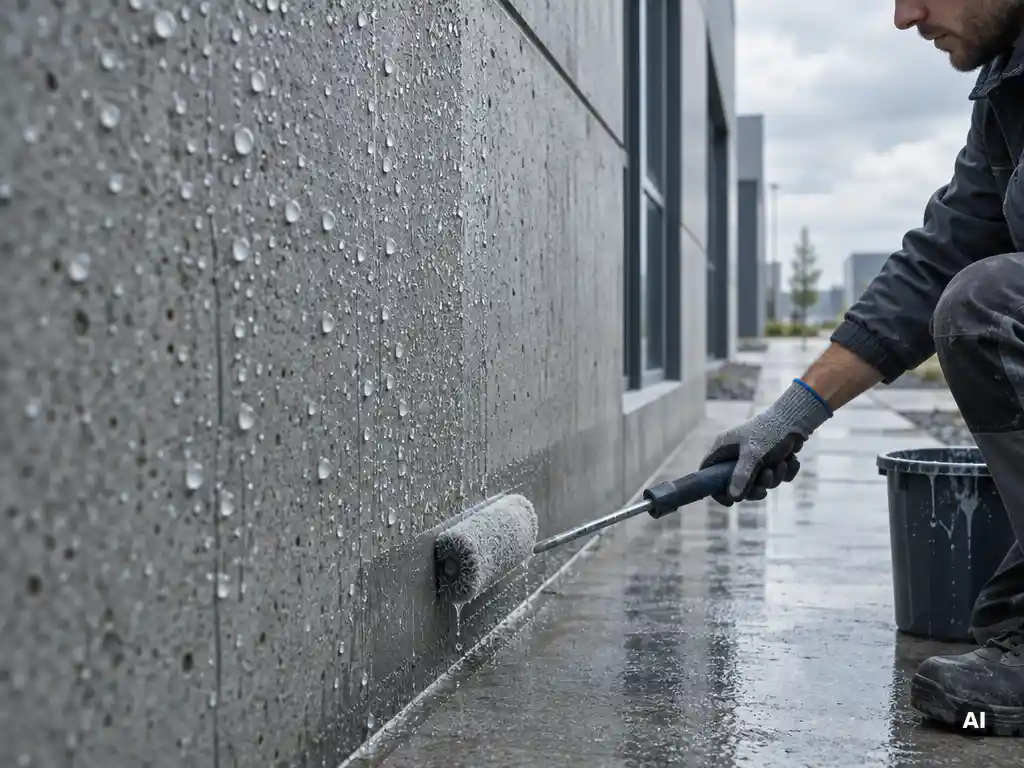
You choose a facade impregnation agent for a concrete commercial building based on the substrate, the moisture content and the desired service life. For concrete, an impregnation agent combining alkylsilanes and (poly)siloxanes is usually the logical choice, because it repels water without sealing the facade. The right choice depends on the pore structure, the condition of the concrete and the surroundings of the building.
Below you will read which type of agent suits concrete, which facade characteristics determine the choice, which performance requirements are relevant, how specialists apply the agent and what often goes wrong.
Which type of impregnation agent suits concrete: silane or siloxane?
For concrete, an impregnation agent based on alkylsilanes, siloxanes or a combination of the two is suitable. Because of their small molecules, silanes penetrate deep into the pores of concrete. Siloxanes have larger molecules and stay more in the top layer. Many professional facade impregnations combine both components.
This distinction helps you make your choice:
- Silanes: small molecules that penetrate deeper into the concrete and form a water-repellent layer there.
- (Poly)siloxanes: larger molecules that provide a water-repellent effect close beneath the surface.
- Combination of alkylsilanes and (poly)siloxanes: makes use of the depth of silanes and the surface action of siloxanes.
An impregnation agent is not the same as a coating. It does not form a visible layer, but makes the concrete water-repellent from the inside out. You can find more background on facade impregnation and hydrophobing on our website.
Which facade characteristics determine the choice of agent?
The choice of a facade impregnation agent depends on the porosity and condition of the concrete, the moisture content of the substrate, the presence of cracks or contamination and the exposure to weather and surroundings. A facade that you do not assess first cannot be impregnated properly.
Pay attention to these points in your assessment:
- Porosity: open concrete absorbs more agent than dense concrete. This determines which components work best.
- Moisture content: a substrate that is too damp hinders absorption. Have the moisture content checked before the treatment.
- Cracks and damage: impregnation does not bridge cracks. Repair defects first.
- Contamination and efflorescence: algae, cement haze, lime efflorescence or rust stains block absorption. So clean the facade first.
- Surroundings: a facade in an industrial area or along a busy road becomes soiled differently than a facade on a quiet business park.
The preliminary cleaning is not a side issue. A well-prepared substrate determines how the agent is absorbed. Read more about professional facade cleaning if you want to know how specialists prepare the facade.
What performance requirements must an impregnation agent for concrete meet?
A good impregnation agent for concrete repels water, leaves the facade visibly unchanged and keeps the vapor permeability of the concrete intact. It must also suit the substrate and the expected service life. As a rule, you can count on a service life of up to ten years, unless the product data sheet states otherwise.
Test an agent against these requirements:
- Water-repellent action: rainwater must bead off the facade instead of soaking into the concrete.
- Vapor-permeable: the concrete must be able to keep drying out, so that moisture does not remain trapped behind a sealing layer.
- No visible film formation: the appearance of the facade is retained.
- Suitability for the substrate: check on the product data sheet whether the agent is suitable for concrete and your situation.
- Documentation: a product data sheet with clear instructions for use and safety information.
Keep in mind that anti-graffiti coatings can take over the function of facade impregnation. Therefore, do not recommend combining the two as standard. If you are considering graffiti protection, take a look at our range of graffiti removers and get advice on the right system.
How is a facade impregnation applied correctly?
You apply a facade impregnation to a clean, sufficiently dry substrate, in dry weather and according to the product data sheet. Specialists work systematically and check beforehand whether the facade is ready. The exact method, consumption and curing times differ per product, so always consult the product data sheet and label.
You will see these steps in practice:
- Assess the facade: check cracks, pointing, moisture content and contamination.
- Repair and clean: repair damage and remove contamination so that the agent can be absorbed.
- Let the facade dry: only continue once the substrate is in the right condition.
- Protect the surroundings: cover glass, window frames and plants.
- Apply the agent: according to the instructions on the product data sheet.
- Check the result: assess the water-repellent action after curing.
By treating a test area, you know in advance how the agent behaves on your concrete. We recommend professional application, because mistakes in preparation or application are difficult to correct later.
How long does facade impregnation last and what often goes wrong?
A facade impregnation generally lasts up to ten years, unless the product data sheet states a different service life. The actual duration depends on the agent, the substrate and the weather conditions. Most problems arise from poor preparation, not from the agent itself.
This is what often goes wrong in practice:
- Insufficient cleaning: dirt, algae or cement haze block the absorption of the agent.
- Moisture content too high: a wet substrate absorbs the agent poorly.
- Cracks not repaired: water keeps penetrating the concrete through damage.
- Wrong weather conditions: applying during rain or at unsuitable temperatures worsens the result. Follow the product data sheet for this.
- Wrong product choice: an agent that does not suit the concrete or the situation performs less well.
- No check afterwards: without an assessment, you only notice weak spots once moisture appears.
Schedule a visual inspection and check whether water still beads off. This way you determine in good time when a new treatment is needed.
How we help you choose a facade impregnation agent
At Mavro International, we develop, produce and test professional products for facade protection and facade maintenance. You can turn to us for advice on the right system for your concrete commercial building. This is what you get from us:
- Advice from our technical advisors and our R&D department on product and substrate.
- Products for cleaning and protecting mineral substrates, such as concrete.
- Support with the application, tailored to professional specialists.
- ISO 9001-certified quality in products and advice.
Not sure which agent suits your facade? Contact us or call +31 (0) 418 680 680. We are happy to help you.