
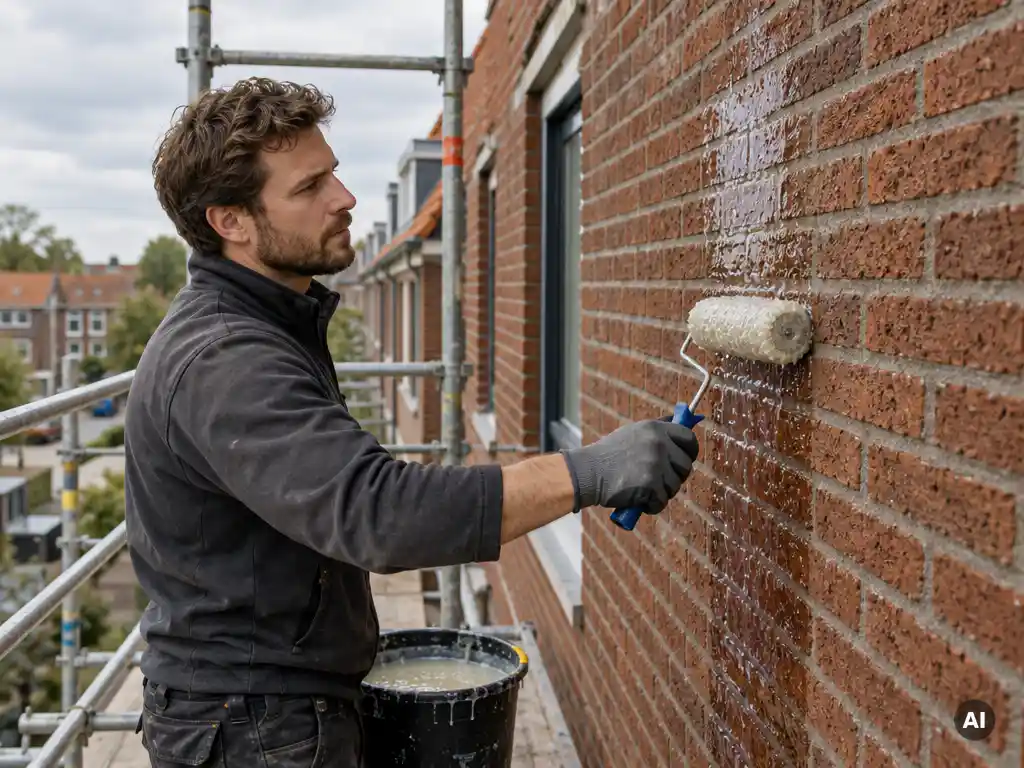
You use a gel-based impregnating agent in professional facade protection when you want a longer contact time than a liquid gives on vertical surfaces, in hard-to-reach areas or on porous mineral substrates. Because of its gel form, the product runs off less. Specialists choose a gel mainly when moisture content, porosity and the way the work is carried out call for it.
A liquid impregnating agent remains a good choice in many situations. Below you can read, question by question, when each form is suitable and what to look out for during application.
Why does a gel penetrate deeper than a liquid impregnating agent?
A gel does not necessarily penetrate deeper, but it stays in contact with the substrate for longer. On vertical surfaces, liquid quickly runs downwards, whereas a product in gel form stays where you apply it. This longer contact time gives the active components more opportunity to be absorbed into the pores of the facade.
With a facade impregnation, what counts is absorption by the substrate. An impregnating agent does not form a layer on top of the masonry. It works inside the pores, so that the facade becomes water-repellent without the surface being smeared shut. For facade impregnation of masonry, this usually involves a combination of alkylsilanes and (poly)siloxanes.
How much product a substrate absorbs depends on the porosity and moisture content of the facade. A gel does not automatically compensate for a wet or dense substrate. Therefore, always check the condition of the facade first and apply a test patch.
What is the difference between gel and liquid impregnation?
The main difference lies in the consistency. Thanks to its gel form, a gel stays on the surface and gives a long contact time, whereas a liquid impregnating agent is thinner, flows out more easily and is absorbed or runs off faster. Both forms have the same purpose: a water-repellent facade treatment.
In practice, you will see these differences:
- Gel: stays in place on vertical surfaces, gives a controlled dosage in one spot and suits hard-to-reach areas.
- Liquid: spreads quickly over large surfaces, is absorbed easily and suits flat, open facades where you want to work efficiently.
The choice therefore does not depend on which form is better, but on the situation on site. The nature of the substrate, accessibility and the method of application all play a role. The actual protective effect comes from the active components in the product, not from its form.
On which facade substrates does an impregnating gel work best?
An impregnating gel works best on porous mineral substrates that you want to treat vertically and evenly, such as brick, concrete, sandstone and terracotta. The gel form keeps the product on the facade, so that the substrate can absorb it slowly. Always check suitability in advance with a test patch.
Do not make absolute assumptions about natural stone. Not every natural stone reacts to a product in the same way, and pointing, calcareous types of stone and finishing materials require extra attention. Always consult the product data sheet and the label of the chosen product for the applicable substrates.
Good preparation determines the result. Only impregnate on a clean, dry substrate. If the facade has dirt, efflorescence or cement haze, tackle it first with professional facade cleaning. Rinse the substrate thoroughly and let it dry before you treat it. This prevents dirt or moisture from being left behind under the impregnation.
When is a liquid impregnating agent the better choice?
A liquid impregnating agent is the better choice on large, flat and easily accessible facades where you want to work quickly and evenly. You can apply it efficiently over a large surface and it is absorbed easily. On horizontal or slightly sloping surfaces, you do not need a gel form to make the product stay in place.
Also choose a liquid when the way of working is set up for it. Think of working with fixed work methods and equipment for larger surfaces. A gel then offers little added value, because the longer contact time is not needed on such surfaces.
Are you torn between the two forms? Then assess the facade, the accessibility and the product that suits the substrate. A test patch often gives a direct answer to the practical question of which form works best on your project.
How is an impregnating gel applied to the facade?
You apply an impregnating gel in an even layer with the tools prescribed by the product data sheet, on a clean, dry and suitable substrate. Work systematically, observe the stated reaction time and leave the execution to specialists. For the exact method, follow the product data sheet and the label.
A practical sequence looks like this:
- Assess the facade and check the moisture content of the substrate.
- Clean the facade and let it dry completely.
- Protect surrounding parts, such as window frames, glass, plants and finishing materials.
- Apply a test patch to assess suitability and the result.
- Apply the product evenly according to the product data sheet.
- Let the product take effect and protect the treated surface from rain according to the product information.
Temperatures, reaction times and consumption differ per product. Therefore, do not use general guideline values, but the data on the product data sheet of the product you are applying.
How long does a gel impregnation protect and when should it be repeated?
A facade impregnation generally protects for a maximum of ten years, unless the product data sheet of the chosen product states a different service life. The actual duration depends on the substrate, weather influences, the execution and maintenance. A gel does not automatically change that service life.
Repeat the treatment when the water-repellent effect noticeably decreases. You can see this, for example, when water no longer beads off and soaks into the facade. Have the facade assessed by specialists before you treat it again. A new impregnation again starts with a clean, dry substrate.
Take care with anti-graffiti coatings. A semi-permanent coating disappears during graffiti removal and must be reapplied. A permanent coating withstands multiple cleaning rounds, but the number differs per system. Anti-graffiti coatings can also take over the function of facade impregnation, so we do not recommend the combination as standard. If you have questions about graffiti protection, take a look at our graffiti removers.
How Mavro helps with professional facade protection
With a facade treatment, it is all about the right combination of product, substrate and execution. We help you with this using knowledge from the field and products that we develop, test and supply ourselves.
- Tailored advice: our technical advisers look at the substrate and the soiling on site and help think through the right approach.
- Test patches: we apply test patches to assess the suitability of a product before you start the whole job.
- Training and support: we show you how to apply the product, so that the result is an interplay of product and craftsmanship.
- Wide range: from facade cleaning to facade impregnation and protective coatings for facades and window frames.
Would you like to know which solution suits your project? Contact us or call +31 (0) 418 680 680. We are happy to think along with you, from question to application.