
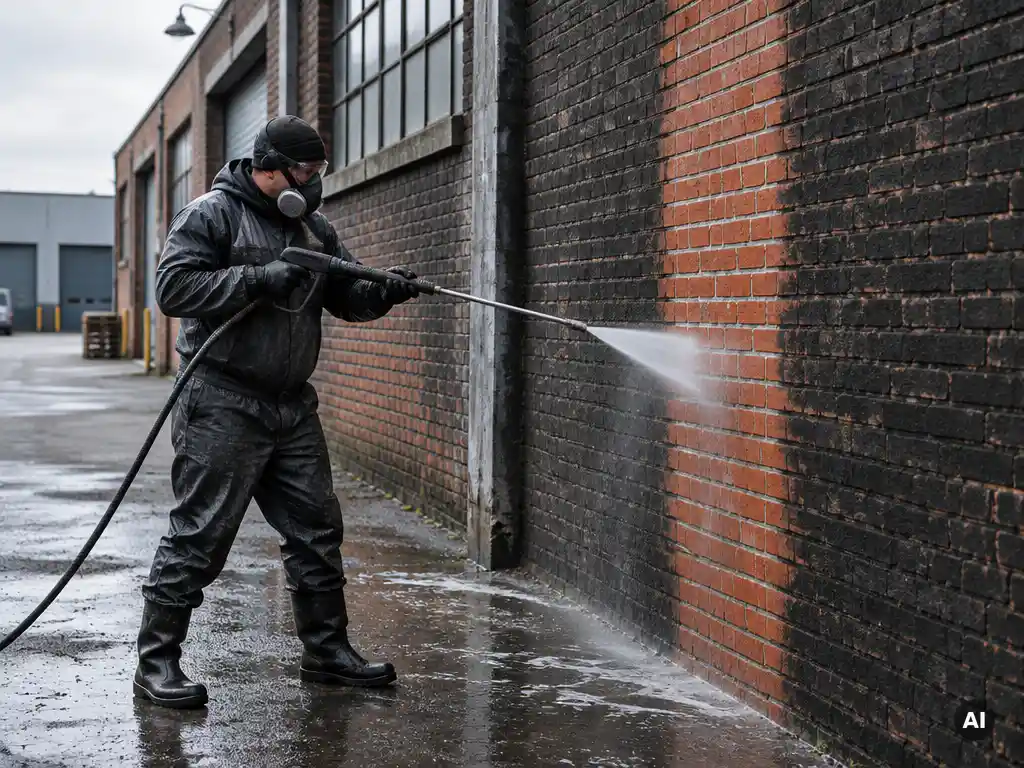
For soot and industrial pollution on mineral facades, choose an alkaline facade cleaner based on sodium hypochlorite, such as Facadeclean HC, or an acidic facade cleaner for extremely soiled substrates. The right choice depends on the type of substrate and the nature and degree of the soiling. Below, you can read per question which cleaner is suitable for what and how to treat the facade professionally.
Why does soot adhere more stubbornly to facades than ordinary dirt?
Soot adheres stubbornly because it consists of fine, greasy and often oily particles that settle into the pores of mineral substrates. As a result, it does not dissolve in water and remains visible as a grey or black film even after simple high-pressure cleaning.
Industrial pollution rarely consists of a single component. Besides soot, you often find atmospheric pollution, organic deposits and green growth on the same facade. An open, porous substrate such as brick or concrete holds on to these components especially well. That is why a cleaner with a longer contact time and a powerful action works better than just water and a brush.
Which type of facade cleaner works best against soot?
An alkaline facade cleaner based on sodium hypochlorite effectively tackles organic and atmospheric pollution. Facadeclean HC is such a concentrated cleaner for soiled mineral substrates. For heavier soiling, acidic facade cleaners work well, such as Facadeclean, Facadeclean Gel or Facadeclean Strong, which we explain per substrate further below.
The distinction between the two types helps you choose a product:
- Alkaline cleaner (Facadeclean HC): based on sodium hypochlorite and sodium hydroxide, with a pH of 12 to 13. The product removes atmospheric, organic and green contamination and foams strongly, so you can apply it with foam equipment for a longer contact time. Rinsing is not necessary with this product, but it can help remove the last residues.
- Acidic cleaner (Facadeclean): based on ammonium bifluoride, intended for heavily soiled mineral substrates.
- Acidic cleaner in gel form (Facadeclean Gel): the same base, but thanks to the gel form the product does not drip. This works well on vertical surfaces and hard-to-reach spots.
- Very powerful acidic cleaner (Facadeclean Strong): based on hydrofluoric acid and phosphoric acid, for extremely soiled mineral substrates.
Start with the milder product and only move to a more powerful cleaner if the soiling requires it. Always do a test patch in an inconspicuous spot before use.
Which facade cleaner suits concrete, brick or natural stone?
Concrete and brick are mineral substrates on which Facadeclean HC and the acidic Facadeclean products are used. With natural stone, you look at how each type of stone reacts to the product. Not every natural stone reacts the same way to acids or alkaline agents, so a prior test is necessary.
The following applies per product:
- Facadeclean HC: applicable to, among others, concrete, slate, brick, unpolished marble, stucco, sandstone, basalt-like stone and granite. Do not use on metal.
- Facadeclean and Facadeclean Gel: suitable for most mineral substrates, including granite, sandstone, concrete, slate, brick, terracotta, unpolished marble, stucco and basalt-like stone. Both can attack calcareous stone types.
- Facadeclean Strong: suitable for most mineral substrates, including granite, sandstone, concrete, slate, brick, terracotta, unpolished marble, stucco and basalt-like stone. This product can also attack calcareous stone types.
Do you have a calcareous stone type, or are you unsure about the composition of the substrate? Then ask our technical advisors for advice before you start.
How do you clean soot from a facade step by step?
You clean soot from a facade by applying the chosen product, letting it take effect and then cleaning the substrate. The exact method differs per product. Below is the method for Facadeclean HC, as described in the product data sheet. You can read more background on the approach in our application facade cleaning.
- Do a test patch in an inconspicuous spot on the facade.
- Choose the dilution based on the soiling: 1:2 for light soiling, 1:1 for moderate soiling and undiluted for extreme soiling.
- Apply Facadeclean HC with a low-pressure sprayer, brush or foam equipment. On vertical surfaces, work from the bottom up.
- Let the product take effect for 20 to 45 minutes.
- Optionally rinse afterwards to remove the last residues. This is not necessary, but can be effective.
- Repeat the treatment if needed.
The theoretical consumption of Facadeclean HC is between 5 and 15 m² per litre, depending on the soiling and the porosity of the substrate. If you use an acidic cleaner such as Facadeclean Gel or Facadeclean Strong, follow the instructions for use of that specific product. For both, you must keep the substrate moist during the dwell time and then clean it with a high-pressure sprayer. Dilutions, dwell times and pressure values differ per product, so always read the product data sheet.
Which safety and environmental rules apply to professional facade cleaning?
For professional facade cleaning, you follow the instructions on the product data sheet, the label and the safety data sheet. These differ per product. Work with suitable personal protective equipment and leave the execution to specialists who know how the product and the substrate behave.
A number of points from our product documentation require extra attention:
- Never mix facade cleaners with other products. With Facadeclean HC and Facadeclean Strong, pay extra attention to combinations with alkaline or acidic products and ammonia, because of toxic fumes.
- Facadeclean Strong causes severe burns and eye damage. Avoid skin and eye contact and wear suitable gloves, protective clothing and safety goggles.
- Facadeclean HC is corrosive to metals. Protect exposed metal surfaces and use only application equipment made of chemically resistant plastic.
- Do not apply the cleaner to hot substrates or in full sun, and do not let the product dry out.
If in doubt, always consult the safety data sheet or our R&D department. The user remains responsible for product choice, application and result.
How do you prevent soot from quickly returning after cleaning?
You limit returning soot by protecting the cleaned facade. Impregnation or hydrophobic treatment makes a facade water-repellent and weather-resistant, so moisture, algae, moss and atmospheric pollution get less grip. Cleaning then becomes much easier and cheaper.
Pay attention to the order. Make sure the substrate has been fully rinsed and dried before you apply a coating or impregnation, especially after cleaning with Facadeclean HC. The moisture content of the substrate is an important point of attention here. Read more about facade impregnation and hydrophobic treatment to determine which system suits your substrate. This is generally a combination of alkylsilanes and (poly)siloxanes, with a service life of up to ten years, unless product-specific information states otherwise.
Is it about non-porous facade cladding or window frames? Then impregnation is not the right method. For weathered facade cladding, we have renovation coatings, such as Nitowax, Nitoshield, Nitocryl® and the colour-restoring coating Nitocolour.
How Mavro helps with removing soot and industrial pollution
We supply the right facade cleaner and the accompanying advice for your project. Every product in our range is developed and tested for professional use, and we help you think through the combination of cleaning and protection.
- A suitable product for your substrate and degree of soiling, from Facadeclean HC to Facadeclean Strong.
- Facadeclean Gel for vertical surfaces and hard-to-reach spots.
- Advice from our technical advisors and R&D department if you are unsure about the stone type or soiling.
- Training and support during application, so your specialists use the product correctly.
- A free sample of Facadeclean Gel on request, so you can experience how it performs on your project.
Is there also graffiti on the facade? Then take a look at our graffiti removers. Want to know which cleaner suits your facade? Contact us or call +31 (0) 418 680 680. We are happy to help you think it through.