
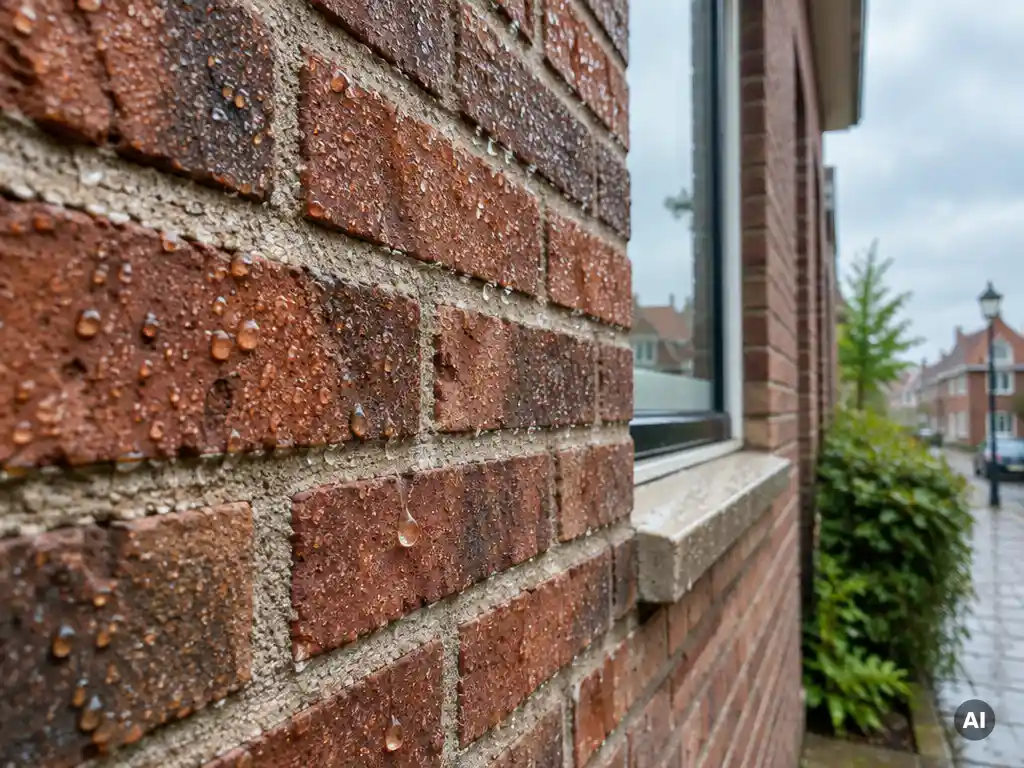
For a previously impregnated facade, choose a facade impregnation agent based on a combination of alkylsilanes and (poly)siloxanes that is compatible with the existing treatment and for which the substrate has a sufficiently low moisture content and sufficient permeability. First check whether the old impregnation still works, then choose the product and the preparation.
Whether a new agent is absorbed properly depends on the condition of the substrate, the residues of the old treatment, and the chosen system. Below you can read, question by question, what specialists assess before impregnating again.
Why does a new impregnation agent sometimes fail to penetrate after an old impregnation?
A new impregnation agent penetrates the substrate poorly if the pores are still filled with residues of the previous treatment, dirt, or deposits. An impregnation does not bond as a coating on the surface, but penetrates into the material. A closed or contaminated pore structure prevents this.
Several causes play a role here:
- Residues of the old treatment: a hydrophobic layer that is still present can slow the absorption of the new agent.
- Contamination and deposits: algae, soot, salts, or cement residues fill the pores and block penetration.
- Incompatible components: different systems do not always react well with each other.
- Moisture content too high: a damp substrate absorbs the agent less evenly.
A test patch gives clarity in advance about absorption and the final result.
How do you determine whether a facade is still water-repellent?
You test whether a facade is still water-repellent by applying water to the surface and observing what happens. If the water beads up or runs off, the impregnation still works. If the water is quickly absorbed into the stone and leaves a dark patch, the water-repellent effect has diminished.
Carry out this check in several places, because weather exposure differs per side of the facade. Pay attention to differences between the upper and lower sections, and between the sunny side and the rain side. Also check whether the facade is visibly contaminated. Dirt can distort the result, because a soiled surface reacts differently from a clean substrate.
If in doubt, a test patch on a representative section of the facade helps. This way you can assess the effect without treating the entire facade.
Which type of facade impregnation agent is suitable for a previously treated facade?
For a previously treated facade, a facade impregnation agent based on a combination of alkylsilanes and (poly)siloxanes is generally suitable. The agent penetrates the substrate and makes it water-repellent, while the facade remains vapor-permeable. The choice must suit the substrate and what was applied previously.
Take these points into account when choosing:
- the type of substrate, such as brick, concrete, or natural stone
- the porosity and moisture content of the facade
- the type of previous treatment, as far as known
- whether an anti-graffiti coating is already present on the facade
That last point is relevant, because anti-graffiti coatings can take over the function of facade impregnation. We therefore do not recommend a combination as standard. Explore the options for facade impregnation and water-repellent treatment and always check the product sheet and label for application and safety.
Does the old impregnation have to be removed first?
In most cases the old impregnation does not need to be removed completely, as long as the facade is clean and the new agent can still penetrate sufficiently. An impregnation sits inside the stone and cannot be scraped off as a layer. What you do remove are the contamination and deposits that block absorption.
Specialists assess per situation whether additional steps are needed. For a facade with a closed surface or clear residues of a previous coating, a test patch can show whether the agent is still absorbed properly. Are you unsure whether a previous layer was an impregnation or a coating? Have that determined first, because the approach differs.
A semi-permanent anti-graffiti coating disappears during graffiti removal and must then be applied again. For graffiti residues on the facade, take a look at the graffiti removers, which we apply undiluted.
How do you prepare a previously impregnated facade for re-impregnation?
You prepare a previously impregnated facade by cleaning it thoroughly, letting it dry, and checking it for damage. Only then do you apply the new agent. A clean, dry, and intact substrate determines whether the impregnation agent is absorbed evenly.
The preparation consists of the following steps:
- Cleaning: remove algae, soot, lime efflorescence, rust stains, and cement residues with a cleaner suited to the substrate and the contamination.
- Rinsing and drying: ensure a sufficiently low moisture content before you impregnate.
- Checking: repair cracks, pointing, and damage, because impregnation does not fix those.
- Applying a test patch: assess absorption, color, and appearance on a small spot.
The right cleaner depends on the contamination and the substrate. Acidic cleaners, for example, remove lime, rust, and cement residues, but attack calcareous types of stone. Alkaline cleaners work well against green deposits, grease, and oil, but are not suitable for every substrate. Read more about professional facade cleaning and always apply a test patch first.
How often does a facade need to be re-impregnated?
A facade impregnation generally lasts a maximum of ten years, unless product-specific information indicates otherwise. There is no fixed moment. The actual lifespan depends on the substrate, the weather exposure, and the components used. Therefore, check regularly whether the facade is still water-repellent.
Facades that take a lot of rain and wind wear faster than sheltered facades. If you notice that water no longer beads up or that the facade develops damp patches, re-impregnation is worth considering. A periodic check with a water test offers more guidance than a fixed interval.
How we help with re-impregnating facades
With us, you get advice that suits your facade and project. Our technical advisors inspect substrates and contamination in the field every day, apply test patches, and support you in starting up large projects. This way you choose a system that suits the previous treatment.
- advice on the condition of the substrate and the previous impregnation
- help choosing a cleaner for the preparation
- test patches to assess absorption and appearance in advance
- training for specialists who apply the product
Would you like to know which facade impregnation agent suits a previously impregnated facade? Contact us or call +31 (0) 418 680 680. Our advice is free of charge.