
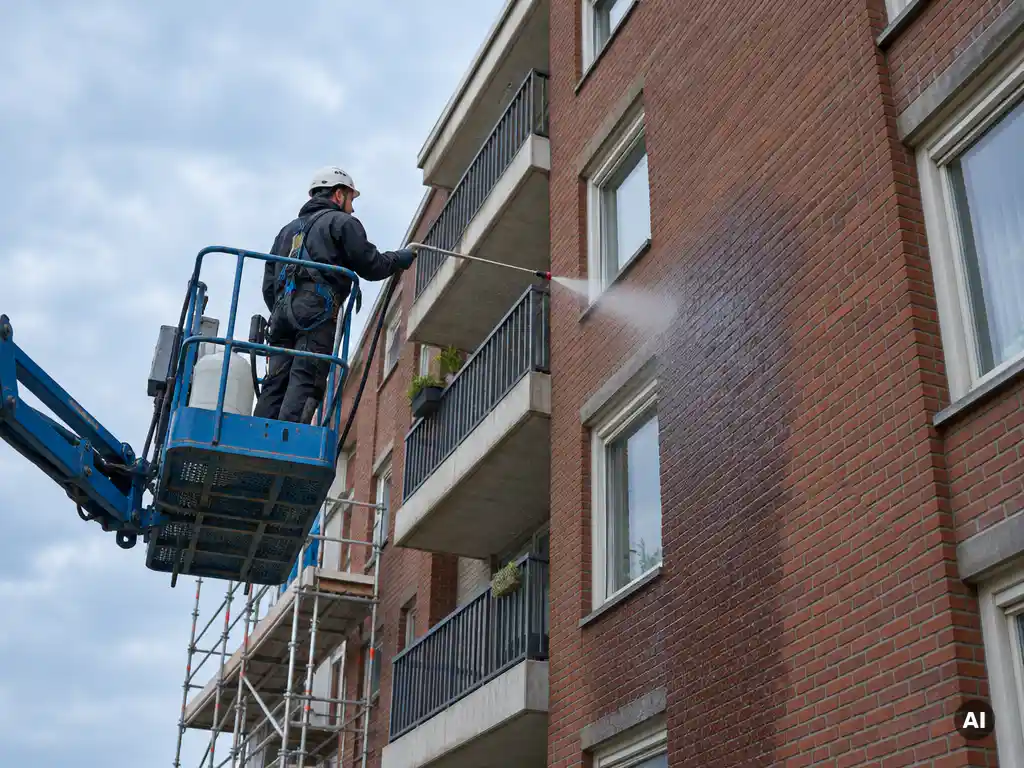
You calculate the amount of impregnating agent you need by dividing the facade surface area to be treated in m² by the coverage per liter of the chosen product, and then adjusting that result for the absorbency of the substrate. The coverage is listed on the product data sheet, but in practice it often deviates from that figure.
On a large facade project, every deviation counts: a difference of a few tens of milliliters per m² adds up to a considerable number of extra liters across thousands of m². Below, you can read which data you need, how to calculate, why materials differ, and how much margin to allow for.
What data do you need for a reliable calculation?
For a reliable calculation, you need four pieces of data: the exact surface area of the facade in m², the type of facade material, the absorbency and moisture content of the substrate, and the consumption indication on the product data sheet of the chosen impregnating agent.
A good starting point is accurate measurement. Use building plans or measure up the facade, and add up the facade surfaces separately. Subtract large openings such as windows and doors, and count details such as drip sills, plinth courses, and recessed panels as a separate surface.
Also note down:
- the material (brick, concrete, calcium silicate, natural stone, or rendered surfaces);
- the condition of the substrate, such as pointing, cracks, and previous treatments;
- the absorbency and moisture content at the time of application;
- the application method, for example low-pressure spraying or rolling.
A clean, dry substrate is a prerequisite for a good result. Also read how professional facade cleaning prepares the substrate before you start impregnating.
How do I calculate consumption per m² step by step?
You calculate consumption by multiplying the total net facade surface area in m² by the consumption in liters per m² from the product data sheet, and then adjusting that for the porosity of the substrate. The result is the minimum number of liters you need.
Work out the calculation in five steps:
- Determine the gross surface area: width times height for each facade surface.
- Subtract openings: windows, doors, and other parts you will not treat.
- Add detail surfaces: reveals, drip sills, and projecting sections.
- Consult the product data sheet: note the stated coverage or consumption for your type of substrate.
- Multiply: net surface area times consumption per m² gives the base quantity in liters.
An example for illustration: with 2,000 m² of net facade and an assumed consumption of 0.3 liters per m², you arrive at 600 liters. That figure is a calculation example, not product data. Always use the consumption that applies to your product and substrate.
Why does consumption differ by facade material and substrate?
Consumption differs because every facade material has a different porosity and absorbency. A highly absorbent substrate takes up more impregnating agent than a dense, low-absorbency substrate. Roughness, cracks, pointing, and previous treatments also influence how much product the facade absorbs.
Porous materials such as certain types of brick and calcium silicate often absorb more product than dense concrete surfaces. Natural stone reacts differently depending on the type, so do not draw general conclusions from a single type of stone. Smooth surfaces result in lower consumption than rough or profiled surfaces, because the actual surface area is larger than the measured m².
Moisture content also plays a role. A damp substrate absorbs less and can negatively affect the result. Specialists therefore measure absorbency and moisture content before application. You can read more about how water-repellent protection works under facade impregnation and hydrophobing.
How do I determine actual consumption with a test area?
You determine actual consumption with a test area of a pre-measured surface on a representative part of the facade. You weigh or measure the amount of product used, divide it by the number of m², and extrapolate this to the total project.
Proceed as follows:
- Choose an area that matches the average of the facade, for example 10 to 20 m².
- Clean the substrate and allow it to dry sufficiently.
- Apply the impregnating agent according to the product data sheet and using the method you will also use in the project.
- Record the exact amount of product you use.
- Divide the liters used by the number of m² to get the actual consumption per m².
On large facades, set up a test area on multiple facade sides or material types. A north-facing facade with algae growth and a south-facing facade with plenty of sun may absorb differently. The test area also shows whether the substrate is suitable and whether the result meets expectations. For application, always consult the product data sheet and the label.
How much extra impregnating agent should I order as a margin?
Order a margin on top of the calculated consumption, so that you do not run out of product during application. The size of the margin depends on the accuracy of your measurement, the variation in the substrate, and the waste during application. Determine the margin together with a technical advisor based on your test area.
When determining the margin, take into account:
- variation in absorbency between facade sides and materials;
- losses from spray mist, wind, and residual volume in equipment;
- repair work and follow-up treatment of missed spots;
- the available packaging sizes, so that you are not left with unnecessary leftovers.
Preferably order all the product you need from a single production batch. This keeps the composition consistent and prevents differences between sections of the facade. An order that is too tight quickly leads to downtime on site, and on a large project that is more expensive than a slightly larger stock.
How Mavro helps with calculating impregnating agent
We support you on large facade projects, from the initial estimate to the execution. Our technical advisors regularly visit projects to inspect substrates, set up test areas, and assist customers in starting up large projects.
Here is what you can expect from us:
- advice on the right impregnating agent for your facade material;
- help with setting up and assessing a test area;
- a substantiated consumption estimate based on the product data sheet;
- training for specialists on correct application;
- support from our R&D department for special issues.
Do you have a large facade project in preparation? Contact us or call +31 (0) 418 680 680. We are happy to think along with you about the calculation and the approach.