
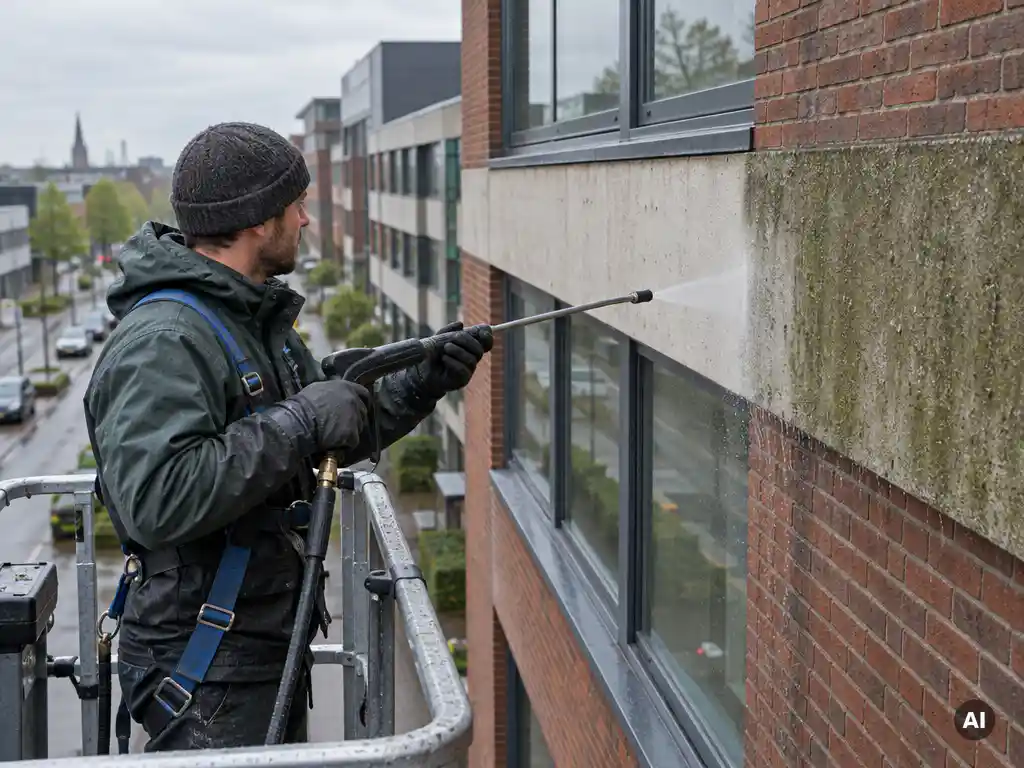
For periodic maintenance of a real estate portfolio, you choose the facade cleaner based on the facade material and the type of soiling: acidic cleaners for heavy soiling on acid-resistant mineral substrates, alkaline cleaners for organic dirt, soot and oil, and bleach-based cleaners for green growth. A test patch per property determines whether the chosen product is suitable.
This applies to you as a property manager or facility manager maintaining multiple buildings with different facades. Below, you can read per question how to make the right choice, how to set up the schedule, and when protection after cleaning makes sense.
Which cleaning product suits which facade material?
The facade material and the type of soiling together determine the right cleaning product. Acid works on acid-resistant mineral substrates such as brick and concrete, alkaline works on organic dirt and soot, and bleach-based works on green growth. Substrates react differently, so always do a test patch.
Facade cleaners are strongly acidic or alkaline products. Used incorrectly, they cause damage. Therefore, keep the following principles in mind:
- Acidic facade cleaners: use these only on acid-resistant facades. They will etch calcareous natural stone. Facadeclean Gel is an acidic facade cleaner in gel form based on ammonium bifluoride for heavily soiled mineral substrates. The gel form stays well in place on vertical surfaces and provides a long contact time. Facadeclean Strong is a liquid acidic cleaner based on hydrofluoric acid and phosphoric acid for extremely soiled substrates. Specialists use this product only when other products offer no solution.
- Alkaline facade cleaners: use these only on alkali-resistant substrates, so not on marble or aluminium. They work on stubborn organic dirt, soot, oil and atmospheric deposits.
- Bleach-based facade cleaners: Facadeclean HC is a concentrated cleaner based on sodium hypochlorite. It removes atmospheric, organic and green soiling without the need to rinse afterwards. Thanks to its foaming properties, you apply it with foam equipment for a longer contact time. You use it on facades, roofs, terraces, balconies, walkways and paving.
Also pay attention to plants, paintwork and finishing materials on the facade. Never mix products with each other and take extra care with alkaline products. For application and safety, we refer to the product data sheet and the label. You can read more about the approach in our facade cleaning section.
How often should a facade be cleaned periodically?
There is no fixed interval that applies to every facade. The cleaning frequency depends on the location, the facade material, the degree of soiling and the appearance you want to maintain as an owner. An inspection per property provides the basis for your own maintenance schedule.
Factors that determine the frequency:
- Environment: facades along busy roads collect soot and atmospheric pollution faster than facades in a quiet environment.
- Moisture content and shade: a facade with a high moisture content and little sun develops green growth faster.
- Facade material: porous substrates hold on to dirt more quickly than closed surfaces.
- Appearance: for prestigious buildings, you tackle soiling sooner than for commercial buildings.
Our technical advisors inspect substrates and soiling in the field every day and set test patches. This way, you record per property how quickly soiling returns and adjust the interval based on observations, not on assumptions.
What requirements apply to environmentally friendly facade cleaners?
There is no fixed definition of environmentally friendly for facade cleaners. Assess a product on the product-specific data in the technical data sheet, such as composition and biodegradability. A biodegradable product is not automatically safer, milder or plant-based.
As a property manager with sustainability goals, you should therefore ask suppliers for concrete documentation. Pay attention to these points:
- Check in the data sheet which properties the manufacturer substantiates. Facadeclean and Facadeclean Gel, for example, list biodegradability as a property.
- Read the composition. Acidic, alkaline and bleach-based cleaners each have their own points of attention for use and surroundings.
- Work according to the data sheet and label, with appropriate protection of plants, paintwork and finishing materials.
- Have the work carried out professionally by specialists, so that dosage and application comply with the instructions.
Targeted application also helps. Appropriate pressure, supported by a chemical facade cleaner, prevents you from damaging vulnerable brickwork with blasting or excessively high pressure.
How do you standardize facade maintenance across multiple properties?
You standardize facade maintenance by recording the substrate and soiling per property, linking a fixed cleaning product and method to them, and bundling everything into a maintenance schedule. This way, you work consistently, keep costs predictable and compare properties objectively.
A practical approach consists of four steps:
- Take inventory of the facades. Note the facade material, the type of soiling and the accessibility for each property.
- Group properties with similar facades. For each group, you choose a suitable cleaning product, for example a gel-form acidic cleaner for vertical brick facades or a bleach-based cleaner for green growth.
- Set a test patch per property. This confirms that the chosen product suits the substrate before the entire facade is treated.
- Record the working method. Include product choice, application method and executing specialists in your schedule, so that each execution is consistent with the previous one.
Training helps here. A product only works well if you use it properly, and a successful result remains a combination of products and craftsmanship.
Is a facade protection layer worth it after cleaning?
Yes, in many cases. Facade impregnation or a protective coating makes a facade water-repellent and weather-resistant, giving moisture, UV radiation, algae, moss and atmospheric pollution less chance. Cleaning then becomes easier and cheaper. The choice depends on the facade material and the desired result.
Facade impregnation (hydrophobing) involves a combination of alkylsilanes and (poly)siloxanes. Which type of protection is suitable depends on the substrate. You choose from water-based coatings, solvent-based impregnating agents and creams. You can find more details at facade impregnation and hydrophobing.
If you have graffiti problems, an anti-graffiti coating can take over the function of facade impregnation. Therefore, do not combine the two as a matter of course. A semi-permanent coating disappears during graffiti removal and must be reapplied. A permanent coating withstands multiple cleaning rounds, with the number varying per system. Also take a look at our graffiti removers, which we apply undiluted.
For weathered facade cladding, impregnation is not the right method. For this, we have our own line of renovation and protection products, including semi-permanent coatings such as Nitowax, Nitoshield and Nitocryl® and the permanent, colour-restoring coating Nitocolour. The service life is generally a maximum of ten years, unless the data sheet states otherwise.
How Mavro helps with periodic facade maintenance for your real estate portfolio
We develop and produce facade cleaners and protection products in-house and support you from product selection to execution. This delivers the following for you:
- A suitable range of facade cleaners: acidic (Facadeclean, Facadeclean Gel, Facadeclean Strong), alkaline and bleach-based cleaners (Facadeclean HC).
- Technical advisors who inspect substrates and soiling and set test patches, including at the start of large projects.
- Training in product use for specialists, so that results remain consistent across multiple properties.
- Products for facade impregnation, renovation and protection of facade cladding and window frames.
- Advice and data sheets with product-specific data for your substantiation.
Want to know which approach suits your portfolio? Contact us or call +31 (0) 418 680 680. We will then discuss your properties and facade materials together.