
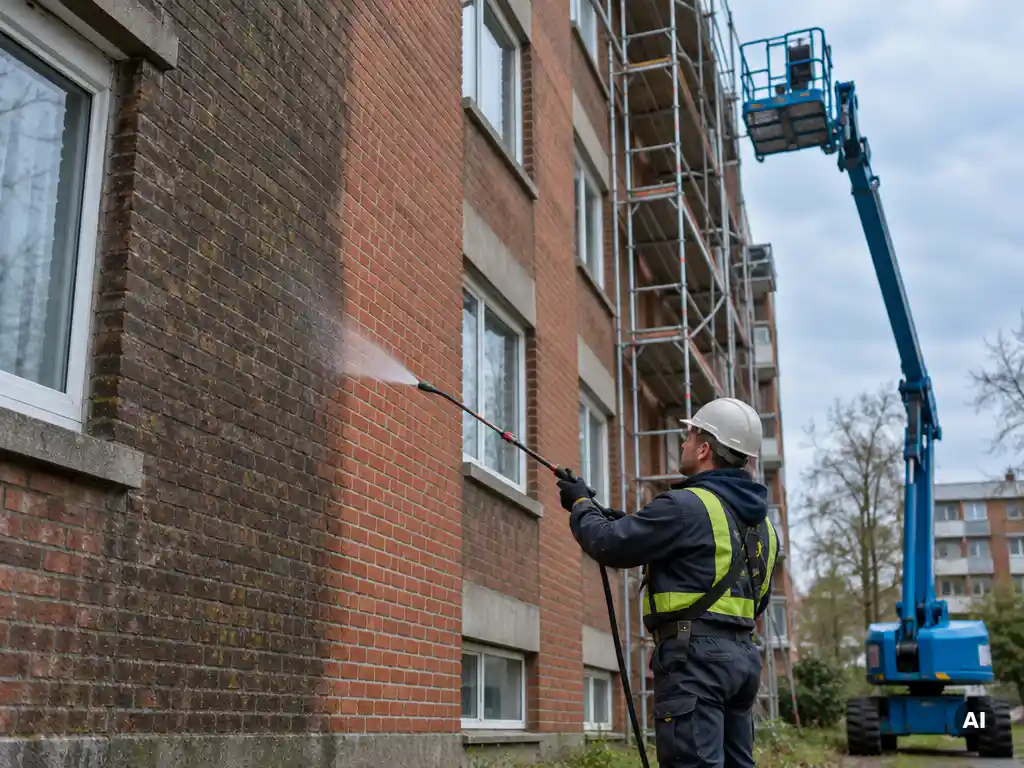
You calculate consumption by dividing the facade surface area to be cleaned in m² by the product-specific coverage in m² per liter. For our Facadeclean products, the theoretical coverage is 5 to 15 m² per liter. Actual consumption depends on the level of soiling and the porosity of the substrate. Below you will read how to calculate this step by step, including a test area and a safety margin.
Which formula do you use to calculate consumption per m²?
You divide the total facade surface area in m² by the coverage in m² per liter. A facade of 2,000 m² with a coverage of 10 m² per liter therefore requires 200 liters of undiluted cleaner. Always use the coverage figure from the data sheet of the chosen product.
The formula looks like this:
- Liters required = surface area (m²) ÷ coverage (m² per liter)
- Example with 5 m² per liter: 2,000 ÷ 5 = 400 liters (heavily soiled or highly porous)
- Example with 15 m² per liter: 2,000 ÷ 15 = approximately 133 liters (lightly soiled or low porosity)
The difference between the two results is large. Therefore, always calculate with a range and adjust it after the test area. Also take the actual facade surface area into account: window openings, frames, and parts that are not to be cleaned should be deducted from the gross surface area. Measure the facade section by section, so that you also account for differences in soiling.
Which factors determine the consumption of facade cleaner?
The nature and degree of soiling and the porosity of the substrate have the greatest influence on consumption. Green growth, soot, or atmospheric pollution require different amounts. An open, highly absorbent brick takes up more product than a dense brick.
The following factors also play a role:
- Type of substrate: brick, concrete, and natural stone react differently. Not every natural stone reacts the same way to acids or alkaline agents, so let the choice of product depend on the substrate.
- Moisture content of the facade: a wet or damp substrate absorbs differently than a dry substrate.
- Weather conditions: low temperatures can slow down the effect and call for an adjusted dwell time. Do not apply the product to hot surfaces or in full sun, and do not let it dry out.
- Number of treatments: for stubborn soiling, you repeat the treatment if necessary, which increases total consumption.
Want to know which approach suits your facade? Then take a look at our page on professional facade cleaning.
How do dilution and dosage affect the required quantity?
Dilution changes the amount of concentrate you need, but not the number of liters of working solution you apply to the facade. Therefore, always keep concentrate and working solution separate in your calculation, and follow the dilution from the data sheet of the relevant product.
For Facadeclean Strong, the data sheet specifies a dilution of 1:5 to 1:20 with water, depending on the soiling. The data sheet gives a theoretical coverage of 5 to 15 m² per liter for this product. Use this as a starting point and confirm it in the test area, because the nature of the soiling and the porosity determine actual consumption.
Facadeclean HC and Facadeclean Extra Strong each have their own product information. Therefore, always take the dilution, dwell time, and consumption from the data sheet of the product you are using, and never mix products with each other. Also keep in mind that the effectiveness of Facadeclean HC may decrease after approximately 6 months. To compensate for this, you can apply the product undiluted instead of using the recommended dilutions. Therefore, check the shelf life of your stock.
What is the difference in consumption between spraying, brushing, and high pressure?
The application method mainly determines how evenly you apply the product and how much product is lost, not the theoretical consumption per m². The data sheet does not provide consumption figures per method. Therefore, determine the difference in the test area.
This is what the data sheets indicate per method:
- Low-pressure sprayer or brush: you apply Facadeclean Strong with a low-pressure sprayer or brush. With Facadeclean Extra Strong, you use a soft brush and work from bottom to top to prevent run marks and staining.
- Foam equipment: Facadeclean HC has strongly foaming properties. With foam equipment, the product stays in place as a blanket of foam, which extends the contact time.
- High pressure: with the products from our data sheets, you use high pressure to rinse and clean after the dwell time, with a pressure between 50 and 200 bar depending on the substrate. You therefore do not apply the product itself with high pressure.
On fragile masonry, blasting and high-pressure cleaning can cause damage. By combining appropriate pressure with a chemical facade cleaner, you can often still achieve a good end result. The test area shows which method suits your facade.
How do you determine the right quantity for a test area?
Set up a test area of a few square meters on a representative part of the facade, measure the amount of product used, and extrapolate it to the total surface area. This way you replace the theoretical consumption with a measurable consumption for your project.
Work through these steps:
- Choose a test area with representative soiling and substrate. If the facade has multiple materials or different degrees of soiling, set up multiple test areas.
- Measure the surface area of the test area in m².
- Apply the product according to the data sheet, including dwell time and rinsing.
- Note the liters used and your assessment of the result, including on adjacent materials such as plants, paintwork, and finishing materials.
- Calculate the consumption per m²: liters used ÷ test area in m². Multiply this by the total surface area.
The test area also verifies the suitability of the product for the substrate. Therefore, always do a test patch before starting the entire project. If you plan a treatment with an impregnating agent or coating after cleaning, make sure the substrate has been fully rinsed and dried. You can read more about the next step on our page on facade impregnation and water repellent treatment.
How much extra facade cleaner should you buy as a margin?
There is no fixed margin that we can recommend for every project. Derive the margin from the difference between your test area result and the range on the data sheet, and calculate with more product if the facade is unevenly soiled or you need to repeat treatments.
When determining your margin, take the following into account:
- Repeat treatments: the data sheets state that you repeat the treatment if necessary.
- Differences within the project: north and south facades, undersides, and sheltered areas often become soiled differently.
- Packaging size: Facadeclean HC is available in 1 and 10 liters, Facadeclean Strong and Facadeclean Extra Strong in 10 liters. Round your order up to whole packages.
- Shelf life: Facadeclean Strong and Facadeclean Extra Strong have a shelf life of at least 24 months in the original unopened packaging. For Facadeclean HC, our product documentation states both 24 and 6 months, depending on the edition. Check this on the data sheet that belongs to your delivery.
For large projects, you can also have the margin determined by our technical advisors, who regularly set up test patches and assist customers when starting up large projects.
How Mavro helps with calculating facade cleaner consumption
A good consumption calculation requires product knowledge, a test area, and insight into the substrate. We support you with this through our technical advisors, who inspect substrates and soiling in the field every day.
- Advice on the right facade cleaner for your substrate and soiling
- Help with setting up and assessing test areas
- Product information with theoretical consumption, dilution, and application per product
- Training in the correct application of our products
For application and safety, always consult the data sheet and the label. Would you like to have your project calculated? Contact us or call +31 (0) 418 680 680. We are happy to think along with you.