


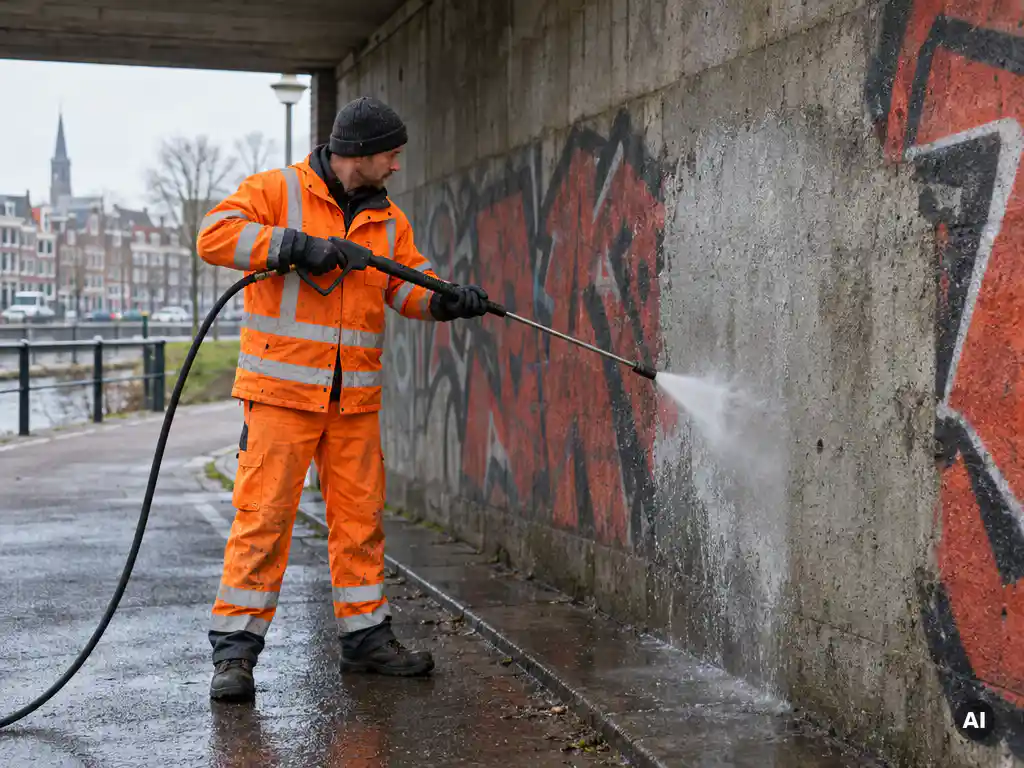
A suitable graffiti remover for municipal cleaning matches the substrate, the type of paint and the situation in the public space. No single product works everywhere: a municipality chooses per object, for example concrete, brick, metal or glass. Specialists match the product to the type of paint and the porosity of the substrate. Below you can read which factors determine the choice and how to remove graffiti with care.
Which substrates determine the choice of a graffiti remover?
The substrate determines which graffiti remover you can use, because porous and non-porous surfaces react differently to cleaning products. Concrete, brick and natural stone absorb paint, whereas metal, glass and plastic are non-porous surfaces. Always check the substrate first.
In public spaces you come across many different materials. Think of concrete viaducts, brick facades, steel electrical cabinets, traffic signs, bus shelters and transit stops. On porous substrates, paint penetrates deep into the material, which makes removing graffiti more difficult and can also leave a ghost image behind. You can read more about this problem in our article on removing graffiti ghosting.
Do not make absolute assumptions about a material. Natural stone, such as granite, does not always react the same way to acidic or alkaline products. The moisture content of the substrate and earlier treatments, such as impregnation, also affect the result. Therefore, test the product in an inconspicuous spot and follow the product data sheet and the label.
What types of graffiti removers are there for professional use?
For professional use, graffiti removers come in different forms, such as liquids and gels. Which type you choose depends on the substrate, the type of paint and the location where you are working. Specialists select the product based on these factors.
A gel stays in place better on vertical surfaces than a thin liquid. This is useful on facades, viaduct piers and noise barriers. A professional liquid graffiti cleaner, on the other hand, works well on flat, non-porous surfaces. Specialists apply our graffiti removers undiluted. You can find the full range on our page about graffiti removers.
Also pay attention to the composition of the product. Different components work on different types of paint, such as spray paint, markers or lacquer. Therefore, read the product data sheet for the application, the suitable substrates and the processing.
What environmental and safety requirements must a municipal product meet?
A municipal product must comply with applicable laws and regulations and with the municipality’s own procurement conditions. Exactly which requirements apply differs per municipality and per application. Therefore, always request the product data sheet and the safety data sheet.
In public spaces, pay particular attention to what happens with run-off water, bystanders, greenery and the surrounding surface. A biodegradable product is not automatically safer, milder or plant-based. So always assess the product-specific information instead of relying on a general claim.
Leave the execution to specialists who know the product information. They work according to the label and use the right protective equipment. This keeps the work manageable and prevents damage to the surroundings.
Is an anti-graffiti coating better than removal alone?
An anti-graffiti coating often pays off at locations that are regularly vandalized, because graffiti penetrates less deeply into the substrate and is easier to remove. Removal alone costs time and materials again and again when the nuisance keeps recurring. A coating reduces that recurring work.
There are two variants, which you need to keep clearly apart:
- Semi-permanent coating: this disappears when graffiti is removed and must be reapplied afterwards.
- Permanent coating: this withstands multiple cleaning cycles. The number differs per system.
Our Graffitiguard Permanent is an impregnating agent with anti-graffiti properties. Anti-graffiti coatings can also take over the function of facade impregnation. Therefore, do not recommend combining it with a facade impregnation based on alkylsilanes and (poly)siloxanes as a standard. The service life is generally a maximum of ten years, unless the product data sheet states otherwise.
How does a municipality remove graffiti safely, step by step?
A municipality removes graffiti safely by assessing the substrate, choosing the right product, testing first and then working according to the product data sheet. Have this work carried out by specialists. They master the correct sequence and the associated safety measures.
- Assess substrate and paint: determine the material, the porosity and the type of graffiti.
- Choose the right product: match it to the substrate and follow the product data sheet.
- Test in an inconspicuous spot: check whether the substrate tolerates the product well.
- Apply the product undiluted: you use our graffiti removers without dilution.
- Remove and rinse: work according to the label and watch the surroundings.
- Check the result: see whether a ghost image or residual paint remains.
If you are working on specific objects, additional points of attention apply. For buildings, you can find more information in our article on removing graffiti from buildings. For vehicles and stops, read more about removing graffiti in public transport.
What should a municipality look for when choosing a supplier?
When choosing a supplier, a municipality looks at product knowledge, demonstrable quality, complete product documentation and support with the application. A good supplier not only delivers the product, but also helps you make the right choice for your situation.
Assess the following points:
- Is a complete product data sheet and safety data sheet available?
- Can the supplier give advice on substrate and type of paint?
- Does the supplier offer training or support for specialists?
- Does the supplier work with a certified quality system?
Also ask about the range. A supplier that provides both graffiti removers and anti-graffiti coatings can give you coherent advice on removal and protection.
How Mavro helps with graffiti removal in public spaces
We develop, produce and test professional products for graffiti removal and protection. This helps you tackle graffiti in public spaces in a targeted way. Our work consists of:
- Graffiti removers that specialists apply undiluted.
- Graffitiguard anti-graffiti coatings in permanent and semi-permanent variants.
- Advice on the right choice per substrate and situation.
- Training and support with the application.
- Product quality within an ISO 9001-certified company.
Want to know which graffiti remover suits your objects? Contact us or call +31 (0) 418 680 680. We are happy to think along with you.