


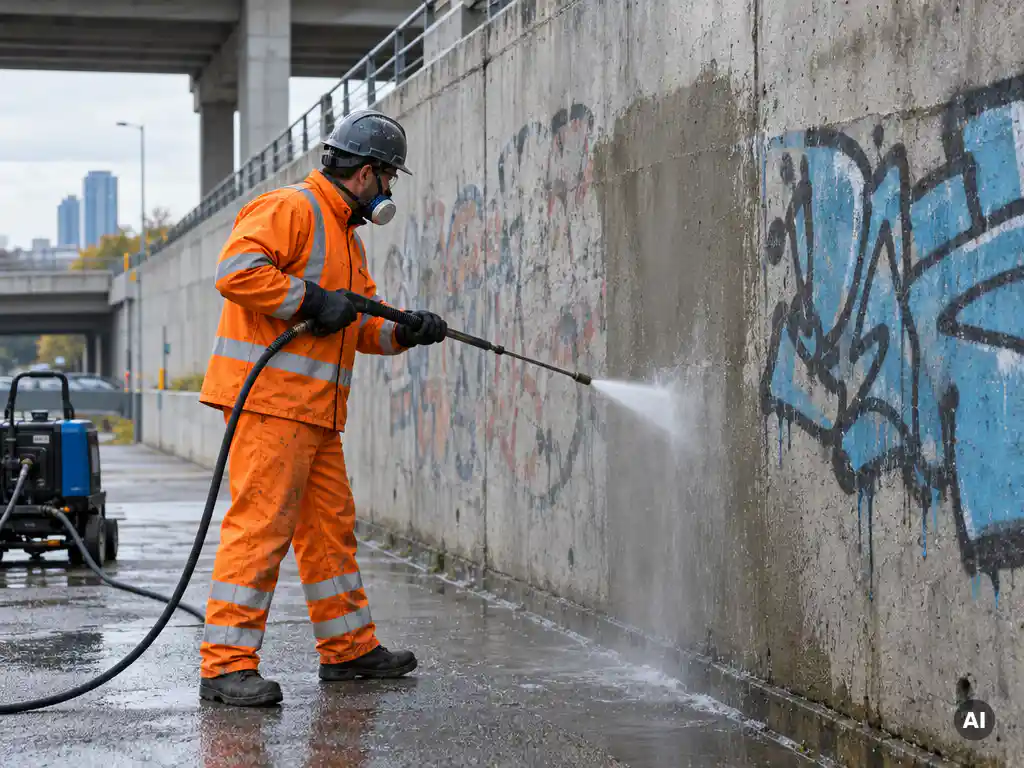
You can reduce graffiti removal costs on large projects the most by preventing graffiti or making removal easier with an anti-graffiti coating, choosing the right removal method for each substrate, and planning locations in bundled routes. This reduces the number of removal jobs and keeps each job shorter and cheaper.
The biggest savings usually lie in total maintenance costs over several years, not in the price of a single cleaning job. Below you can read which cost items count and how you, as a client or asset manager, can bring down costs per project.
Which cost items determine the total price of graffiti removal?
The total price of graffiti removal consists of labor, materials, equipment, access to the surface, and repetition. On large projects, the number of removal jobs matters most, because the same location is often vandalized again. Every recurring job therefore adds to your graffiti maintenance costs.
The main items at a glance:
- Labor: hours of specialists on site, including travel time and preparation.
- Materials: graffiti remover, tools, and any aftercare of the substrate.
- Equipment and access: aerial work platforms, scaffolding, barriers, and traffic measures for infrastructure.
- Downtime: for rolling stock and public transport, taking vehicles out of service costs extra.
- Repetition: recurring vandalism in the same spot multiplies all of the items above.
The substrate strongly influences costs. Porous materials such as concrete or brickwork often require more effort than sealed surfaces, because paint can penetrate deeper. You can find more about the approach per object on our page about removing graffiti from buildings.
How does an anti-graffiti coating reduce removal costs in the long term?
An anti-graffiti coating protects the substrate, so paint penetrates less deeply and graffiti can be removed faster and with fewer resources. This lowers labor and material consumption per removal. Over several years, this offsets the one-time investment in the coating.
The type of coating determines how you spread the costs over time:
- Semi-permanent coating: this is removed along with the graffiti and you then reapply it. This suits locations with limited vandalism or temporary protection.
- Permanent coating: this withstands multiple cleaning rounds. The number varies per system, so consult the product data sheet for your situation.
A coating generally has a lifespan of up to ten years, unless product-specific information states otherwise. Graffitiguard Permanent is an impregnating agent with anti-graffiti properties. Anti-graffiti coatings can also take over the function of facade impregnation, so an additional impregnation layer is not necessarily required. Have specialists assess which system suits each substrate.
Which removal method is the most cost-effective for large surfaces?
The most cost-effective method is the one that suits the substrate and the type of graffiti and does not damage the substrate. On large surfaces, a well-matched chemical system saves a great deal of time. A wrong choice leads to repeated work or damage, and that costs more than a careful first choice.
Pay attention to these points when choosing:
- Substrate: concrete, brickwork, metal, glass, and plastic react differently. Don’t make assumptions per material; even natural stone such as granite does not always react the same way to acidic or alkaline agents.
- Type of paint: spray paint, marker, and lacquer require a different approach.
- Product choice: specialists apply our graffiti removers undiluted. View the range on our page about professional graffiti removers.
- Ghosting: after removal, a residual shadow may remain. You can read how to tackle it at removing graffiti ghosting.
For application and safety, always follow the product data sheet and the label.
How do you plan graffiti control efficiently across multiple locations?
You plan graffiti control efficiently by bundling locations into fixed routes, prioritizing them by vandalism frequency and visibility, and responding quickly to new graffiti. This limits travel time and downtime and prevents vandalism from inviting more vandalism.
Practical starting points for clients:
- Map the locations: record where, how often, and on which substrate graffiti appears.
- Prioritize: tackle spots with a lot of repeat vandalism first, because that is where a coating delivers the most.
- Bundle the work: combine removal and coating in a single visit per location or route.
- Remove quickly: the shorter graffiti stays up, the less it gets copied.
- Work with a single point of contact: this ensures consistent methods and products across all locations.
In public transport and rolling stock, asset managers work with tight time windows. Read how this works in practice at removing graffiti in public transport.
How can training and product advice prevent waste and repair costs?
Training and product advice prevent waste because specialists use the right product on the right substrate and avoid unnecessary rework or damage. An incorrect approach can damage the substrate or a coating, resulting in repair costs that good advice could have prevented.
This is what advice upfront delivers in concrete terms:
- A product choice that suits the substrate and the type of graffiti.
- Less trial-and-error work on site.
- Clarity about when a coating needs to be reapplied, depending on the system.
- A uniform way of working when multiple teams or contractors work at different locations.
Stick to the product data sheets and labels. This keeps application and safety well safeguarded.
When does investing in prevention pay off more than cleaning alone?
Preventive graffiti protection pays off as soon as a location is vandalized several times a year. The sum of recurring removal costs then exceeds the one-time investment in a coating. For incidental vandalism, cleaning alone may be sufficient; for structural vandalism, protection is almost always more cost-effective.
Weigh these criteria:
- Frequency: the more often graffiti appears in the same spot, the faster a coating pays for itself.
- Accessibility: locations with expensive access, such as aerial work platforms or barriers, make every removal more costly.
- Substrate: porous substrates benefit greatly from a protective layer.
- Expected lifespan: count on a lifespan of generally up to ten years, unless the product data sheet states otherwise.
Ask a specialist for an estimate per location, so you can substantiate the choice between semi-permanent and permanent.
How Mavro helps reduce graffiti removal costs
We develop, produce, and supply professional anti-graffiti coatings and graffiti removers, and support you with advice and training for their application. This way, you choose an approach per project that suits the substrate and the level of vandalism.
- Graffitiguard coatings: available in permanent and semi-permanent variants for facades, infrastructure, and rolling stock.
- Professional graffiti removers: to be applied undiluted by specialists, according to the product data sheet and label.
- Advice per substrate: we help you choose the right system before the work begins.
- Training and support: for uniform and efficient execution across multiple locations.
Want to know what this means for your project? Contact us or call +31 (0) 418 680 680. We’d be happy to think along with you.