


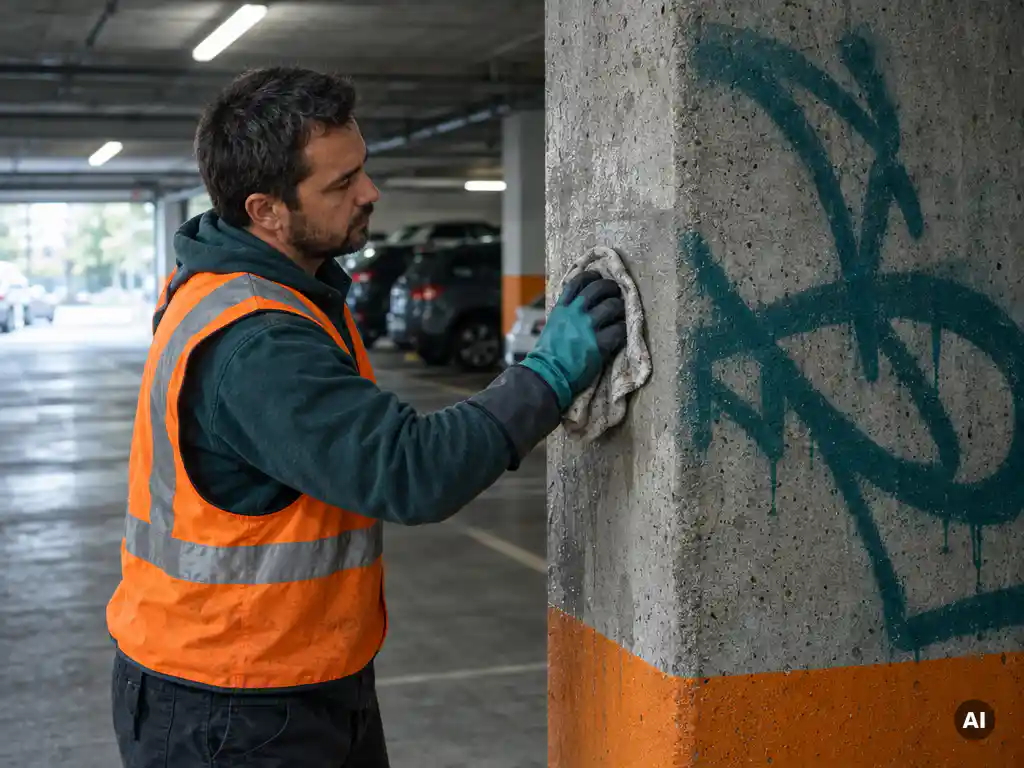
The most efficient way to remove graffiti in a parking garage is to first determine the substrate and the type of paint, then apply a suitable graffiti remover undiluted, let it take effect, and rinse thoroughly. Porous concrete requires a different approach than coated or smooth surfaces.
Ventilation, a fixed working sequence and protective measures determine how quickly and cleanly you get the result. Below, you can read per question what you need to know as a property manager or parking garage maintenance specialist.
Which substrates in a parking garage require a different approach?
Every substrate reacts differently to graffiti and to cleaning products. Rough, porous concrete absorbs paint deeply, while smooth, coated or varnished surfaces mainly keep the paint on the outside. Always determine the type of substrate first before choosing a product.
In a parking garage you will usually encounter several substrates:
- Untreated concrete: porous, so paint and spray can residue soak into the pores.
- Coated concrete floors and walls: the coating determines which products you can use.
- Metal, such as railings, doors and elevator housings: smoother, but susceptible to scratches and wear.
- Painted walls: here you sometimes remove the graffiti and the underlying paint in one go.
- Plastic and glass: often the signs, cover caps and elevator walls.
Always test a graffiti remover on an inconspicuous spot first. This shows you how the substrate reacts before you treat a larger area. Do not make assumptions about natural stone or finishing layers: not every substrate reacts the same way to acidic or alkaline products. Consult the product data sheet for suitable substrates.
Which method removes graffiti the fastest and most safely?
A chemical graffiti remover that matches the paint type and the substrate is usually the fastest and most controllable method. Mechanical techniques such as blasting can work, but they damage a concrete surface more quickly and create dust and waste in an enclosed space.
In practice you choose between three routes:
- Chemical removal: you apply a graffiti remover, let it take effect and rinse afterwards. This works in a targeted way and is gentler on the substrate than mechanical intervention.
- Mechanical removal: blasting or grinding also removes a layer of the substrate. This often leaves visible patches.
- Painting over: a temporary solution that ultimately clogs the substrate and makes maintenance more complicated.
Specialists apply our graffiti removers undiluted. This aligns the result with the method described in the product data sheet and prevents the effectiveness from decreasing through dilution. Leave professional application to specialists who follow the method, exposure time and aftertreatment from the documentation.
How do you remove graffiti from concrete step by step?
You remove graffiti from concrete by inspecting the surface, applying the graffiti remover undiluted, observing the recommended exposure time from the product data sheet, cleaning and rinsing afterwards. Then you check the result and repeat the treatment where necessary.
- Inspect the substrate: determine the type of concrete, any coating and the type of graffiti, such as spray paint, marker or pen.
- Test on a small area: check whether the substrate remains colorfast and whether the product gives the desired effect.
- Protect the surroundings: cover vehicles, plastic, glass and sensitive parts and cordon off the work area.
- Apply the product: follow the instructions from the product data sheet and use the graffiti remover undiluted.
- Let it take effect and clean: observe the prescribed exposure time and then remove the loosened paint.
- Rinse afterwards: completely remove residues of product and paint and let the surface dry.
- Check for ghosting: assess whether any outlines or color residues are still visible.
If discoloration remains after cleaning, it is often a so-called ghost image. Read more about removing graffiti ghosting. Porous concrete holds on to paint most stubbornly, so plan multiple treatment rounds for heavily soiled surfaces.
What should you pay attention to regarding ventilation and safety?
When removing graffiti in a parking garage, always ensure sufficient ventilation and follow the product data sheet and label of the product used. Parking garages are often semi-enclosed spaces, so vapors linger longer than outdoors. Specialists therefore work with good ventilation and suitable personal protective equipment.
In practice, pay attention to these points:
- Ventilation: work with open entrances or mechanical ventilation so that vapors can be extracted.
- Protective equipment: follow the instructions on the label for gloves, eye protection and respiratory protection.
- Cordoning off and marking: close off the work area to visitors and staff and clearly indicate wet floors.
- Disposal of rinse water: take drains and drainage in the garage into account and follow the applicable instructions for waste disposal.
- Fire safety and vehicles: move vehicles away from the work area or cover them well.
For every product, consult the product data sheet and the label for specific safety information. Do not make assumptions about the safety of a product based on its name or origin.
How do you prevent graffiti from returning again and again?
You limit recurring graffiti with an anti-graffiti coating, quick removal of new graffiti and a good layout of the garage. A coating ensures that paint penetrates less deeply into the substrate, which makes removal faster and cheaper. Visible maintenance also discourages new attacks.
For anti-graffiti protection you choose between two systems:
- Semi-permanent coating: disappears when graffiti is removed and must be reapplied afterwards.
- Permanent coating: withstands multiple cleanings, with the number varying per system.
Our Graffitiguard coatings are available in both variants. Graffitiguard Permanent is an impregnating agent with anti-graffiti properties. The service life of a coating is generally a maximum of ten years, unless the product data sheet states otherwise. An anti-graffiti coating can also take over the function of facade impregnation, so do not automatically combine the two. If you come across facade impregnation, it usually concerns a combination of alkylsilanes and (poly)siloxanes.
Besides protection, behavior helps: remove new graffiti quickly, ensure good lighting and consider camera surveillance at the spots where graffiti appears most often. Also read how we remove graffiti from buildings, because many principles also apply to parking garages.
When is professional advice or training worthwhile?
Professional advice pays off when you manage a large or repeatedly affected parking garage, combine multiple substrates or want to have a coating applied. A specialist matches the product, method and aftertreatment to the situation and prevents damage to concrete or coatings.
Training or advice is especially useful in these situations:
- You work with different substrates and do not know which product suits which.
- You want to teach your own maintenance team to remove graffiti correctly and safely.
- You are considering a semi-permanent or permanent anti-graffiti coating and want to make the right choice.
- After cleaning you see lasting ghosting or discoloration and do not know how to tackle it.
How Mavro helps with graffiti removal in parking garages
At Mavro, we develop, produce and test professional graffiti removers and anti-graffiti coatings ourselves. We advise you on choosing the right product for your substrate and situation. This is how we do it:
- We advise on graffiti removers that specialists apply undiluted, matched to the substrate and paint type.
- We supply Graffitiguard coatings in semi-permanent and permanent variants for concrete, masonry, plastic, metal and glass.
- We offer training and support with application, so that your specialists use the product according to the product data sheet.
- For roads, tunnels and other infrastructure, we share our experience from, among other areas, public transport.
Want to know which approach suits your parking garage? Contact us or call +31 (0) 418 680 680. We are happy to think along with you.