


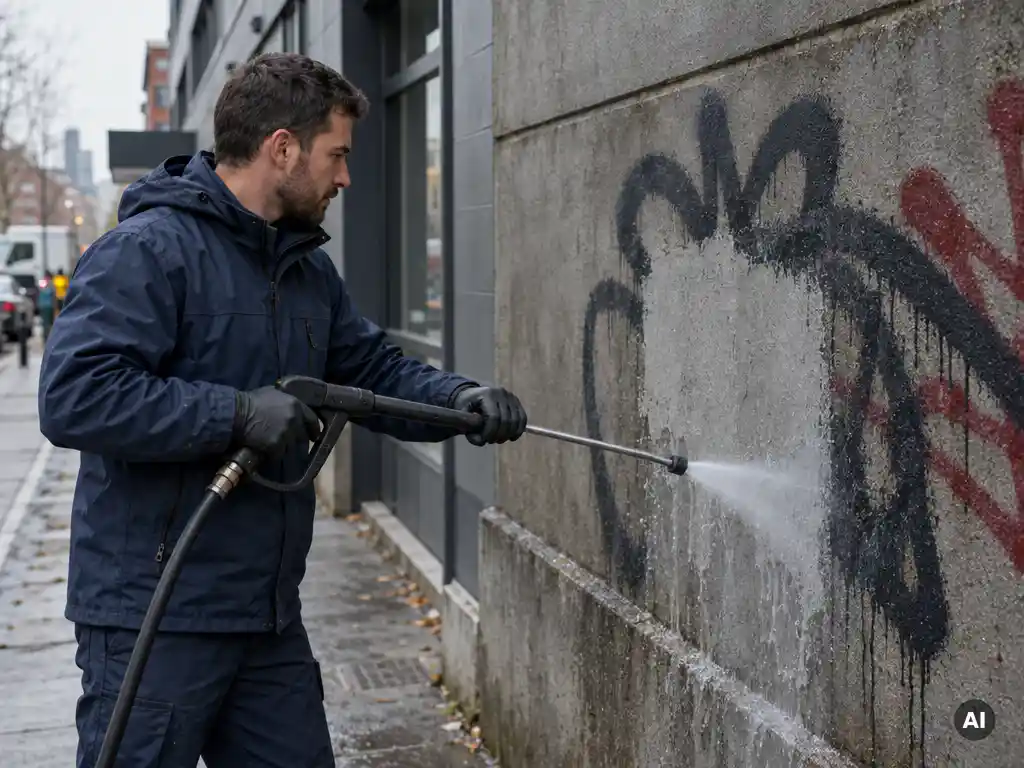
The best remedy for stubborn graffiti on a commercial building is the one that suits both the type of paint and the substrate. A gel-type graffiti remover applied undiluted often works well on porous façades, while smooth metal surfaces call for a different approach. The result depends on the substrate, the type of paint, and the age of the graffiti.
That is why it pays to first determine what is on the façade and what it is on. In this article you will read how to choose the right product, how to work step by step, when to call in specialists, and how to prevent it from happening again.
Why doesn’t every graffiti remover work on the same substrate?
Every substrate reacts differently to cleaning products, because porous and sealed surfaces absorb paint differently. On smooth substrates, graffiti mainly stays on the surface. In porous materials, the paint soaks in deeper, which means a product has to do more than just dissolve it.
When removing graffiti from stone and concrete, the moisture content of the substrate plays a role. A façade that contains a lot of moisture absorbs paint and product differently than a dry façade. The structure is also decisive: rough brick holds on to pigment faster than smooth, sealed stone.
When removing graffiti from metal, you often work with a coating or lacquer that must not be damaged itself. A product that is too aggressive can damage the finish. Therefore, always test first on an inconspicuous spot.
Also, don’t make absolute assumptions about materials. Natural stone, such as granite, does not always react the same way to acidic or alkaline products. Check the product data sheet and the product label before you start.
What types of graffiti removers are there and when do you use which?
Graffiti removers differ mainly in form and action: liquid or gel, for porous or sealed substrates, for fresh or set-in paint. You choose based on the substrate, the type of graffiti (spray paint, marker, or paint), and whether the application is vertical or horizontal.
In practice, you will roughly encounter these categories:
- Gel-type removers: stay put on vertical surfaces such as façades and run off less.
- Liquid removers: suitable for smooth, sealed surfaces and smaller areas.
- Products for graffiti ghosting: intended for pigment residues that remain visible after the first cleaning.
Our range of graffiti removers includes several products for these situations. We apply our graffiti removers undiluted. For the correct application and safety measures, always consult the product data sheet and the label.
How do you remove stubborn graffiti from a façade step by step?
You remove stubborn graffiti from a façade by first assessing the substrate and the type of graffiti, testing the product on a trial area, and then applying it in a controlled manner and letting it take effect. Always work according to the product data sheet and have it carried out by specialists.
- Assess the substrate. Determine whether it is brick, concrete, natural stone, metal, or a coated façade. Also note whether an impregnation or coating has already been applied.
- Test on an inconspicuous spot. This shows you whether the product damages or discolors the substrate.
- Apply the product. Use the graffiti remover as the product data sheet prescribes. You use our graffiti removers undiluted.
- Let it work and remove the residue. Follow the instructions on the label for contact time and rinsing.
- Check the result. If a ghost image remains, repeat the treatment or use a product intended for that purpose.
You can find more background on this approach under removing graffiti from buildings. If you are mainly bothered by pigment residues, read about removing graffiti ghosting.
When is a professional graffiti remover better than a standard product?
A professional graffiti remover is better when the graffiti has soaked deep into the substrate, the surface is large or sensitive, or the façade has a coating or impregnation. Specialists choose the right product, test the substrate, and prevent damage caused by incorrect use.
A standard product from the DIY store is usually not tailored to your specific combination of paint and substrate. For a commercial building, you also want the result to be even and the façade not to end up blotchy. Specialists work with professional products and assess beforehand what the substrate can handle.
Call in specialists for:
- large or high façade surfaces;
- natural stone or sensitive finishes;
- graffiti that has been on the façade for a longer time;
- recurring graffiti at the same location;
- infrastructure and vehicles, such as in removing graffiti in public transport.
How do you prevent graffiti from returning to commercial buildings?
The best way to prevent recurring graffiti is with an anti-graffiti coating. It forms a protective layer that prevents paint from soaking into the substrate, which makes removing graffiti later easier and cheaper. In addition, prompt removal helps, because fresh graffiti attracts less attention.
There are two variants, with a clear difference in behavior:
- Semi-permanent anti-graffiti coating: disappears when the graffiti is removed and must then be reapplied.
- Permanent anti-graffiti coating: withstands multiple cleanings. The number varies per system.
An anti-graffiti coating can also take over the function of façade impregnation. Therefore, do not routinely advise combining both; have specialists assess what suits your façade. The lifespan of a coating is generally a maximum of ten years, unless product-specific information indicates otherwise.
How Mavro helps with stubborn graffiti on commercial buildings
We develop and produce graffiti removers and anti-graffiti coatings for professional applications ourselves. This gives you both a solution for existing graffiti and protection against new graffiti.
- Graffiti removers: professional products that you apply undiluted to façades and other substrates.
- Graffitiguard coatings: available as a semi-permanent and a permanent variant. Graffitiguard Permanent is an impregnating agent with anti-graffiti properties.
- Advice and training: we help you think through the right choice and support specialists with the application.
Would you like to know which product suits your façade and type of graffiti? Contact us or call +31 (0) 418 680 680. We will be happy to advise you.