


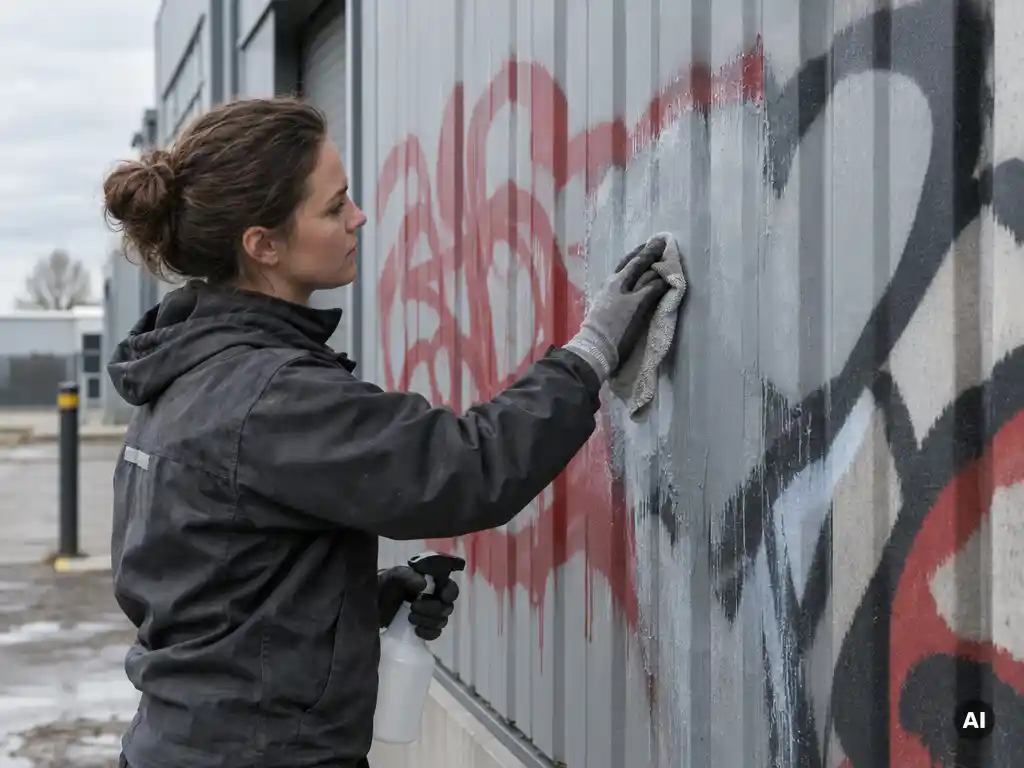
The right graffiti remover for industrial facade cladding depends on the facade material, the type of graffiti, and whether a coating is present. On coated and dense substrates, specialists choose a remover that does not attack the coating. On porous substrates, the choice and execution are more critical, because paint can penetrate deep into the surface.
Every facade reacts differently to cleaning agents. That is why it is important to determine in advance what your facade is made of and what paint is on it. In this article you will read how to substantiate that choice, how the process works, and how to limit repeated vandalism.
Which facade materials determine the choice of graffiti remover?
The facade material determines how deeply graffiti penetrates and how sensitive the surface is to the cleaning agent. Dense substrates such as steel, aluminium, or coated facade panels call for a different approach than porous substrates such as concrete or brickwork.
With industrial facade cladding, you will usually encounter one of these substrates:
- Steel and aluminium: dense substrates on which paint mainly adheres to the surface. Pay attention to any existing powder coating or wet paint, because that layer determines which product you can use.
- Coated facade panels: the paint layer on the panel is often more sensitive than the metal underneath. Always test the product on an inconspicuous spot.
- Concrete and brickwork: porous substrates into which graffiti can soak. The moisture content of the substrate plays a role here.
- Natural stone, such as granite: not every natural stone reacts the same way to acidic or alkaline products. Therefore, check for each type of stone which product is suitable.
If your facade already has an anti-graffiti coating, the type of coating (semi-permanent or permanent) determines which approach is appropriate. Browse our range of graffiti removers and consult the product sheet for each product to find suitable substrates.
How does the type of graffiti determine the right remover?
The type of paint or marker determines which product dissolves the graffiti. Spray paint, permanent marker, chalk, glue, and etching liquids each have a different composition and require a suitable remover. Therefore, first determine the type of graffiti before choosing a product.
Spray paint often consists of multiple layers, sometimes from different manufacturers. That makes removal more difficult than with a single layer of marker. On porous substrates, a slight discolouration can also remain after cleaning, a so-called ghost image. Read more about removing graffiti ghosting if that applies to your facade.
We apply our graffiti removers undiluted. Diluting changes how the product works and does not comply with the product instructions. Always consult the product sheet for the right product per paint type.
How do you remove graffiti step by step without damaging the coating?
You remove graffiti without damaging the coating by first determining the substrate and the coating, testing the product on a small trial spot, and then working in a controlled manner. Professional execution by specialists reduces the risk of damage to facade panels and coating layers.
A working method that proves effective in practice:
- Inspect the facade: note the material, any coating, and the type of graffiti.
- Test on an inconspicuous spot: check whether the surface tolerates the product.
- Apply the graffiti remover: follow the instructions in the product sheet and use the product undiluted.
- Remove the paint and the product: work in a controlled, non-abrasive manner so that the coating stays intact.
- Rinse or treat the surface afterwards: as prescribed by the product sheet.
- Check the result: assess whether any ghosting remains and whether follow-up treatment is needed.
With a semi-permanent anti-graffiti coating, the coating disappears along with the graffiti. You then need to recoat the facade. A permanent coating withstands multiple cleaning rounds, but the number differs per system. If you work on objects such as rolling stock, also take a look at our approach to removing graffiti in public transport.
What safety and environmental requirements apply to professional graffiti removers?
For safety and the environment, what applies is whatever the product sheet and the label prescribe for each product. These documents list personal protective equipment, ventilation requirements, and the disposal of residual material. Have the work carried out by specialists who know and apply this documentation.
Take the situation around the facade into account. Think of shielding surrounding surfaces, collecting cleaning residue, and the presence of passers-by or employees. Use the current safety data sheets of the chosen product as a starting point and make no assumptions about what a product does or does not allow.
How does an anti-graffiti coating prevent repeated vandalism of the facade?
An anti-graffiti coating forms a protective layer that prevents graffiti from penetrating the substrate. As a result, removal is quicker and carries less risk of residual damage. The lifespan of a coating is generally up to ten years, unless product-specific information states otherwise.
At Mavro, we offer both semi-permanent and permanent variants under the name Graffitiguard:
- Semi-permanent: disappears during graffiti removal and must be reapplied afterwards.
- Permanent: withstands multiple cleaning rounds. The number differs per system.
Graffitiguard Permanent is an impregnating agent with anti-graffiti properties. Anti-graffiti coatings can also take over the function of facade impregnation, so additional impregnation is not automatically necessary. Where facade impregnation is relevant, it involves a combination of alkylsilanes and (poly)siloxanes.
When is professional advice or training in graffiti removal advisable?
Professional advice is advisable for sensitive or valuable facades, for unknown substrates, and for recurring graffiti. Training helps specialists apply products correctly, limit damage to coatings, and achieve consistent results.
Especially with larger objects, such as an industrial facade or a building with multiple materials, advice in advance pays off. Also read our page on removing graffiti from buildings for a practical approach per situation.
How Mavro helps with removing graffiti from industrial facade cladding
We develop, produce, and test professional products for graffiti removal and facade protection in-house. That helps you choose the right product and the right approach for your facade. What you can expect from us:
- Graffiti removers that we apply undiluted, with a product sheet for each product covering substrates and application.
- Graffitiguard anti-graffiti coatings in semi-permanent and permanent variants for concrete, brickwork, plastic, metal, and glass, among others.
- Advice on the combination of substrate, graffiti type, and coating.
- Training and support for specialists in applying our products.
Would you like to know which graffiti remover suits your facade? Contact us or call +31 (0) 418 680 680. We are happy to think along with you.