


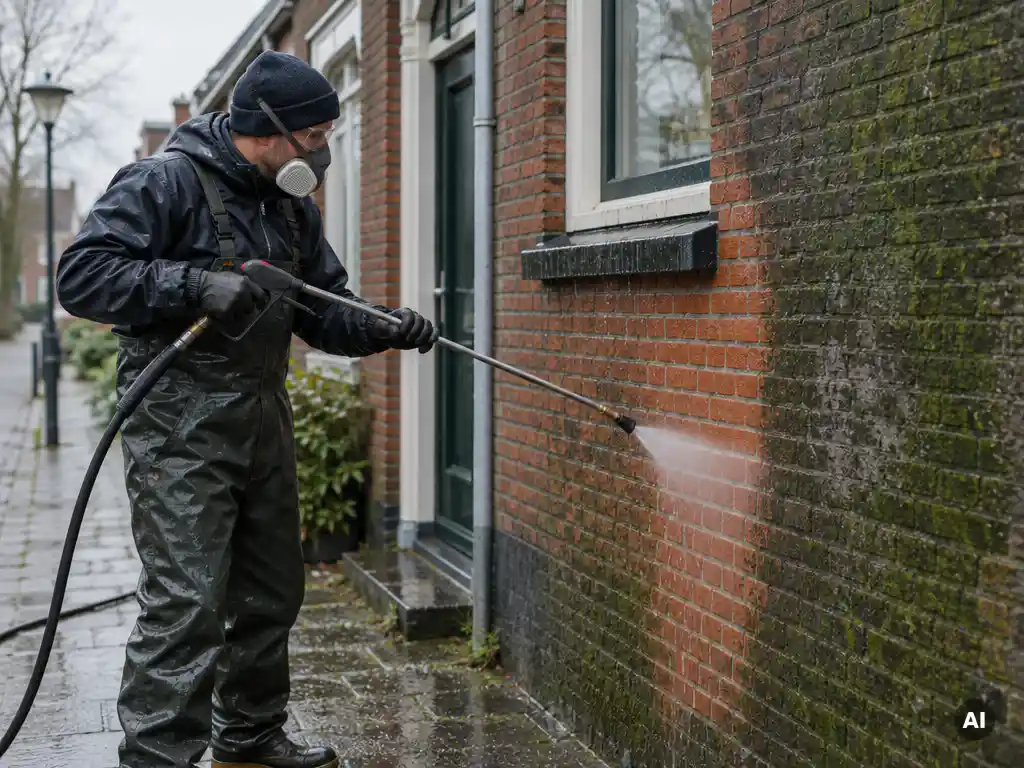
You remove stubborn facade stains by first identifying the type of dirt and then choosing the right cleaning method and the matching cleaning agent. For light soiling, a pressure washer with water is often enough, but for stubborn stains such as rust, limescale, or graffiti you need targeted cleaning agents that are matched to the specific type of soiling and the facade material. In this article we answer the most frequently asked questions about facade cleaning, from common types of soiling to prevention.
Which types of soiling are most common on facades?
The most common types of facade soiling are algae and moss growth, limescale deposits, rust streaks, pollution from exhaust fumes, and graffiti. Which type predominates depends on the facade’s surroundings, the material, and its exposure to moisture, sun, and traffic. Each type calls for a different approach in professional facade cleaning.
- Green growth and biological soiling: algae, mosses, and lichens that settle on damp or shaded facades.
- Limescale deposits: white efflorescence that forms when salts from the masonry are drawn to the surface.
- Rust streaks: brown streaks caused by ferrous materials such as anchors, lintels, or gutters.
- Exhaust fumes and soot: black deposits, particularly on facades along busy roads or in urban environments.
- Graffiti: paint or marker stains that can penetrate deep into porous materials if they are not removed quickly.
- Oil and grease stains: common on facades near parking areas or industrial environments.
Recognizing the type of soiling is the first step. The wrong approach can damage the facade material or cause the dirt to penetrate even deeper.
Which cleaning method suits which type of facade soiling?
The cleaning method you choose depends directly on the type of soiling and the facade material. Pressure washing works well for surface dirt on hard materials, but is too aggressive for soft or cracked facades. Chemical cleaning is better suited to stubborn stains such as limescale, rust, or graffiti. For the correct pressure values and working instructions, always consult the product data sheet and label of the product being used.
- Pressure washing: effective for general soiling on concrete, stone, and hard facade cladding. The correct pressure setting varies by material and situation; consult the product data sheet.
- Low-pressure or soft cleaning: suitable for sensitive materials such as wood, rendered facades, and historic masonry.
- Chemical cleaning: necessary for specific stains such as limescale deposits, rust, graffiti, and biological growth. Always use an agent matched to the facade material and consult the product data sheet for correct application.
- Steam cleaning: an option for superficial biological soiling where no chemical agents are used.
- Mechanical cleaning: sanding or blasting, to be used only on very robust materials and in cases of severe soiling.
Combine methods where necessary: a chemical pre-treatment followed by pressure washing gives the best result on many facades. Leave the choice and execution to specialists when the facade material is sensitive or the soiling is complex.
We’ll figure it out for you!
Want to talk through your challenge?
Our advisors will gladly help you find a practical solution.
Which cleaning agents are suitable for stubborn facade stains?
For stubborn facade stains you use targeted cleaning agents matched to the type of soiling. Acidic agents can tackle limescale deposits and rust streaks, alkaline agents generally work well against oil and grease, and specific biocides target green growth. Never use a universal cleaning agent without checking whether it is suitable for the facade material in question. Always consult the product data sheet and label for correct application and safety measures.
- Acidic cleaning agents: can be used for limescale deposits, efflorescence, and rust streaks on concrete and certain types of stone. Do not use on sensitive materials; not all types of natural stone react to acids in the same way. Consult the product data sheet for suitable substrates.
- Alkaline cleaning agents: generally effective against oil, grease, and exhaust fume residue on concrete and brick facades. Check suitability for the specific facade material via the product data sheet.
- Biocides and algae removers: aimed at removing biological soiling such as algae, mosses, and lichens. Consult the product data sheet for contact times and method of application.
- Graffiti removers: specifically formulated to remove paint and marker stains and applied undiluted. For the best results, use an agent that is compatible with the underlying facade material. Take a look at the graffiti removers available for this purpose.
Always test the cleaning agent on a small, inconspicuous area before treating the entire facade, and follow the instructions on the product data sheet and label.
How do you remove green growth and biological soiling from a facade?
You remove green growth and biological soiling by first applying a biocide or algae remover, letting it take effect, and then rinsing the facade with water or a pressure washer. The required contact time varies by product and degree of soiling; consult the product data sheet for the correct working instructions.
Follow these steps for an effective approach:
- Assess the severity of the infestation. Superficial algae are easier to remove than deeply rooted moss or lichens.
- Apply a biocide or algae remover. Make sure the affected surface is fully covered.
- Let the product take effect in line with the product data sheet. The required contact time varies by product and situation.
- Rinse the facade with water or a pressure washer at the correct pressure to remove loosened residue.
- Treat stubborn spots again if necessary, or call in specialists to supplement the mechanical method.
Moisture problems in the facade are often the underlying cause of recurring biological soiling. A water-repellent treatment after cleaning can help keep moisture out and keep the facade clean for longer, provided the moisture content of the substrate at the time of application falls within the limits set by the manufacturer.
When is professional facade cleaning necessary?
Professional facade cleaning is necessary when the soiling has penetrated deeply, when the facade material is susceptible to damage, or when the scale of the work is too large for a DIY approach. Execution by specialists is also required for historic buildings, facades containing asbestos, or when strong chemical agents are used.
Call in specialists in the following situations:
- Severe or deeply rooted biological infestation that does not respond to standard cleaning.
- Facades made of sensitive materials such as natural stone, historic masonry, or rendered surfaces.
- Large facade surfaces where working at height is required.
- Soiling caused by hazardous substances, such as soot after a fire or chemical emissions.
- Situations where the wrong approach can permanently damage the facade or void the warranty on a coating.
Specialists have the right equipment, knowledge of materials, and access to professional cleaning agents that are not freely available.
How do you prevent soiling from returning to a facade?
You prevent soiling on a facade by applying a protective treatment after cleaning, such as an impregnation layer based on alkylsilanes and (poly)siloxanes. This treatment seals the pores of the facade material, so water and dirt get less grip on the surface. Facade impregnation is one of the most effective ways to keep a clean facade clean for longer. The service life of an impregnation treatment is generally up to ten years, depending on the system applied and the conditions.
Preventive measures you can take:
- Impregnate the facade after cleaning with a water-repellent coating based on alkylsilanes and (poly)siloxanes that repels water and dirt. Before application, check the moisture content of the substrate in accordance with the product data sheet.
- Check joints and seals regularly for cracks or damage that let moisture in.
- Ensure good drainage around the building to limit moisture build-up at the facade.
- Prune vegetation in the immediate vicinity of the facade to reduce shade and humidity.
- Schedule periodic maintenance so that light soiling is removed in good time before it becomes stubborn.
The more porous the facade material, the more important a protective treatment is. Materials such as brick and concrete absorb moisture quickly, which promotes biological growth and increases the frequency of cleaning. When an anti-graffiti coating is applied, it can take over the function of facade impregnation; therefore, do not recommend the combination of impregnation and anti-graffiti coating as standard, but tailor it to the specific situation.
How we help you with facade cleaning and facade protection
At Mavro International we develop and produce professional products for facade cleaning and facade protection, tailored to the requirements of contractors, maintenance companies, facility managers, and property managers. Our solutions are user-friendly and developed to deliver demonstrable results.
What we offer:
- Targeted cleaning agents for all types of facade soiling, from green growth to graffiti and rust streaks.
- Water-repellent impregnation products based on alkylsilanes and (poly)siloxanes that protect the facade against moisture and new soiling.
- Semi-permanent and permanent coatings such as Nitowax, Nitoshield, and Nitocryl® for the renovation and protection of facade cladding and window frames. Semi-permanent anti-graffiti coating must be reapplied after graffiti removal; permanent anti-graffiti coating withstands multiple cleaning cycles, with the exact number varying per system.
- Color-restoring coatings such as Nitocolour, which give weathered facades a fresh look while protecting them at the same time.
- Advice and training for specialists on the correct application of our products in practice.
Would you like to know which products best suit your facade situation? Get in touch with us and we will gladly think along with you.