


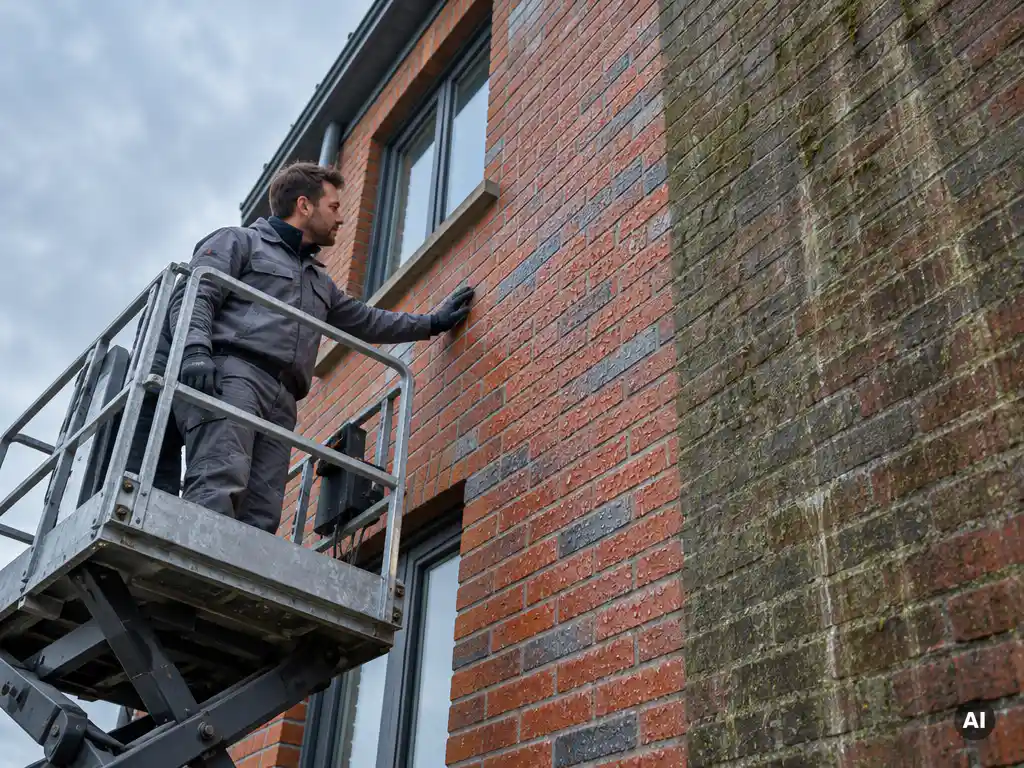
A professional façade coating lasts 5 to 10 years on average, depending on the type of coating, the quality of the substrate preparation and the degree of exposure to the weather. Permanent colour-restoring coatings can remain effective for up to 10 years. The actual lifespan varies from situation to situation, but with the right products and approach you get the most out of every treatment. In this article we answer the most frequently asked questions about the lifespan of façade coatings.
Which factors determine the lifespan of a façade coating?
The lifespan of a façade coating depends on several factors: the type and quality of the coating, the condition and type of the substrate, the quality of the application and the degree of exposure to sun, rain, wind and pollution. No two façades are alike, and those differences largely determine how long a coating remains effective.
The most decisive factors at a glance:
- Type of coating: Semi-permanent coatings offer protection for several years, while permanent coatings such as colour-restoring systems can generally last up to 10 years.
- Substrate type: Non-porous façade cladding, aluminium, plastic window frames and concrete react differently to coatings than porous materials such as brick.
- Climate load: South-facing façades are subjected to heavier UV exposure. Façades in urban environments have to deal with more pollution and graffiti.
- Application quality: A coating applied by specialists adheres better and lasts longer than a carelessly applied treatment.
- Maintenance: Regular façade cleaning significantly extends the effectiveness of the coating.
How long does a professional façade coating last on average?
A professional façade coating generally lasts 5 to 10 years. Semi-permanent coatings for façade cladding and window frames have a lifespan that differs per system; consult the product data sheet for product-specific information. Permanent colour-restoring coatings, such as systems specially developed for weathered façades, can remain effective for up to 10 years.
The range in lifespan is wide because conditions differ greatly from façade to façade. A coating on a sheltered inner façade in a mild climate will last longer than the same coating on a south-facing façade in an urban environment with a lot of pollution. Professional application by specialists is one of the strongest predictors of a long lifespan.
With façade impregnation, where a water-repellent treatment based on alkylsilanes and (poly)siloxanes penetrates the substrate, the duration of effectiveness differs per system and depends on the porosity of the material and the weather conditions. Impregnating a façade with a high-quality product ensures that water and dirt adhere less readily, which reduces the need for maintenance.
We’ll figure it out for you!
Want to talk through your challenge?
Our advisors will be happy to help you find a practical solution.
When is a façade coating due for replacement or retreatment?
A façade coating is due for replacement or retreatment when its protective effect visibly declines. Concrete signs include water absorption in the façade, discolouration, peeling of the coating, visible cracks or a weathered appearance that no longer responds to cleaning.
Watch out for the following signs:
- Water absorption: If water no longer beads off but soaks into the substrate, the water-repellent effect has disappeared.
- Discolouration and stains: Algae, moss or black streaks that return after cleaning indicate a weakened protective layer.
- Peeling or blistering: Visible damage to the coating means that adhesion has been compromised.
- Colour fading: With colour-restoring coatings, fading is a clear sign that the coating is nearing the end of its lifespan.
- Higher maintenance costs: If cleaning is needed more often and has less effect, retreatment pays off more in the long run than ongoing maintenance.
Don’t wait until the damage is visibly severe. Early retreatment prevents damage to the substrate, which keeps the total renovation costs considerably lower.
How do you extend the lifespan of a façade coating?
You extend the lifespan of a façade coating by cleaning regularly, spotting damage early and retreating the coating at the right time. Preventive maintenance is more effective and cheaper than corrective intervention after the coating has already deteriorated.
Practical measures to maximise lifespan:
- Annual inspection: Check the façade every year for water absorption, cracks and discolouration, preferably after winter.
- Periodic façade cleaning: Remove dirt, algae and moss in good time before they attack the coating. Use products that are suitable for the specific coating and substrate type.
- Repair damage immediately: Small areas of damage in the coating can quickly grow into bigger problems if they are not dealt with in time.
- Use compatible cleaning agents: Aggressive cleaning agents can damage the coating. Always use products that are matched to the coating type; consult the product data sheet and label for this.
- Plan professional retreatment in time: Don’t wait until the coating has completely worn out, but plan a retreatment when the first signs of wear become visible.
Does the quality of the substrate preparation affect lifespan?
Yes, the quality of the substrate preparation is one of the most decisive factors for the lifespan of a façade coating. A coating applied to a dirty, damp or damaged substrate adheres poorly and lasts considerably less long, regardless of the quality of the coating product itself.
Good substrate preparation always includes:
- Thorough cleaning: Completely remove dirt, algae, moss, loose paint and other contaminants before applying the coating.
- Repair of damage: Seal cracks, holes and damaged joints before the coating is applied.
- Check the moisture content of the substrate: Never apply a coating to a damp substrate. Excessive moisture beneath the coating leads to blistering and peeling.
- Primer or pretreatment: Some coating systems require a primer to optimise adhesion. Consult the product data sheet to determine whether this step applies.
A professionally prepared substrate can significantly extend the lifespan of the same coating. Always invest in thorough preparation, even if it requires extra time and cost. The savings on retreatment and damage repair more than outweigh the initial investment.
How we help you with façade coating and protection
At Mavro International, we develop and produce professional coatings and protective products for façades, window frames and façade cladding. Our solutions are aimed at long-lasting protection, a well-kept appearance and lower maintenance costs. Here is what we offer in concrete terms:
- Semi-permanent coatings such as Nitowax, Nitoshield and Nitocryl® that repel moisture, oils, solvents and graffiti from non-porous façade cladding and window frames.
- Permanent colour-restoring coatings such as Nitocolour, with a lifespan of generally up to 10 years, specially developed for weathered façades that have lost their colour and appearance.
- Professional façade cleaners for thorough substrate preparation, so that the coating adheres optimally and lasts longer.
- Expert advice and training for contractors, maintenance companies and facility managers who want to achieve the best result.
Would you like to know which coating best suits your façade and situation? Get in touch with us and we’ll help you further with concrete advice.