


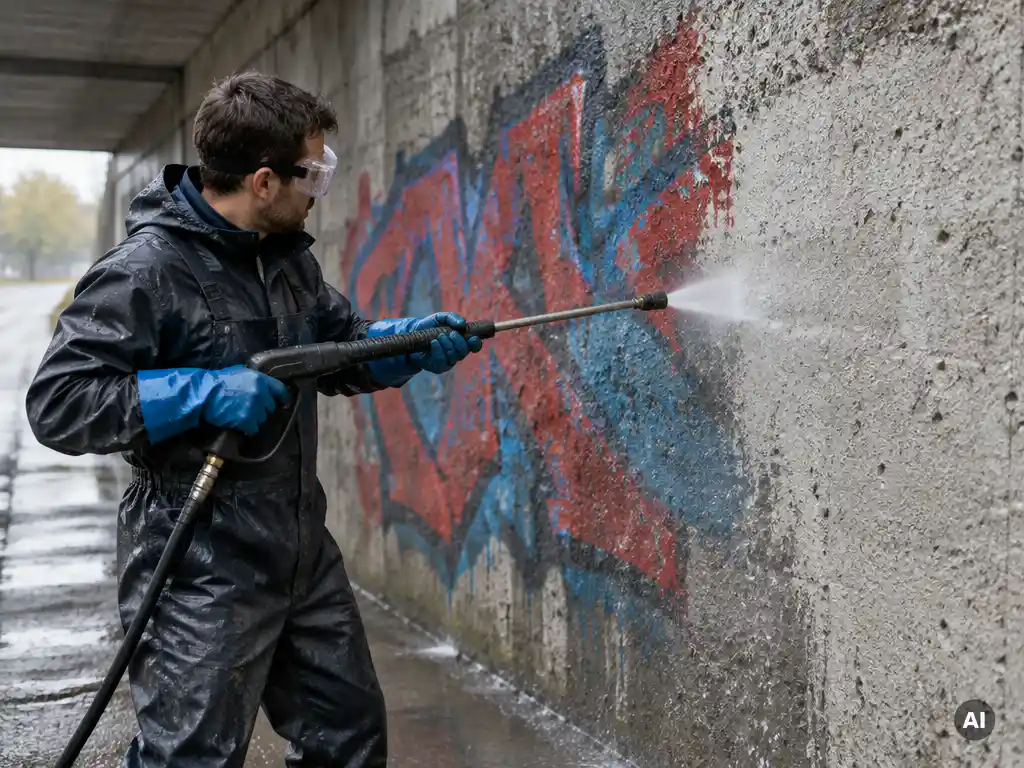
You remove graffiti from a concrete wall with a chemical graffiti remover, followed by mechanical cleaning with a pressure washer or brush. Concrete is a porous material, so paint quickly soaks into the surface structure. The faster you act after the graffiti has been applied, the better the result. In this article, we answer the most frequently asked questions about removing graffiti from concrete.
Which methods work best for graffiti on concrete?
The most effective method for graffiti on concrete is a combination of a chemical graffiti remover and mechanical cleaning. The chemical products dissolve the paint or ink, after which you can clean the surface with a pressure washer or a stiff brush. Mechanical sanding or spraying alone, without chemicals, is rarely sufficient on concrete.
For professional applications, there are two main categories:
- Gel graffiti removers: These stay on the surface longer, which extends the dwell time. Ideal for vertical concrete surfaces such as walls and pillars, because the product does not run off.
- Liquid graffiti removers: Suitable for larger horizontal surfaces and quick treatments. They work fast but sometimes require multiple treatments for deeply penetrated paint.
With fresh graffiti, removal is considerably easier. Dried or fully cured paint requires a longer dwell time and sometimes a second treatment. Consult the product data sheet for the correct dwell time and method for each situation. Take a look at our range of graffiti removers for an overview of professional solutions per surface.
What type of graffiti is the hardest to remove from concrete?
Epoxy-based paint and permanent markers are generally the hardest to remove from concrete. These materials bond strongly to porous surfaces and penetrate deep into the concrete structure. Graffiti that has been there for a long time and has fully cured also requires more intensive treatment than fresh smears.
The level of difficulty depends on three factors:
- Type of paint or ink: Acrylic paint, alkyd paint, and permanent markers all adhere differently. Alkyd paint can be particularly tough on concrete.
- Age of the graffiti: The longer the graffiti has been there, the deeper the pigments can penetrate the concrete.
- Porosity of the concrete: Rough, untreated concrete absorbs paint faster than coated or polished concrete. On untreated concrete, complete removal without a graffiti ghost is sometimes difficult.
A graffiti ghost, the faint stain that remains after cleaning, is a common problem with older or deeply penetrated graffiti. Read more about removing a graffiti ghost if you still see residual traces after the first treatment.
We’ll figure it out for you!
Want to talk through your challenge?
Our advisors are happy to help you find a practical solution.
We’ll figure it out for you!
Want to talk through your challenge?
Our advisors are happy to help you find a practical solution.
We’ll figure it out for you!
Want to talk through your challenge?
Our advisors are happy to help you find a practical solution.
How do you use a chemical graffiti remover on concrete?
You use a chemical graffiti remover on concrete by applying the product undiluted to the affected surface, observing the dwell time, and then cleaning with water and pressure. Always consult the product data sheet and the label, because the dwell time and method differ per product and type of graffiti.
Follow these steps for a good result:
- Protect the surroundings: Cover adjacent surfaces, plants, and drains if the product data sheet requires it.
- Apply the product: Use a brush, roller, or spray bottle to apply the graffiti remover evenly over the graffiti. With a gel product, make sure the layer is thick enough.
- Let it work: Give the product time to penetrate the paint and loosen it. Consult the product data sheet for the recommended dwell time.
- Remove the graffiti: Scrub or brush away the loosened paint and rinse the surface thoroughly with a pressure washer or plenty of water.
- Repeat if necessary: With stubborn or older graffiti, a second treatment is sometimes necessary.
Always wear the personal protective equipment recommended on the product data sheet and label when working with chemical cleaning agents.
Does removing graffiti damage the concrete?
Removing graffiti does not damage the concrete if you use the right products and methods. Professional graffiti removers developed specifically for porous surfaces dissolve the paint without attacking the concrete itself. Aggressive sanding or the use of unsuitable chemicals can, however, damage the surface.
Risks arise mainly with:
- Water pressure that is too high when rinsing, causing the concrete surface to spall or the top layer to be damaged
- Use of acidic or strongly alkaline products that are not suitable for concrete
- Excessive mechanical sanding, which damages the surface structure and makes the concrete more susceptible to future staining
Always choose a graffiti remover that is suitable for the specific surface and consult the product data sheet for the correct application. If in doubt, leave the work to specialists.
How do you prevent new graffiti on a concrete wall?
The most effective way to prevent new graffiti on a concrete wall is an anti-graffiti coating. This protective layer prevents paint and ink from soaking into the concrete, making future graffiti easier and faster to remove. There are two types of coatings: permanent and semi-permanent systems.
- Permanent anti-graffiti coating: Forms a durable protective layer on the concrete that withstands multiple cleaning cycles. The exact number of cleaning cycles differs per system. Suitable for locations with frequent vandalism. An example is Graffitiguard Permanent, an impregnating agent with anti-graffiti properties.
- Semi-permanent anti-graffiti coating: Disappears along with the graffiti when it is removed and must then be reapplied. Easier to apply and generally lower in purchase cost per layer, but requires regular retreatment.
In addition to coatings, environmental measures such as better lighting, cameras, and regular inspection also help to discourage vandalism. Professional graffiti removal from buildings always combines cleaning with a protective aftertreatment for the best long-term result.
How we help with removing graffiti from concrete
We develop and produce professional graffiti removers specifically tailored to porous surfaces such as concrete and masonry, so that graffiti is removed thoroughly without putting unnecessary strain on the surface.
What we offer:
- Gel graffiti removers suitable for vertical concrete surfaces and long dwell times
- Formulations that are applied undiluted and are effective against a wide range of paint types, lacquers, and inks
- Anti-graffiti coatings for permanent or semi-permanent protection of concrete walls
- Expert advice on the right product choice per situation and surface
- Support and training for professional specialists
Whether you are a contractor, municipality, or facility manager, we are happy to think along with you about the most effective approach. Contact us for personal advice or a tailored product recommendation.